The Time Traveller's Dossier: The Wide-Track Illusion – The 1968 Pontiac Grand Prix Exhibition
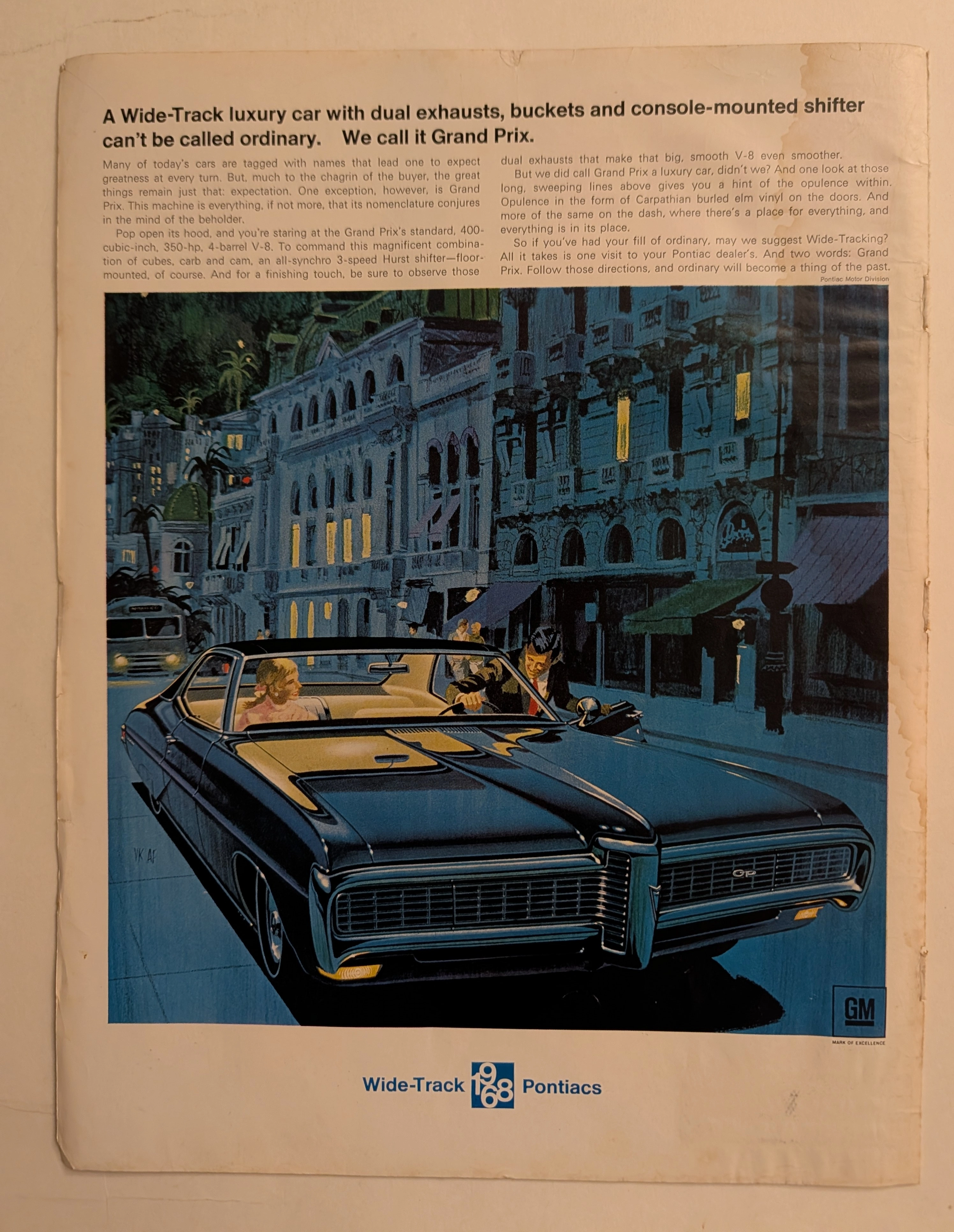
The automobile in mid-twentieth-century America was never merely a utilitarian mode of transportation; it was a profound, rolling projection of identity, aspiration, and social status. The historical artifact elegantly and securely positioned upon the analytical table of The Record Institute today is a majestic, full-page print advertisement for the 1968 Pontiac Grand Prix, originating from the go
Category: Automotive
Brand: Pontiac
The History
To fully appreciate the immense historical gravity, cultural magnitude, and sociological importance of this artifact, one must meticulously contextualize the miraculous corporate turnaround of the Pontiac Motor Division during the 1960s. In the mid-1950s, Pontiac suffered from a staid, conservative image; it was colloquially known as an "old man's car." Under the visionary leadership of General Manager Semon "Bunkie" Knudsen, Chief Engineer John DeLorean, and advertising executive Jim Wangers, Pontiac underwent a radical transformation. They introduced the legendary "Wide-Track" stance—pushing
The Paper
As a physical entity, this printed artifact functions as a living, breathing, and profound record of mid-twentieth-century graphic reproduction and substrate chemistry. Under exceptional macro-lens examination, this document reveals the stunning complexity and mathematical precision of analog color printing. The intricate, dark rendering of the Grand Prix's iconic split grille, the warm, glowing light illuminating the interior of the car, and the crisp typography of the "Pontiac Motor Division" signature are all meticulously constructed from a precise, mathematically rigorous galaxy of halfton
The Rarity
Evaluated under the most exacting, rigorous, and uncompromising archival parameters, this artifact is definitively and securely designated as Class A. The remarkable and defining paradox of mid-century print advertising is that these specific documents were produced by the millions as explicitly and intentionally "disposable media." They were inherently destined by their very nature to be briefly observed, casually folded, read over a morning coffee, and ultimately discarded into the recycling bins and incinerators of history. For a large-format advertisement to survive entirely intact since 1