THE TIME TRAVELLER'S DOISSIER — THE WWII HOME FRONT AND THE AESTHETICS OF DESTRUCTION
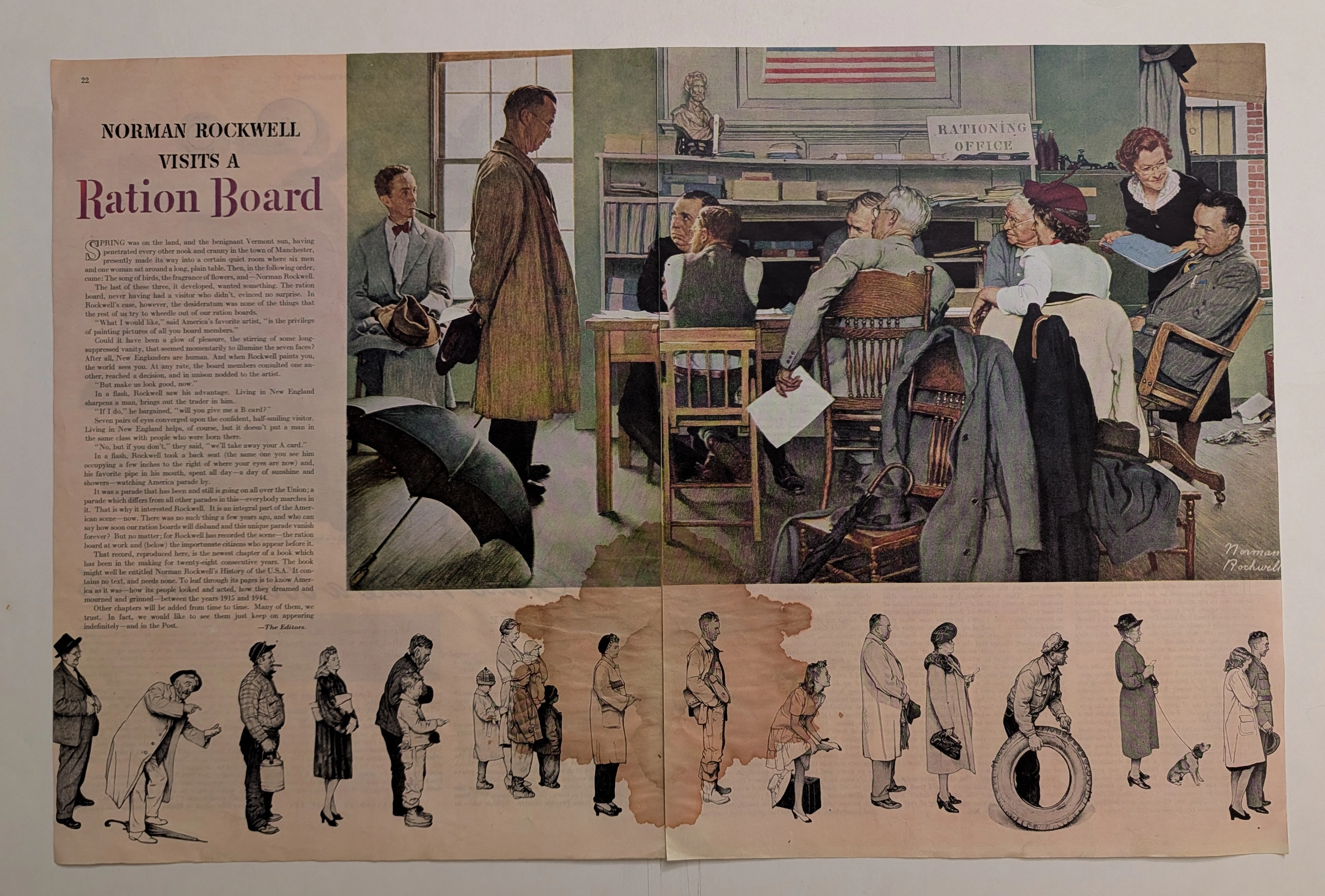
Executive summary of the original vintage double-page cut sheet featuring Norman Rockwell's WWII masterpiece, "Norman Rockwell Visits a Ration Board" (circa 1944). This artwork masterfully captures the egalitarian struggle of the American home front rationing system. The massive, rust-colored water stain blooming across the highly acidic 80-year-old paper is not damage, but a profound 'historical
" THE HISTORY: World War II, The Tribunal of Rations, and the Soul of America " Welcome to the inner sanctum of The Record, where we do not merely deal in paper; we act as the custodians of frozen time. The artifact you are staring at is not just an illustration; it is a mirror held up to humanity during its darkest, most defining hour of the 20th century. This is a monumental masterpiece titled "Norman Rockwell Visits a Ration Board" (published circa 1944), born from the brilliant mind and meticulous brush of America’s undisputed master of illustration, Norman Rockwell. To truly absorb the visceral gravity of this piece, you must strap into our time machine and hurl yourself back to the suffocating tension of World War II. While American soldiers were bleeding into the soil of Europe and the sands of the Pacific, the "Home Front" was engaged in a quiet, desperate war of sacrifice. The United States government enacted draconian rationing policies. Gasoline, tires, sugar, meat, and shoes were severely restricted to fuel the war machine. The absolute arbiters of life, livelihood, and mobility in every town were the "Ration Boards"—ordinary citizens thrust into positions of god-like local authority. Rockwell brilliantly chronicles a real event from his adopted hometown of Manchester, Vermont. He paints a quiet, tense room where six men and one woman sit stoically around a plain table. Looming over them in the background is a bust of Abraham Lincoln, a silent judge of their patri
A Museum-Grade Archive of Rare Vintage Print Media