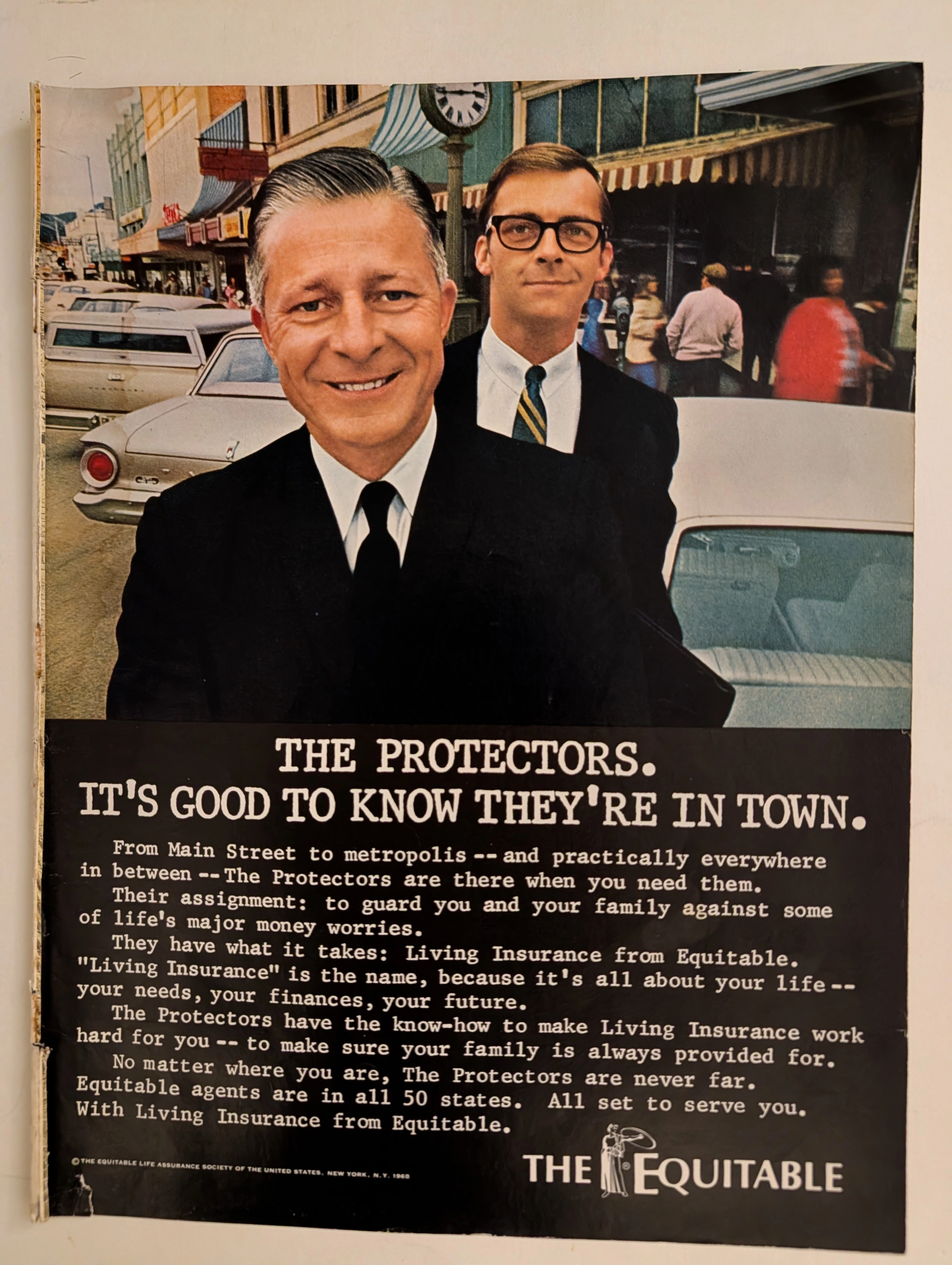
The Time Traveller's Dossier : 1968 Equitable - The Security Shift
The year is 1968. The American societal fabric is actively tearing. The streets are defined by protests, riots, and profound uncertainty. The evening news broadcasts a daily ledger of casualties and assassinations. Then, a deliberate counter-narrative is printed. The Equitable Life Assurance Society of the United States deploys an image of absolute, unshakable stability. They do not sell a financi
Category: Other
The History
The artifact before us requires an exhaustive and unflinching contextualization. To comprehend this printed document, we must dissect the socio-political and psychological anatomy of the world that necessitated its creation. The year 1968 is not merely a date; it is a historical centrifuge. The outside world is spinning into unprecedented chaos. The Tet Offensive shatters the illusion of American military invincibility. Martin Luther King Jr. and Robert F. Kennedy are assassinated, fracturing the national psyche. Cities are burning. Universities are paralyzed by strikes. The cultural hegemony
The Paper
The physical medium is a testament to the mechanics of mass distribution in the late 1960s. We are examining a magazine tear sheet, printed via high-speed web offset lithography. The paper stock is a lightweight, coated sheet, designed for rapid ink absorption and quick drying times in massive print runs. The coating provides a slight sheen, intended to give the photographic elements a sense of depth and fidelity. Under macro examination, the mechanical truth of "The Protectors" is revealed. The reassuring smile of the older man, the sharp suit of the younger man, and the bustling Main Street
The Rarity
Classification: Class B. In 1968, this advertisement was inserted into national publications like LIFE, Look, or Time magazine. Its initial production run was in the millions. As a physical object, the raw material is not inherently scarce. However, the survival rate of ephemeral magazine pages is statistically minute. They were designed for momentary consumption and immediate disposal. The true value of this artifact lies entirely outside of its monetary appraisal. Its value is deeply contextual. It is a pristine psychological artifact. It is a flawless record of how American corporate entiti