The Time Traveller's Dossier : Alinari Caligula - Visualizing Antiquity
There was a time when the past belonged only to those who could travel to it. To look upon the face of a Roman Emperor required wealth. It required the Grand Tour. It required standing in the private galleries of the European elite. Knowledge of antiquity was physical, localized, and guarded. Then came the photographic apparatus. Then came the imperative to catalog human history. This artifact is
Category: Other
The History
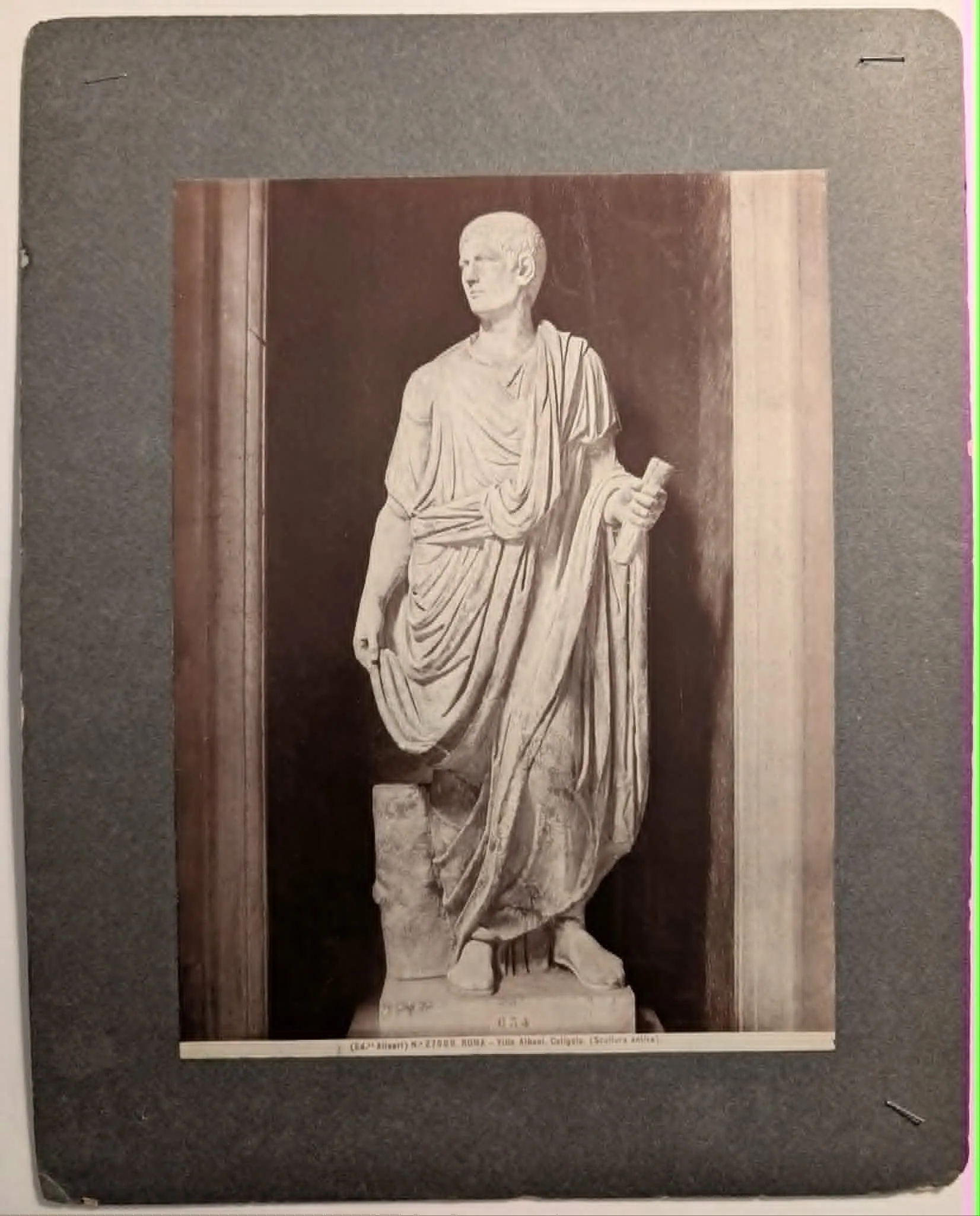
The Tyrant in Repose Gaius Caesar Augustus Germanicus. Known to history as Caligula. He was an emperor defined by erratic power, infinite cruelty, and eventual assassination. His flesh was erased in 41 AD. His image, however, was carved into stone. The marble statue captured in this photograph stands in the Villa Albani in Rome. It presents a stark contradiction to the historical record. Here, the tyrant is not mad. He is serene. He holds a scroll. He is draped in the heavy, ordered folds of classical drapery. The sculpture represents the propaganda of empire. It is an idealized form, designed
The Paper
The physical construction of this artifact is a testament to durability. The photograph itself is mounted on thick, high-GSM binding board. This was a necessity for institutional use. The board prevents the photographic emulsion from curling. It allows the print to be stored vertically in filing cabinets. The print process is monochromatic, relying on silver halides. It does not use a modern CMYK matrix. The image is formed by actual microscopic particles of silver suspended in gelatin or albumen. Over time, the paper has aged. The edges of the mount show physical abrasion. The corners are blu
The Rarity
Classification: Class A The visual image of this specific Caligula statue is not rare. Fratelli Alinari produced thousands of prints from negative number 27588. They were distributed globally. However, the contextual rarity elevates this specific object. The density of the provenance marks creates a unique sociological record. It is not just an Alinari print. It is a deaccessioned Seattle Public Library Alinari print. The stamps, the handwritten catalog numbers, and the municipal warnings ("Use no thumb tacks") make this a singular artifact. It possesses high historical significance regarding