The Time Traveller's Dossier : Bagpipes of Spring - The Dawn of Synchronized Culture
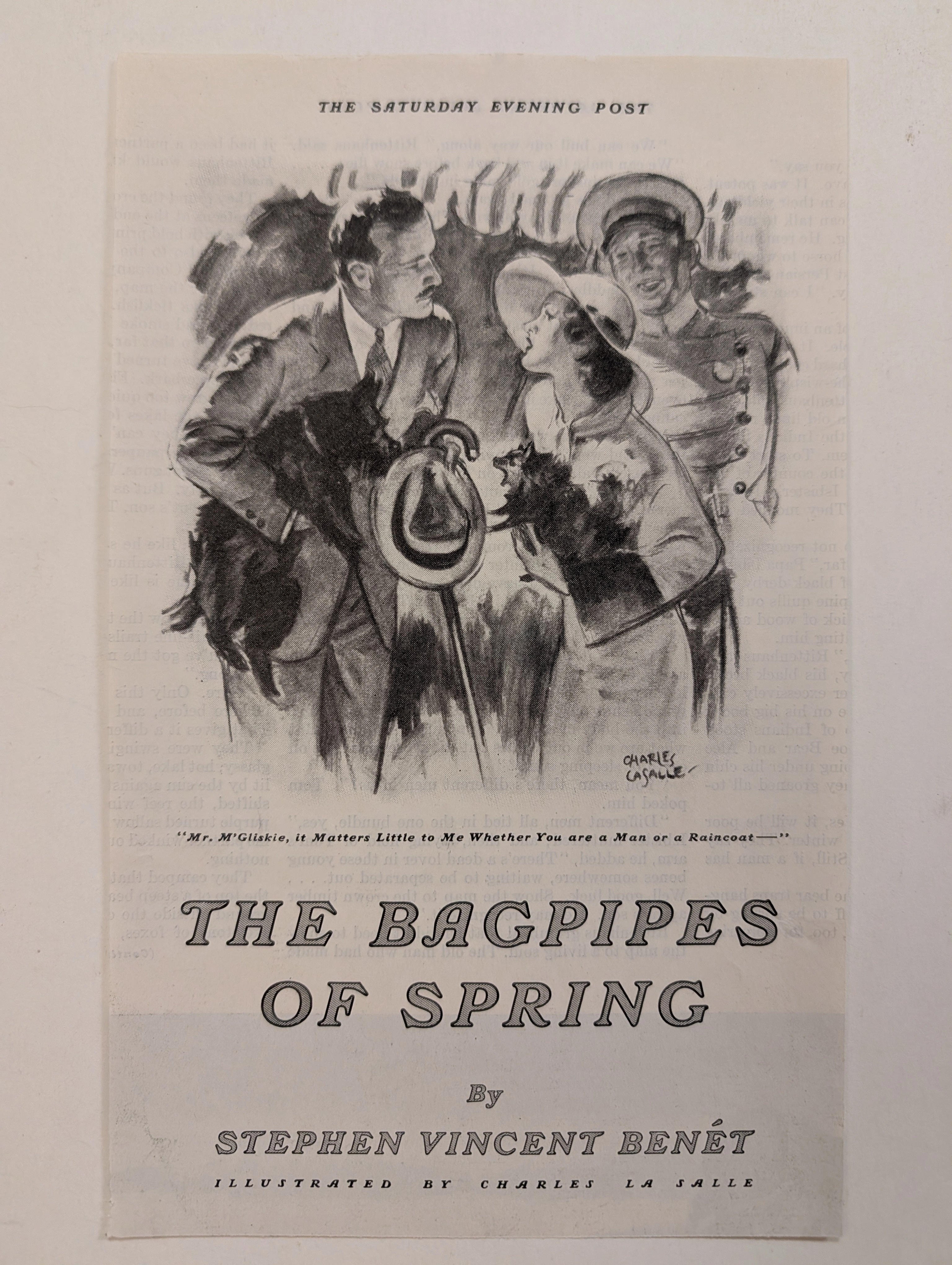
Before the screen, there was the page. Before the algorithm fragmented our attention, there was the monolith of the weekly periodical. This fragment—a title page from The Saturday Evening Post featuring Stephen Vincent Benét’s "The Bagpipes of Spring"—is not merely an illustration. It is a fossil of a unified consciousness. Then, narrative was a synchronized event. Millions of hands turned the sam
Category: Other
The History
To understand this artifact, one must understand the ecosystem from which it was violently torn. The Saturday Evening Post was not just a magazine. It was the cultural bedrock of the American Republic in the early to mid-twentieth century. Under the editorial iron fist of George Horace Lorimer, the Post became the arbiter of middle-class morality, aspiration, and entertainment. It possessed a circulation that modern digital platforms would envy, given the population size of the era. It arrived weekly. It was dependable. It was ubiquitous. This physical page represents the zenith of that empire
The Paper
The substrate is a highly acidic, mechanical wood pulp paper. Estimated weight: 45 to 55 GSM (Grams per Square Meter). It was designed for mass production, not longevity. The heavy presence of lignin—the natural polymer in wood that binds cellulose fibers together—is the architect of its own destruction. Exposure to ultraviolet light and oxygen causes the lignin to oxidize, shifting the paper from its original off-white to a brittle, dry yellow. The printing method is a combination of letterpress for the typography and halftone screen reproduction for La Salle’s illustration. Observe the illus
The Rarity
Rarity in archives is rarely about sheer numbers. It is about survival against intent. Millions of these pages were printed. They were designed to be disposable. They were meant to be read on a train and left on the seat. They were meant to be used to start fires or wrap fragile goods. Its physical existence is not unique. However, its contextual value elevates its classification. To find a surviving page, cleanly severed, unmarred by water damage or severe tearing, preserves a pristine window into the visual and literary standards of the era. It is Class A because of its function as a represe