The Time Traveller’s Dossier: Circa 1970s Shakespearean Richard III Vintage Illustration — The Tudor Web of Blood
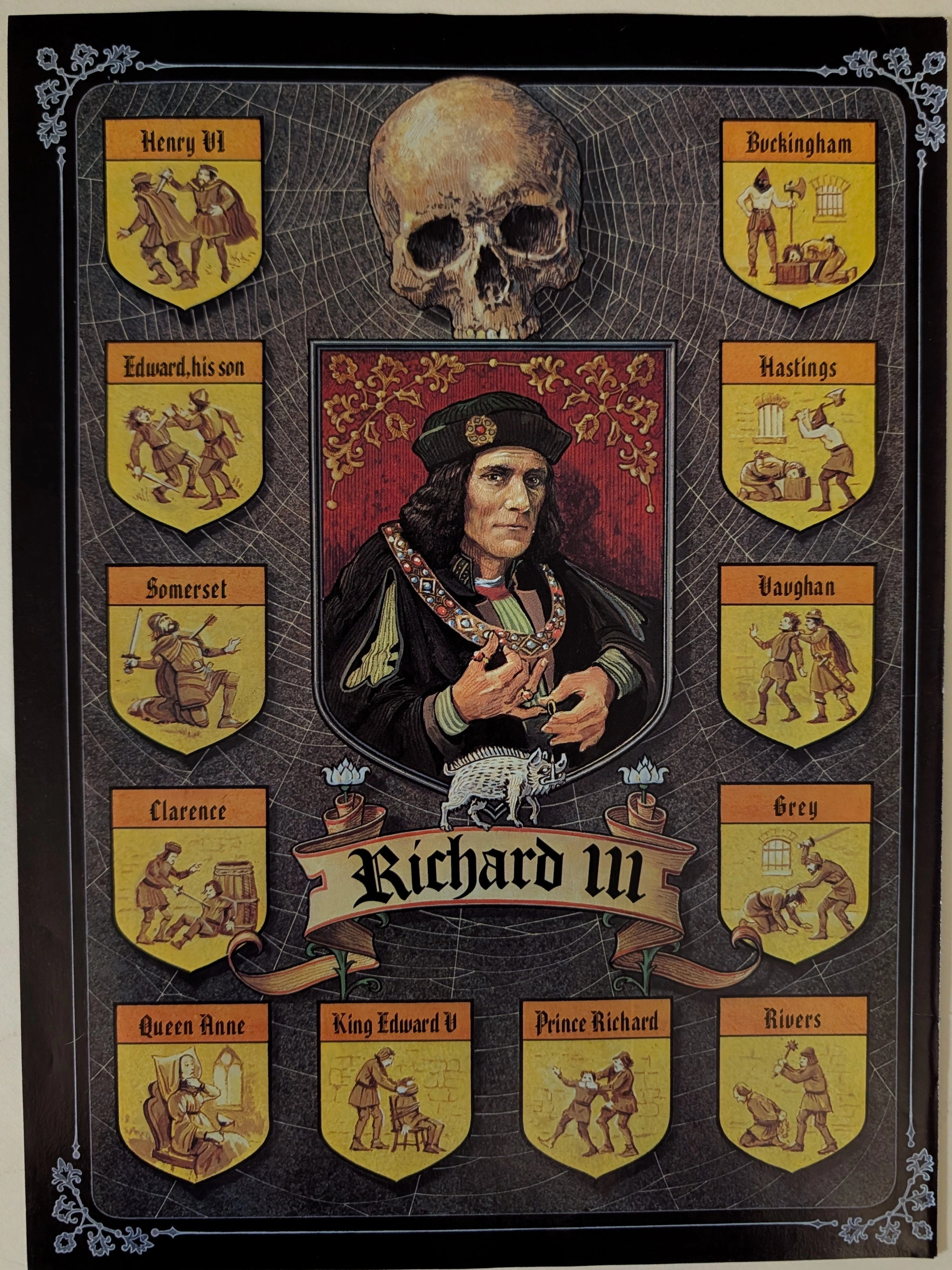
Delve into the archives to explore this definitive Circa 1970s Shakespearean Richard III vintage illustration, a profoundly dark and historically layered piece of theatrical and literary art. Likely produced as an educational broadside or promotional poster for a mid-to-late 20th-century theatrical run, this piece transcends basic historical depiction, serving instead as a macabre visual map of th
The History
The Context of the Wars of the Roses and the "Tudor Myth" To fully decode the semiotics of this illustration, one must first understand the bloody backdrop of the Wars of the Roses—the decades-long dynastic civil war for the English throne fought between the rival Plantagenet cadet branches of Lancaster (the Red Rose) and York (the White Rose). King Richard III was the last monarch of the House of York and the final Plantagenet king. His death at the Battle of Bosworth Field in 1485 marked the definitive end of the Middle Ages in England and birthed a new dynasty: the House of Tudor, led by He
The Paper
Examined through an archival lens, the physical substrate and printing technology anchor this piece firmly in the premium educational or theatrical publishing sector of the late 1970s to early 1980s. The artwork is printed on a substantial heavyweight cardstock, finished with a matte or satin coating. This lack of high gloss was an intentional design choice; it prevents glare when pinned to a classroom wall, a theatre lobby board, or framed in a study, allowing the muted, somber tones to absorb ambient light rather than reflect it. The printing utilizes a standard 4-color CMYK offset lithograp
The Rarity
Rarity Class: S (Super Rare / Specialized Theatrical Ephemera) The scarcity of this item does not stem from a deliberately limited "fine art" print run, but rather from the brutal nature of its intended use. Educational ephemera, literary broadsides, and theatrical posters were inherently functional. They were meant to be handled, tacked to corkboards, taped to brick walls, rolled, unrolled, and eventually thrown away once a semester ended or a play closed its curtain. Because of this high-attrition lifecycle, the survival rate of these pieces in pristine, unfaded condition is exceptionally lo