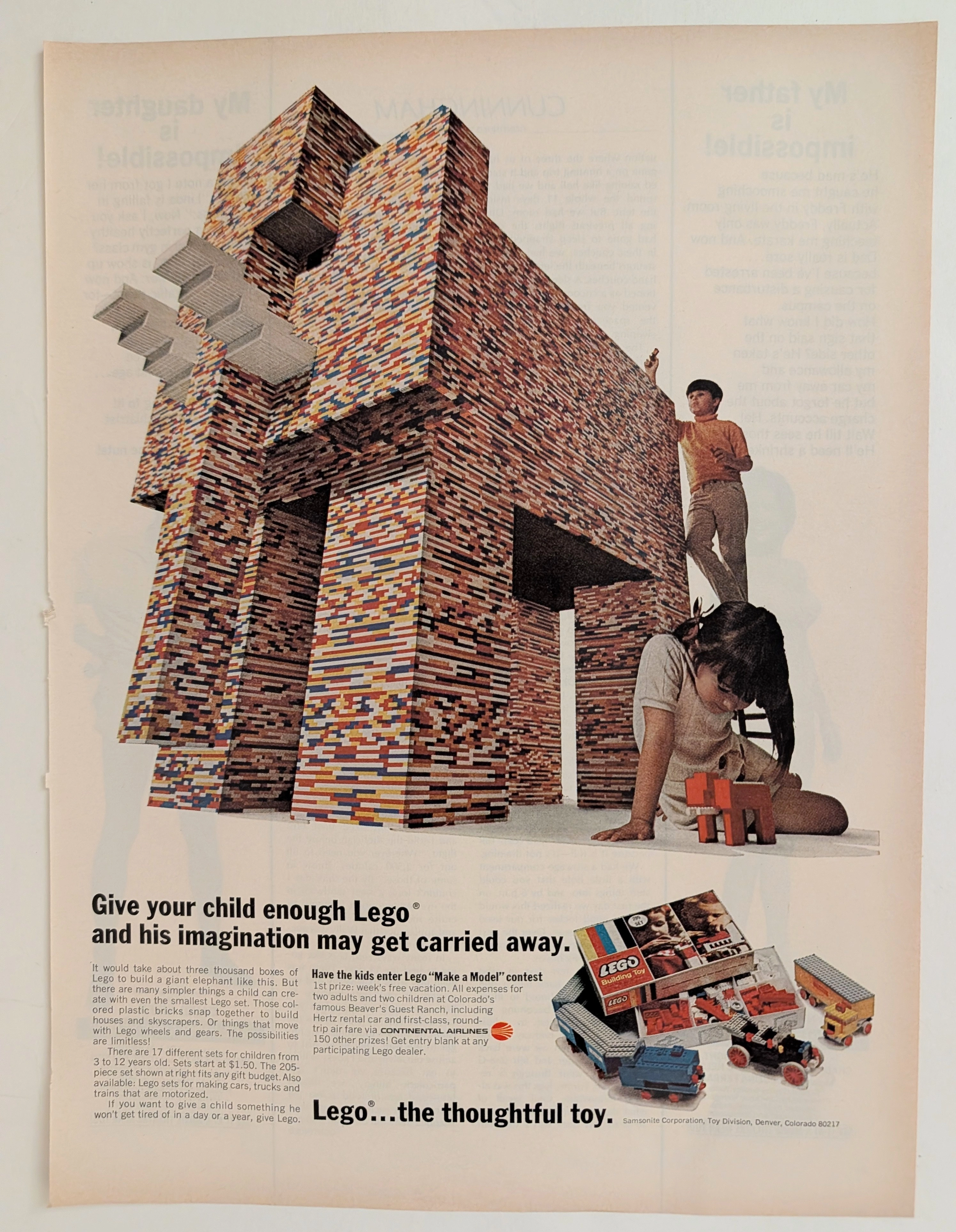
The Time Traveller's Dossier : Samsonite-Era Lego - Engineering the Imagination Shift
The toy industry was once a landscape of static finality. Materials were heavy. Wood. Die-cast metal. Single-purpose tin. A toy was a finished product when it left the factory floor. The child was merely the operator of someone else's vision. Then came the system. The interlocking brick. A paradigm of infinite permutations. This document analyzes a critical juncture in cultural mechanics. The era
Category: Other
Brand: Lego
The History
The Architecture of Play Before the Brick To understand the historical shift represented by this document, we must first analyze the baseline of mid-20th-century playmatics. Before the widespread adoption of the interlocking brick, construction toys were constrained by their own structural logic. Erector sets and Meccano utilized metal struts and microscopic screws, demanding fine motor skills and dictating a fundamentally industrial aesthetic. Lincoln Logs and Tinkertoys relied on localized joints, forcing the user into predictable, rustic architectural outcomes. They taught conformity. They
The Paper
The substrate is a lightweight, coated magazine stock, typical of mass-circulation periodicals from the late 1960s to early 1970s. The basis weight is likely between 60 to 70 GSM. The printing methodology is a standard four-color continuous-tone lithography (CMYK process). Upon close inspection of the solid color blocks—particularly the red and blue bricks—the halftoning rosette patterns become distinctly visible. The paper exhibits noticeable oxidation and acid hydrolysis, particularly along the margins, resulting in a yellowing effect known as foxing. This chemical degradation is a result of
The Rarity
Class A. Contextual and Cultural Density. While the physical advertisement itself was mass-produced in millions of periodicals, its survival in a clean, untorn state elevates its physical rarity. However, its true classification lies in its contextual density. The convergence of the Samsonite manufacturing credit, the Saul Bass Continental Airlines logo, and the transitional era of ABS plastic engineering creates an artifact with high historiographical value. It is a vital node for researchers tracking the evolution of industrial design, marketing psychology, and material science in the mid-20