The Time Traveller's Dossier: The Firestone Margin of Safety
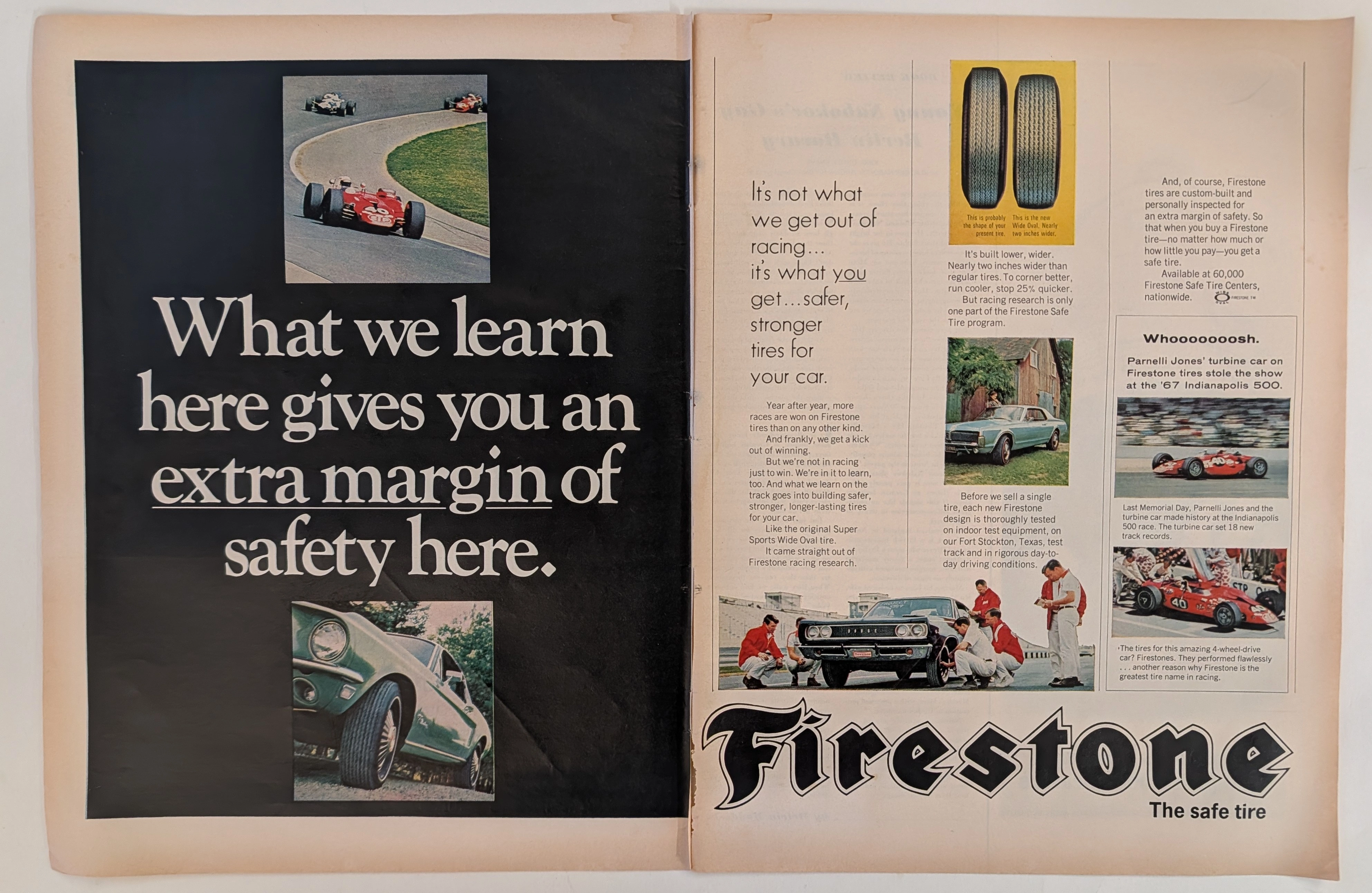
The symbiotic relationship between the extreme, high-stakes crucible of professional motorsport and the evolution of the daily-driven passenger automobile is one of the foundational narratives of twentieth-century industrial design. The historical artifact elegantly and securely positioned upon the analytical table of The Record Institute today is a majestic, large-format, two-page print advertise
Category: Automotive
Brand: Firestone
The History
To fully appreciate the immense historical gravity, cultural magnitude, and sociological importance of this artifact, one must meticulously contextualize the terrifying "traction deficit" that plagued the American automotive industry during the mid-to-late 1960s. During this era, domestic manufacturers in Detroit were engaged in a ruthless, escalating horsepower war. Pontiac, Ford, Chevrolet, and Dodge were dropping massive, high-displacement V8 engines into intermediate and compact chassis, creating the legendary "muscle cars." However, a critical engineering crisis emerged: the tire technolo
The Paper
As a physical entity, this printed artifact functions as a living, breathing, and profound record of mid-twentieth-century graphic reproduction and substrate chemistry. Under exceptional macro-lens examination, this document reveals the stunning complexity and mathematical precision of analog color printing. The intricate textures of the track asphalt, the vibrant red of the STP-Paxton Turbocar, the glossy dark green paint of the Mustang's fender, and the razor-sharp typography of the registered "Wide Oval" trademark are all meticulously constructed from a precise, mathematically rigorous gala
The Rarity
RARITY CLASS: B (Very Good Archival Preservation with Minor Environmental Wear) Evaluated under the most exacting, rigorous, and uncompromising archival parameters, this artifact is definitively and securely designated as Class B. The remarkable and defining paradox of mid-century print advertising is that these specific documents were produced by the millions as explicitly and intentionally "disposable media." They were inherently destined by their very nature to be briefly observed, casually folded, read over a morning coffee, and ultimately discarded into the recycling bins and incinerators