The Time Traveller's Dossier: The Zenith of General Motors
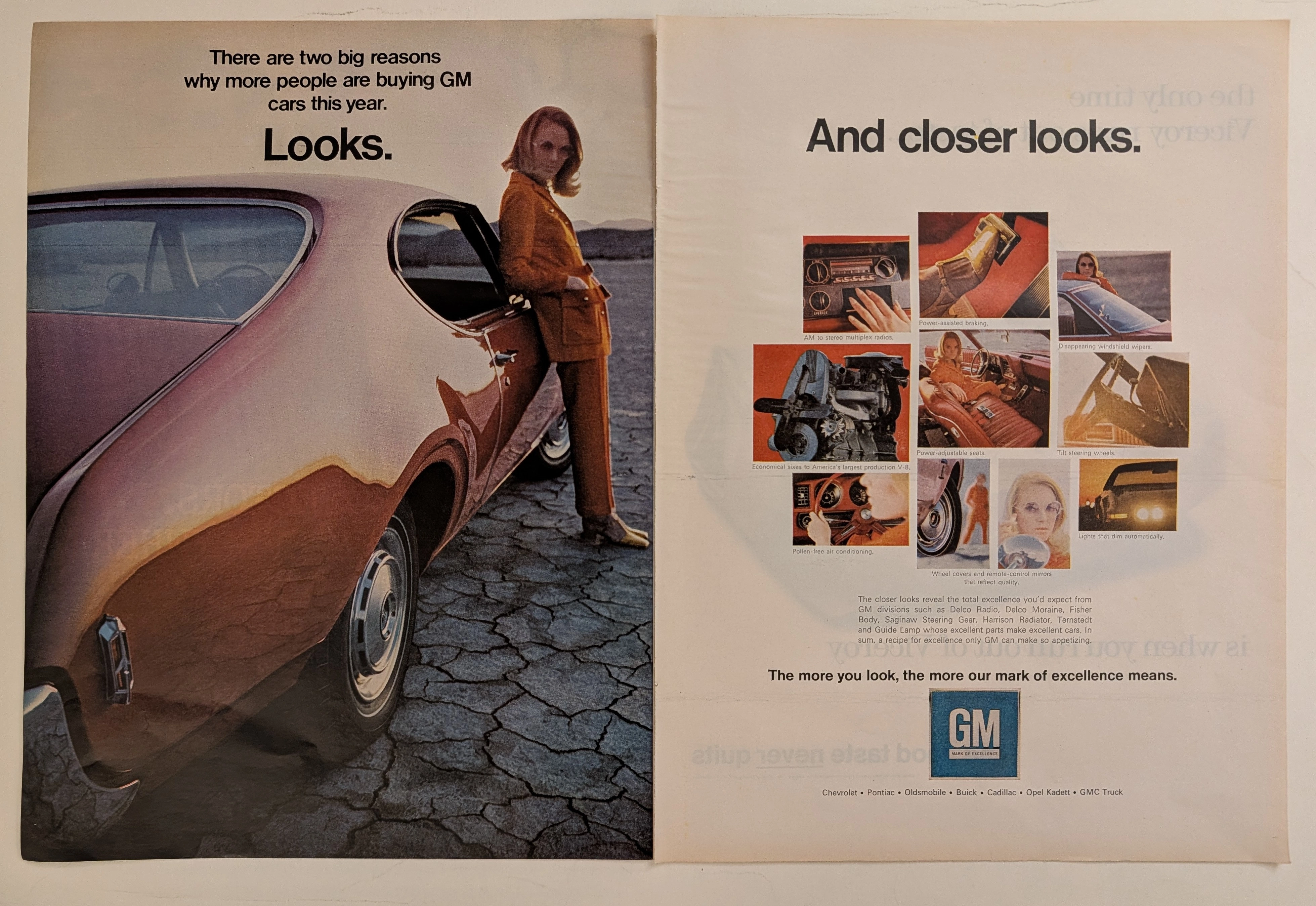
The automobile in mid-twentieth-century America was never merely a mode of transportation; it was a colossal canvas projecting industrial pride, technological advancement, and shifting consumer identities. The historical artifact elegantly and securely positioned upon the analytical table of The Record Institute today is a magnificent, large-format, two-page print advertisement for General Motors
Category: Automotive
Brand: General Motors
The History
To fully appreciate the immense historical gravity, cultural magnitude, and sociological importance of this artifact, one must meticulously contextualize the absolute hegemony of General Motors in the late 1960s, alongside the seismic cultural shifts occurring within American society. During this era, GM was not just a car manufacturer; it was an industrial empire that propelled the American economy, commanding over fifty percent of the domestic automotive market. With a flawless brand hierarchy cascading from Chevrolet to Pontiac, Oldsmobile, Buick, and Cadillac, GM captured every economic de
The Paper
As a physical entity, this printed artifact functions as a living, breathing, and profound record of mid-twentieth-century graphic reproduction and substrate chemistry. Under exceptional macro-lens examination, this document reveals the stunning complexity and mathematical precision of analog color printing. The smooth curves of the automobile, the rich textures of the mustard pantsuit, and the metallic gleam of the radio dials are all meticulously constructed from a precise, mathematically rigorous galaxy of halftone rosettes. This intricate pattern constitutes the mechanical fingerprint of t
The Rarity
RARITY CLASS: A (Excellent Archival Preservation) Evaluated under the most exacting, rigorous, and uncompromising archival parameters, this artifact is definitively and securely designated as Class A. The remarkable and defining paradox of mid-century print advertising is that these specific documents were produced by the millions as explicitly and intentionally "disposable media." They were inherently destined by their very nature to be briefly observed, casually folded, read over a morning coffee, and ultimately discarded into the recycling bins and incinerators of history. For a massive,