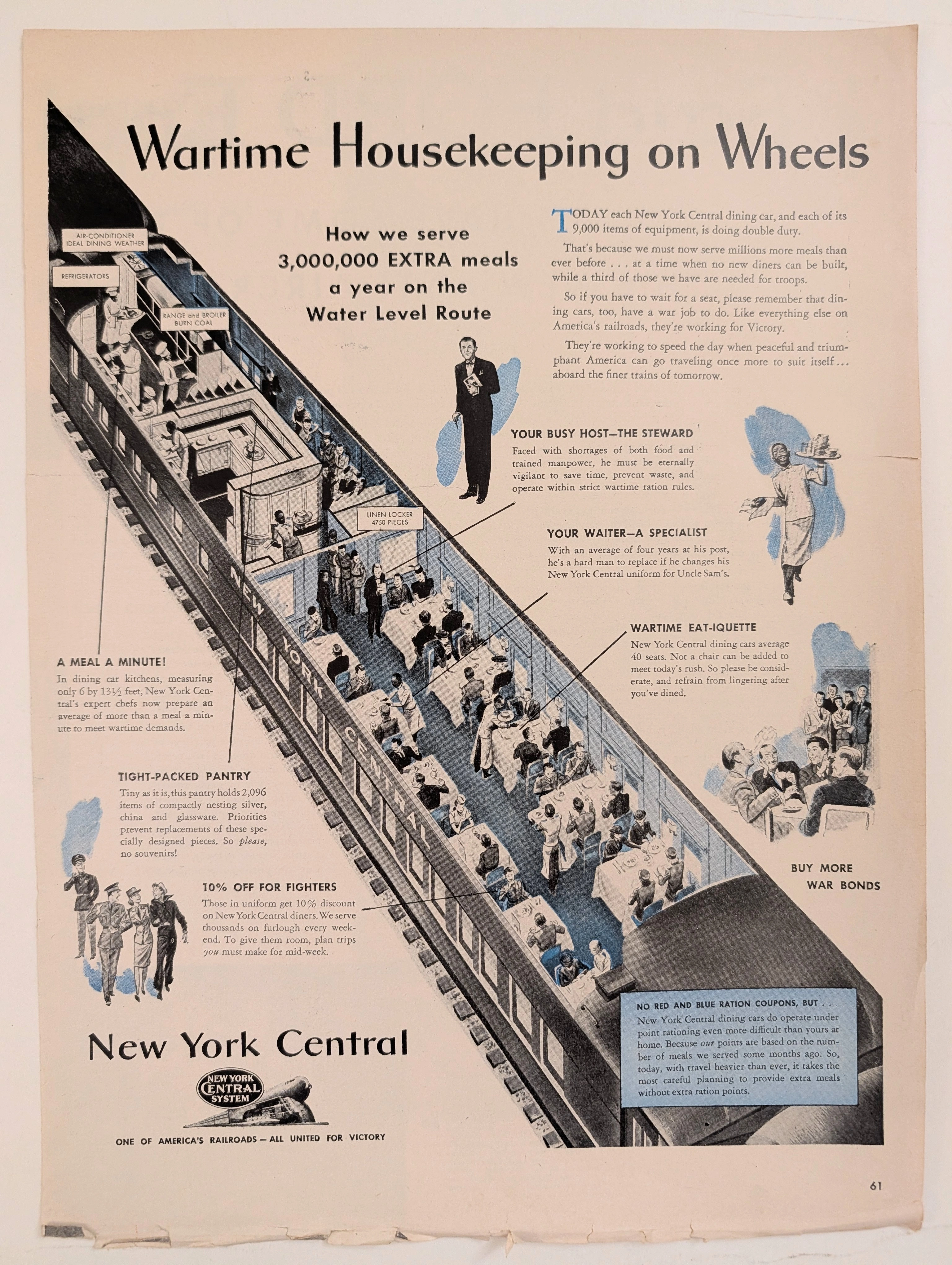
1944 New York Central "Wartime Housekeeping on Wheels" Vintage Advertisement
1944 New York Central "Wartime Housekeeping on Wheels" Vintage Advertisement The Second World War placed an unimaginable strain on the American railroad network. With civilian gasoline and rubber tires heavily rationed, domestic train travel surged at the exact moment the military required massive, continuous troop movements. This advertisement brilliantly addresses the resulting friction of wartime travel by pulling back the curtain on the railroad's hidden operations. By detailing the cramped 6 by 13 ½ foot kitchen where specialized chefs used coal-burning ranges to prepare "a meal a minute," the New York Central System reframes potential passenger delays and crowded conditions as necessary acts of patriotic sacrifice. The copywriting is a treasure trove of WWII home-front vernacular. It explicitly addresses the complex national rationing system, noting the absence of "Red and Blue Ration Coupons" for passengers, while reminding them that the railroad's own food points are strictly monitored based on past service numbers. To manage the incredible volume of "3,000,000 EXTRA meals a year," the ad introduces "Wartime Eat-iquette," politely urging diners to eat quickly and refrain from lingering so that others—particularly the troops—might be seated. Visually, the ad relies on a clean, two-color isometric illustration to guide the reader's eye through the train car's anatomy, from the "linen locker" holding 4,750 pieces to the dining floor shared by civilians and military personnel. The inclusion of a "10% off for fighters" policy, alongside recurring wartime slogans like "Buy More War Bonds" and "All United for Victory," firmly anchors this artifact in the 1940s. It is a profound testament to how American corporations aligned their operational challenges with the nationalistic duty of the era.
Category: Travel & Hotels
Year: 1944
Rarity Class: B
Paper & Print Condition
L'artefact présente un jaunissement modéré dû à l'âge et une légère usure des bords, typiques du papier des magazines en temps de guerre, souvent soumis à des mandats nationaux de conservation du papier. Le processus d'impression en deux couleurs — utilisant une base en demi-teinte noire avec une seule couleur d'accentuation bleu cyan stratégique pour mettre en évidence le personnel et les éléments structurels — reste très efficace et bien préservé sans décoloration significative.
Provenance & Rarity
Provenant d'une publication nationale américaine du milieu des années 1940. Les publicités du front intérieur de la Seconde Guerre mondiale qui fournissent des données logistiques détaillées (telles que les dimensions spécifiques des cuisines et le volume des repas) ainsi que des politiques de rationnement explicites sont très appréciées des historiens. Elles constituent une riche documentation de source primaire sur la vie civile pendant le conflit.
Rarity & Condition Summary
Une pièce d'histoire des transports de la Seconde Guerre mondiale, historiquement significative et bien conservée, offrant un aperçu rare et détaillé des opérations quotidiennes, des sacrifices partagés et des messages patriotiques des chemins de fer américains pendant le conflit mondial.