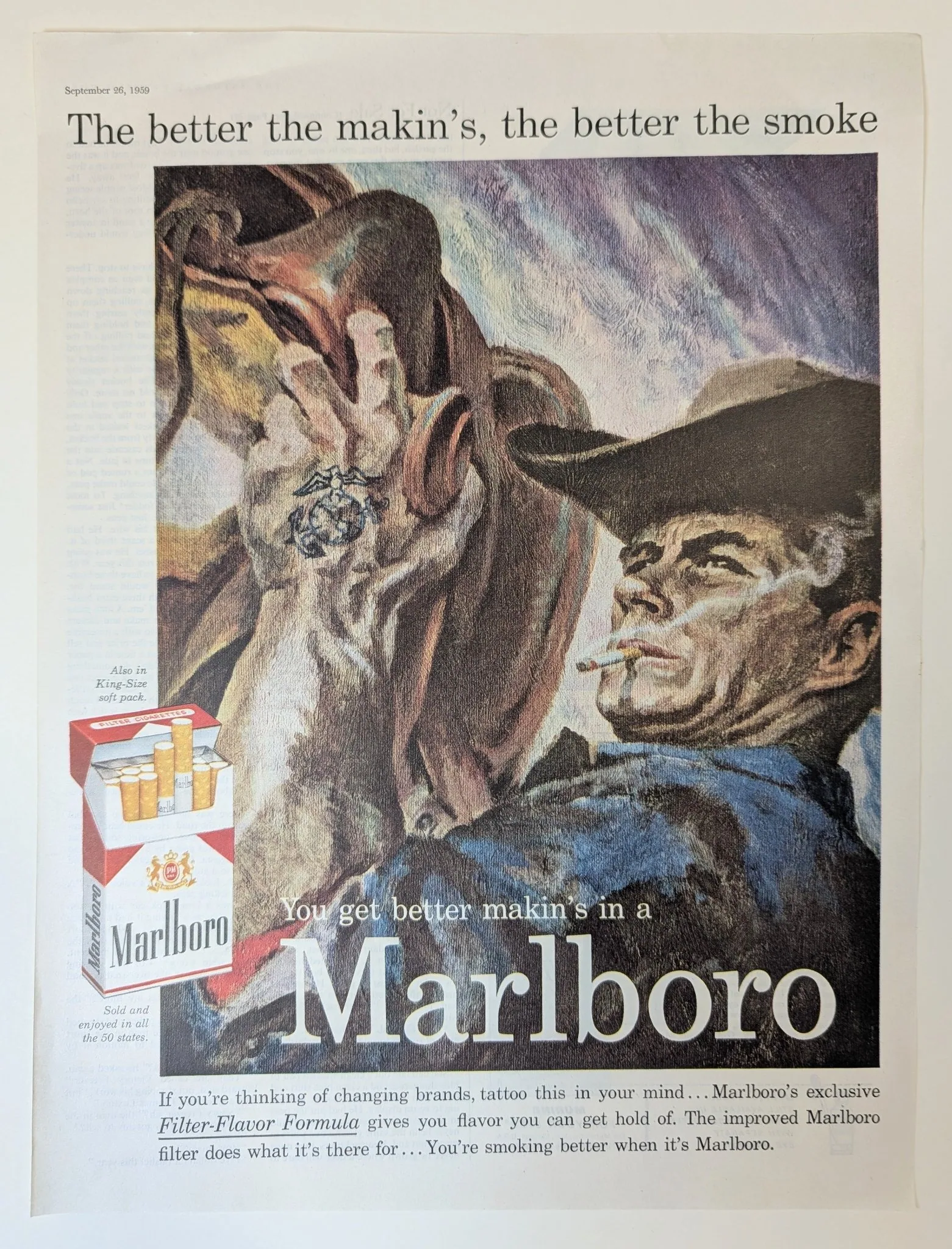
Marlboro Cigarette Advertisement: "The Better the Makin's, the Better the Smoke," 1959
## 1. The Object This full-page magazine advertisement for Marlboro cigarettes ran in an issue dated September 26, 1959, the date printed in the magazine’s running folio at the top of the page. The publication has not yet been identified from the folio alone. The page appears to be the size of a large-format weekly magazine of the period; exact dimensions have not been recorded. The headline, set in a serif display face across the top of the page, reads: “The better the makin’s, the better the smoke.” “Makin’s” (makings) is period vernacular for the loose tobacco and papers of a hand-rolled cigarette — the word is documented in historical dictionaries of North American English and is not exclusive to cowboy speech — a deliberate choice that gives the headline a ranch-hand flavor. The illustration shows a weathered cowboy in a dark hat, a cigarette held in his mouth, raising a saddle toward a horse whose head and neck fill the left side of the frame. The cowboy’s raised hand dominates the center of the composition. On the back of that hand is a dark tattoo resembling the U.S. Marine Corps Eagle, Globe, and Anchor emblem. This is the campaign’s signature tattoo motif placed exactly where the campaign’s early executions placed it: on the man’s hand, suggesting a romantic past of service and adventure. The tattoo is not on the horse; the hand overlaps the horse’s head in the composition, which can make the placement appear ambiguous at a glance. Below the illustration, overprinted on the image, runs the line “You get better makin’s in a Marlboro.” At the lower left stands an illustrated Marlboro flip-top pack, open to show the cigarettes, with the Philip Morris crest above the wordmark. Beside the pack, small type reads “Also in King-Size soft pack.” and, in small type beneath the pack illustration, “Sold and enjoyed in all the 50 states.” This line is printed text on the advertisement page; it is not verified printing on a manufactured pack. The body copy at the foot of the page reads, in full: “If you’re thinking of changing brands, tattoo this in your mind... Marlboro’s exclusive Filter-Flavor Formula gives you flavor you can get hold of. The improved Marlboro filter does what it’s there for... You’re smoking better when it’s Marlboro.” ## 2. The Campaign This advertisement belongs to one of the most studied campaigns in the history of American advertising. In the mid-1950s, the Leo Burnett agency in Chicago developed a complete repositioning of Marlboro for the Philip Morris company — developed in 1954 and launched in 1955, per standard advertising histories. Marlboro had earlier been marketed prominently to women, with “Mild as May” copy and a red beauty tip — a red-colored tip said to disguise lipstick marks. (Company literature of the period called these “Beauty Tips”; the red tip should not be confused with the filter system introduced with the 1955 repositioning.) Burnett’s task was to make a filter cigarette acceptable, even desirable, to men at a moment when filters were widely perceived as feminine and when public concern about smoking and health was beginning to grow. The answer was the cowboy: a solitary figure of independence, physical labor, and authenticity. The campaign featuring rugged male figures launched in 1955 with varied masculine archetypes — ranch hands, pilots, sailors — many bearing tattoos that suggested romantic pasts (Smithsonian NMAH.AC.0198). The tattoo became one of the campaign’s recurring devices, and the copy here makes the device explicit: “tattoo this in your mind” is a direct echo of the visible tattoo on the cowboy’s hand, a textbook example of copy and image working as one. The exclusive cowboy focus that later defined “Marlboro Country” came later, around 1963. This 1959 advertisement sits in the transitional middle of the campaign’s evolution: the cowboy is present, the tattoo motif persists, and the copy still argues for the filter on flavor grounds. ## 3. The Date The issue date, September 26, 1959, gives this artifact a sharp chronological anchor. Hawaii had been admitted as the 50th state on August 21, 1959, by presidential proclamation (Proclamation 3309) — 36 days before the issue date legible on this page. The fifty-star flag itself did not become the official national flag until July 4, 1960 (Executive Order 10834); that date is separate from statehood and should not be conflated with it. The pack copy’s claim “Sold and enjoyed in all the 50 states” is the advertiser’s claim, not an independently verified statement of distribution. The 36-day interval is measured to the issue date printed on the page; it does not establish when the advertisement was designed, approved, printed, or distributed, and no inference about the production schedule should be drawn from it. ## 4. The Product The advertisement promotes Marlboro filter cigarettes in two pack formats: the flip-top box shown in the illustration and the King-Size soft pack noted in the small type. The “Filter-Flavor Formula” and “improved Marlboro filter” language is the campaign’s standard response to the era’s central commercial problem: convincing smokers that a filter did not mean surrendering flavor. These are period marketing claims, not statements of product fact. ## 5. The Military Emblem The tattoo on the cowboy’s hand resembles the Eagle, Globe, and Anchor, the emblem of the United States Marine Corps. No evidence has been found that the Marine Corps endorsed this advertisement or the product, and none should be implied. The use of a military-style tattoo in 1959 advertising is best read as an appeal to the identity of postwar American men, many of them veterans of World War II or Korea, for whom such an emblem signaled toughness, service, and belonging. Whether the emblem in the illustration was authorized for this use is unknown and should not be speculated upon in the record. ## 6. Tobacco Advertising in Context Historical tobacco advertising: this advertisement is presented for historical study and documentation, not as an endorsement of tobacco use or of the claims it contains. In the 1950s, filter cigarettes were marketed amid growing public concern about smoking and cancer. The 1964 report of the U.S. Surgeon General’s Advisory Committee on Smoking and Health concluded that cigarette smoking was a cause of lung and laryngeal cancer in men, a probable cause of lung cancer in women, and the most important cause of chronic bronchitis — findings stated within that report’s scope, separate from later medical knowledge. Product names and trademarks are reproduced as features of the historical object. No affiliation with or endorsement by the trademark owners is implied. ## References - U.S. Presidential Proclamation 3309, admitting Hawaii to the Union, August 21, 1959. (Eisenhower Presidential Library) - Executive Order 10834, prescribing the fifty-star flag as the official national flag effective July 4, 1960. (National Archives) - Smithsonian Institution, NMAH.AC.0198 — Leo Burnett Company records: 1955 Marlboro campaign launch with varied masculine archetypes; cowboy-focused “Marlboro Country” from circa 1963. - Philip Morris historical pamphlet (Stanford-hosted scan): “Beauty Tips” terminology for the pre-1955 red tip and its lipstick rationale. - UBC Dictionary of Canadianisms on Historical Principles — “makings”: tobacco and rolling papers; not cowboy-exclusive slang. - CDC, History of the Surgeon General’s Reports on Smoking and Health — scope of the 1964 report’s findings. - Transcription: punctuation and line breaks normalized; verified against the six documentation photographs. (Not a character-for-character certification.)
Category: Tobacco
Year: 1959
Rarity Class: B