Le Dossier du Voyageur Temporel : Brut 1980 - Le Basculement du Grooming
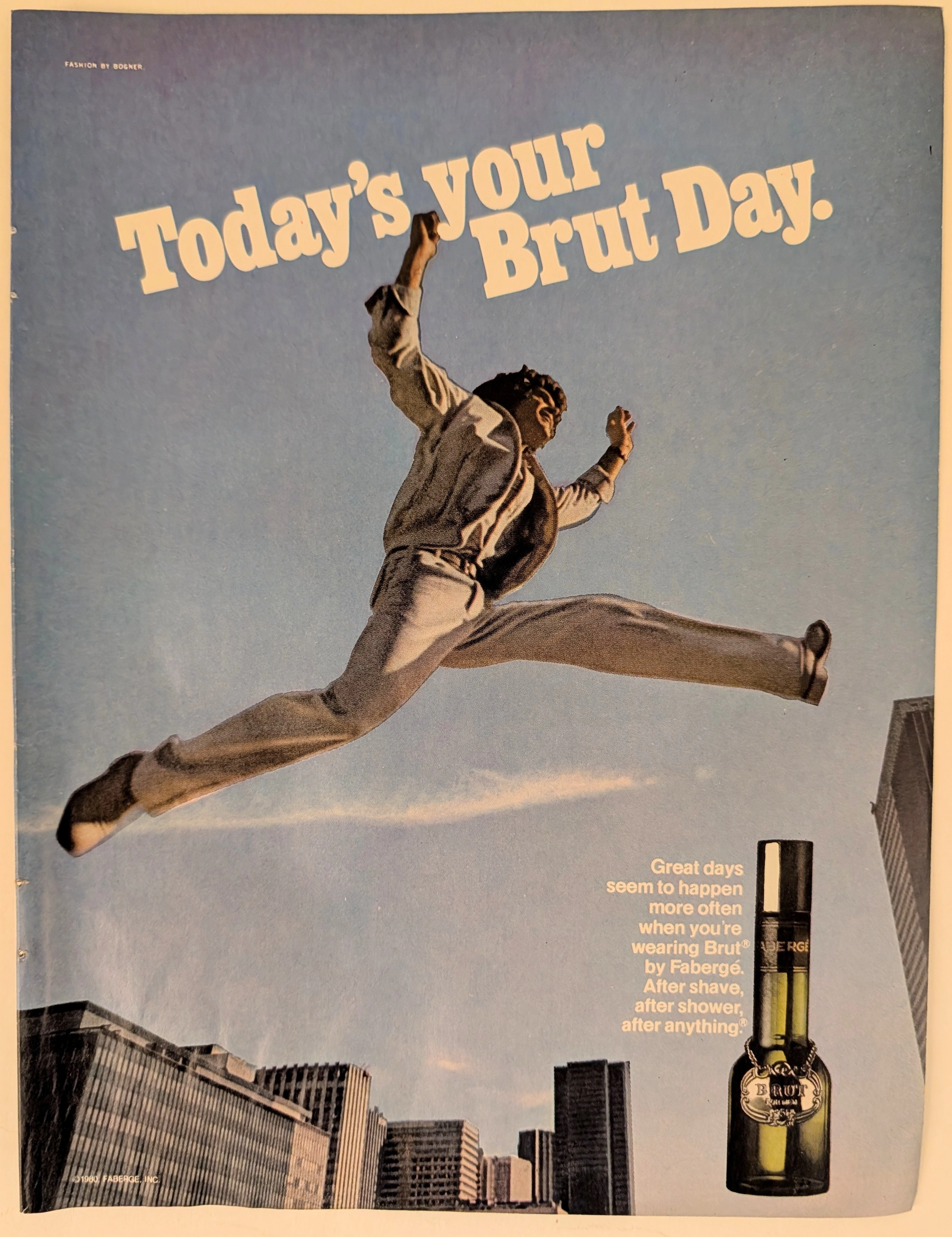
Avant. Le parfum était un luxe. Une commodité rare logée dans le cristal. Réservé pour le sabbat. Pour l'anniversaire. Pour la rare et méticuleuse soirée. C'était une occasion, pas une routine. Maintenant. Le parfum est une utilité. C'est une armure. C'est une attente fondamentale de l'engagement sociétal moderne. L'artefact devant nous marque le point d'inflexion précis. Nous sommes en 1980. Le moment où le parfum masculin a été délibérément découplé du concept "d'occasions spéciales". Il est descendu de l'étagère aristocratique et s'est incrusté dans les rituels mondains de l'homme de tous les jours. "Après le rasage, après la douche, après n'importe quoi." Ce n'est pas simplement un texte publicitaire. C'est un recalibrage profond de la présentation masculine. C'est la démocratisation ingéniée des soins corporels masculins.
Category: Beverage
Brand: Brut
The History
La Chronologie de la Confiance Pour comprendre la gravité de cet artefact, il faut d'abord disséquer le paysage temporel de 1980. Les États-Unis émergeaient du malaise dense et complexe des années 1970. La stagnation économique et le cynisme géopolitique commençaient à céder la place à un nouveau paradigme, agressivement optimiste. L'aube de l'ère Reagan était imminente. Une décennie d'hyper-individualisme, d'ambition d'entreprise et d'énergie cinétique implacable était sur le point de commencer. Les hommes entraient sur un nouveau champ de bataille. Les sols industriels laissaient place aux cubicules des entreprises. Le gratte-ciel était la nouvelle frontière. Dans cet environnement, le travail physique était remplacé par la projection psychologique. La confiance devenait la monnaie principale. L'homme moderne avait besoin d'un nouveau type d'armure. Fabergé a reconnu ce changement de paradigme. Ils ont compris que le marché existant des parfums pour hommes était fondamentalement défectueux. Il était trop précieux. Il était trop rare. Des marques comme Aramis ou Chanel étaient positionnées comme élitistes, aspirationnelles, et par conséquent, rarement utilisées. Old Spice, bien qu'omniprésent, était entièrement lié à l'acte de se raser et portait l'odeur lourde et nostalgique de la génération précédente. Brut a identifié le territoire massif et inexploité qui se trouvait au milieu : le quotidien. L'Ingénierie du Quotidien Le coup de maître de Brut a été le démantèlement complet de la friction. La copie sur cet artefact est une classe de maître en ingénierie comportementale. "Les grands jours semblent arriver plus souvent quand vous portez Brut par Fabergé." Cette phrase établit une corrélation entre l'application du produit et le succès de la période temporelle (la journée). C'est une promesse de réalité optimisée. Vient ensuite le commandement définitif : "Après le rasage, après la douche, après n'importe quoi." Observez la progression. Elle commence par le traditionnel (après le rasage). Elle s'étend au rituel universel d'hygiène quotidienne (après la douche). Elle culmine dans la suppression absolue de toutes les frontières (après n'importe quoi). "Après n'importe quoi" est le cœur philosophique de ce document. Il dicte qu'il n'y a pas de mauvais moment pour appliquer le produit. Vous avez terminé une réunion ? Mettez du Brut. Un match de tennis ? Mettez du Brut. Vous venez de vous réveiller ? Mettez du Brut. C'était la construction délibérée d'une boucle d'habitude. Fabergé ne vendait pas une bouteille de liquide parfumé. Ils vendaient un réflexe comportemental. Ils ont normalisé le concept selon lequel un homme devait constamment gérer et rafraîchir son empreinte olfactive. Ils ont transformé le parfum d'un accessoire de luxe en une utilité quotidienne. La Garde-Robe Cinétique et la Connexion Bogner Observez le sujet de l'artefact. Il ne se tient pas statiquement. Il ne pose pas pensivement avec une main sur le menton. Il est suspendu dans les airs. Il bondit. Cette énergie cinétique est le reflet direct de la philosophie des années 1980. C'est la manifestation visuelle de la mobilité ascendante. Il s'élève physiquement au-dessus de la géométrie dense et concrète de la ville en contrebas. L'horizon est son plancher. Surtout, nous devons analyser la garde-robe. L'artefact crédite explicitement "FASHION BY BOGNER". En 1980, Willy Bogner Jr. redéfinissait l'intersection entre les vêtements de sport et la mode lifestyle haut de gamme. Bogner était célèbre pour ses vêtements de ski luxueux. C'était l'uniforme des riches en plein loisir. En habillant le sujet en Bogner, l'agence de publicité a fusionné la vigueur athlétique avec le privilège exécutif. L'homme ne porte pas un costume trois pièces restrictif. Il porte des vêtements déstructurés, actifs, mais intrinsèquement haut de gamme. C'est un homme en mouvement. Les vêtements suggèrent que sa "Journée Brut" ne se limite pas à un bureau. Elle est expansive. Elle englobe les affaires, les loisirs et l'effort physique. Le parfum doit donc être capable de survivre et d'améliorer toutes ces modalités. "Après n'importe quoi." Le Monolithe en Verre Vert La sémiotique visuelle de la bouteille Brut ne peut être ignorée. Pendant que le sujet vole, la bouteille reste obstinément, lourdement ancrée dans le quadrant inférieur droit. Le design de la bouteille Brut était un exercice calculé de réassurance masculine. À une époque où les hommes étaient encore culturellement hésitants à adopter des routines cosmétiques étendues, l'emballage offrait une sécurité psychologique. Elle est construite en verre vert épais et lourd. Elle ressemble à une flasque ou à une bouteille de liqueur premium. Le médaillon en argent, suspendu par une chaîne, évoque l'imagerie d'une plaque d'identité militaire ou d'une médaille de championnat. Cela ne ressemble pas à un cosmétique. Cela ressemble à un trophée. La prise en main est substantielle et pesante. En concevant un contenant qui ressemblait à un outil ou une arme de conquête sociale, Fabergé a contourné la résistance masculine traditionnelle à la parfumerie. La bouteille elle-même était une approbation de la masculinité traditionnelle, même si le liquide à l'intérieur poussait les hommes vers une vanité moderne. Le Basculement Historique Cette seule page de papier imprimé représente la mort de l'ancien paradigme du soin masculin. Avant cette époque, l'odeur d'un homme était le sous-produit de son savon ou de sa crème à raser. Après cette époque, l'odeur d'un homme est devenue une projection délibérée, soignée et constamment maintenue de son identité. Brut a pavé la voie au boom des sprays corporels des années 1990 et 2000. Il a posé les fondations psychologiques de l'industrie moderne du grooming masculin, évaluée à plusieurs milliards de dollars. Chaque publicité moderne suggérant qu'un homme a besoin d'un gel douche spécifique, d'un déodorant spécifique et d'une eau de Cologne spécifique pour conquérir sa journée doit son lignage génétique à cette campagne exacte. Elle a enseigné à l'homme de tous les jours que la vanité n'était pas une faiblesse. C'était une stratégie.
The Paper
L'artefact physique est un fragment de l'impression de périodiques de masse du début des années 1980. Estimé à 60-70 GSM. Un papier magazine léger. La surface présente une finition brillante calandrée, standard pour les publications à fort tirage de l'époque. Sous analyse microscopique, la structure des points de trame CMJN est prononcée, particulièrement dans la vaste étendue du ciel. La couche cyan porte le poids visuel de l'image, projetant un bleu optimiste. Le temps, l'archiviste ultime, a interagi avec la chimie de l'encre et de la pâte de bois. Un léger jaunissement — dégradation acide — est visible aux marges extrêmes. Le papier est une membrane fragile. Il a été conçu pour exister une semaine, peut-être un mois, sur une table basse ou dans une salle d'attente. Il était éphémère par conception. Sa survie 46 ans plus tard le transforme de détritus commercial en registre sociologique. L'odeur de l'eau de Cologne originale qu'il annonçait s'est depuis longtemps évaporée, remplacée par l'arôme sec et distinct de la lignine en oxydation.
The Rarity
Classification : Classe B Justification de l'Archive : L'artefact n'est pas unique. Des millions d'impressions identiques ont été violemment pressées pour exister par des cylindres rotatifs massifs à travers le monde. Il a peuplé les pages de Time, Sports Illustrated, et Newsweek. Cependant, la valeur intrinsèque dans l'archive n'est pas déterminée uniquement par la rareté de la production, mais par la rareté de la survie et le poids du contexte. Les copies immaculées, non déchirées, qui ont réussi à éviter le bac de recyclage, le sous-sol humide et l'incinérateur sont de plus en plus rares. Sa véritable valeur est sociologique. C'est un artefact de Classe B car il sert de texte de référence fondamental pour comprendre l'évolution du comportement moderne des consommateurs. C'est un spécimen parfaitement préservé d'un changement de paradigme.
Citer cet article
- MLA
- Naodhinsuk, Ronin. “Le Dossier du Voyageur Temporel : Brut 1980 - Le Basculement du Grooming.” The Record Institute, 9 April 2026, https://therecord.institute/fr/journal/the-time-travellers-dossier-brut-1980-the-grooming-shift.
- APA
- Naodhinsuk, R. (2026, April 9). Le Dossier du Voyageur Temporel : Brut 1980 - Le Basculement du Grooming. The Record Institute. https://therecord.institute/fr/journal/the-time-travellers-dossier-brut-1980-the-grooming-shift
- CHICAGO
- Naodhinsuk, Ronin. 2026. “Le Dossier du Voyageur Temporel : Brut 1980 - Le Basculement du Grooming.” The Record Institute, April 9, 2026. https://therecord.institute/fr/journal/the-time-travellers-dossier-brut-1980-the-grooming-shift.