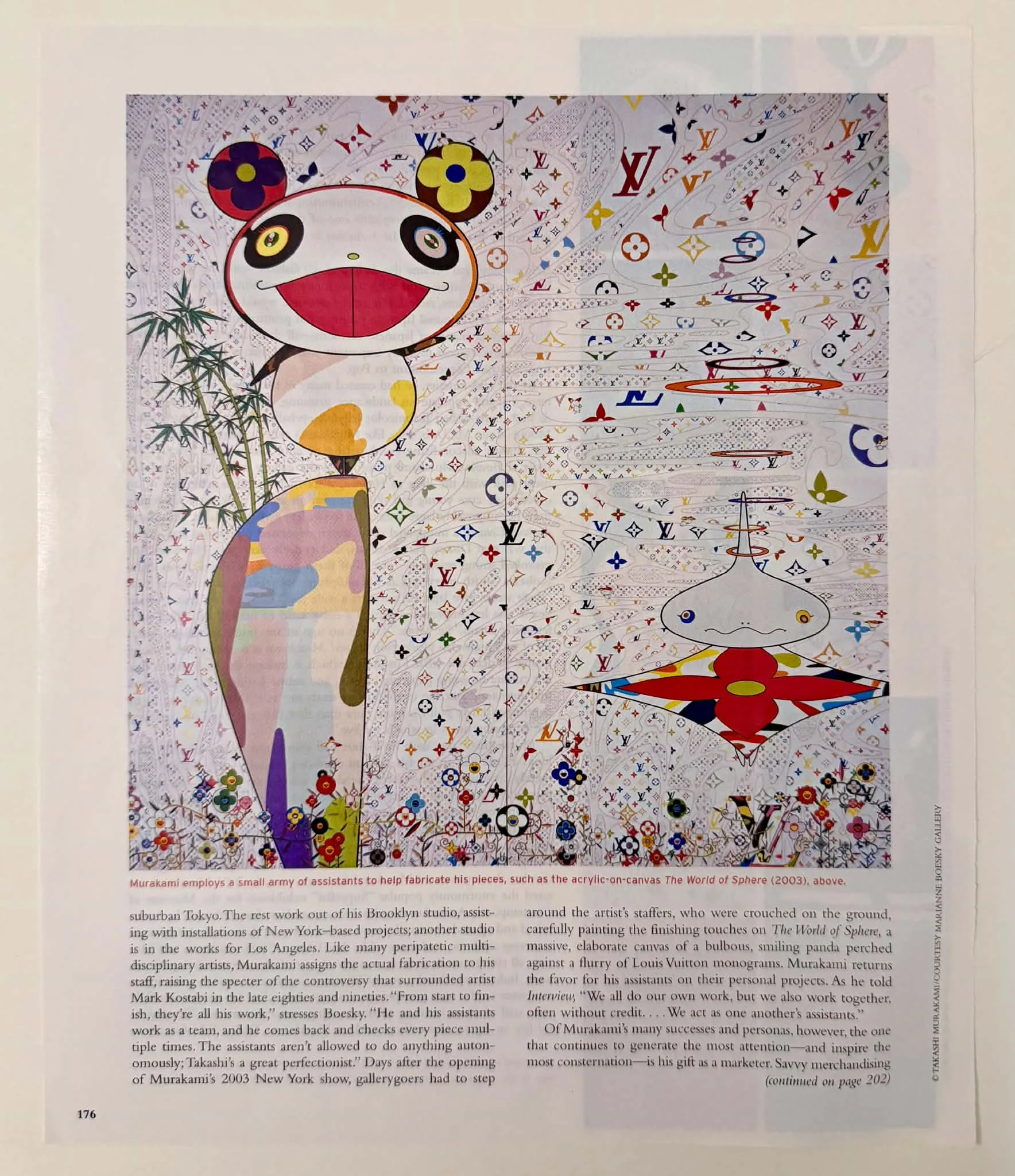
The Time Traveller's Dossier : Murakami & LV - The Corporate Flattening of Fine Art
Before this artifact, the canvas was a sacred, isolated space. It was a realm guarded fiercely against the intrusion of commercial branding. Art was meant to critique capital from a safe distance, not wear its logos as a second skin. After this artifact, the boundary dissolved entirely. The canvas became a billboard. The billboard became the canvas. Captured on this magazine page is a profound str
Category: Fashion
The History
The Myth of the Solitary Creator For centuries, the Western art historical canon has been anchored by a highly romanticized, deeply entrenched myth: the solitary genius. We are conditioned to imagine the artist alone in a dimly lit studio, agonizing over every brushstroke, channeling divine inspiration directly onto the canvas. Authenticity, in this framework, is inextricably linked to the physical touch of the master's hand. If the artist did not paint it, it is not truly theirs. This artifact, a printed page from an art publication circa the early 2000s, aggressively dismantles that paradigm
The Paper
This artifact is a physical page excised from a glossy, high-production commercial publication, likely an art magazine or a retrospective exhibition catalog from the mid-2000s. The substrate is a medium-to-heavyweight coated paper, estimated at 115 to 130 GSM. The gloss coating was applied to maximize color fidelity and saturation, a crucial requirement when reproducing the hyper-vibrant, synthetic palette of Murakami's Superflat universe. However, the passage of two decades has begun to subtlely alter its physical state. The coating shows microscopic signs of dulling, and the edges likely exh
The Rarity
The intrinsic value of this artifact does not lie in its material scarcity. Millions of similar pages were printed, bound, and distributed. Its true rarity is contextual and historical. It holds a Class B classification because it serves as a primary source document capturing a highly specific, highly volatile moment in art history. It is a contemporaneous record of the friction generated by Murakami's corporate methodology. It captures the exact language used by critics and gallerists in 2003 to justify and explain the industrialization of the artist's studio. While the original acrylic canva