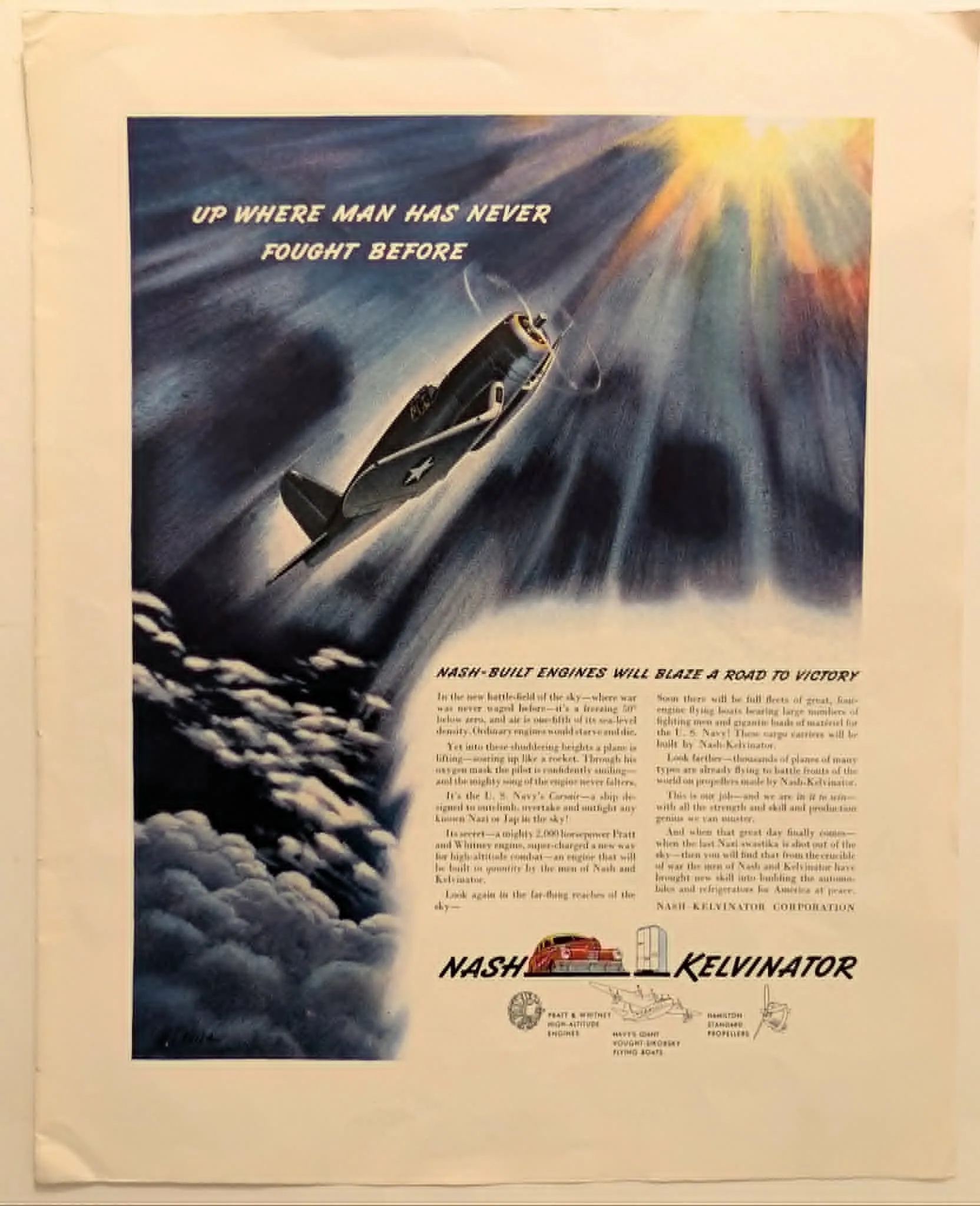
The Time Traveller's Dossier : Nash-Kelvinator 1943 - The Stratospheric Paradigm
War accelerates human engineering with a brutal, unforgiving absolute. Before the global conflict, the horizon of industrial ambition was domestic comfort. The factory floor was a temple dedicated to the preservation of perishables and the convenience of personal transit. Then, the sky was weaponized. This World War II-era Nash-Kelvinator advertisement is not merely a corporate proclamation. It is
Category: Technology
The History
The Domestic Prelude and the Economy of Comfort To understand the profound structural shift represented by this artifact, one must examine the economic and societal landscape of the late 1930s. The United States was slowly climbing out of the Great Depression. The industrial metrics of success were defined by domestic utility. Nash had built a reputation on the reliable, horizontal motion of the passenger automobile. Kelvinator had mastered the quiet, localized thermodynamics of the household refrigerator. Their merger created a conglomerate dedicated exclusively to the American standard of li
The Paper
The physical reality of this artifact provides a parallel narrative of its era. This is a mid-century, mass-produced magazine stock, likely falling within the 60 to 70 GSM range. It was birthed during a period of strict federal rationing, where the highest-grade wood pulp was redirected from civilian publishing toward critical wartime logistics. The paper is inherently acidic. The unrefined lignin within the matrix is actively oxidizing, resulting in the distinct, amber-hued yellowing visible along the outer margins. This is a slow, relentless chemical fire consuming the document from the insi
The Rarity
Class A : Culturally Imperative. While these mass-market magazines were printed by the millions, the survival rate of this specific advertisement in pristine, untorn condition is exceptionally low. However, its true rarity is completely detached from antique market valuations. Its rarity stems from its immense contextual gravity. It is a flawless primary source documenting the "Great Reconversion." It intersects the history of domestic consumerism with the extreme engineering of stratospheric combat. It captures a fleeting moment where a refrigerator company was forced to build the heart of a