The Time Traveller's Dossier : Space Camp - Civilian Orbit
For decades, the void of space was a closed ideological system. It was an arena reserved strictly for elite military test pilots and the apex of theoretical physics. To touch the edge of the atmosphere required a lifetime of rigorous physical perfection and government clearance. Then, the paradigm fractured. The Space Shuttle era reframed the cosmos. It was no longer a battlefield; it was a destin
Category: Technology
Brand: ์NASA
The History
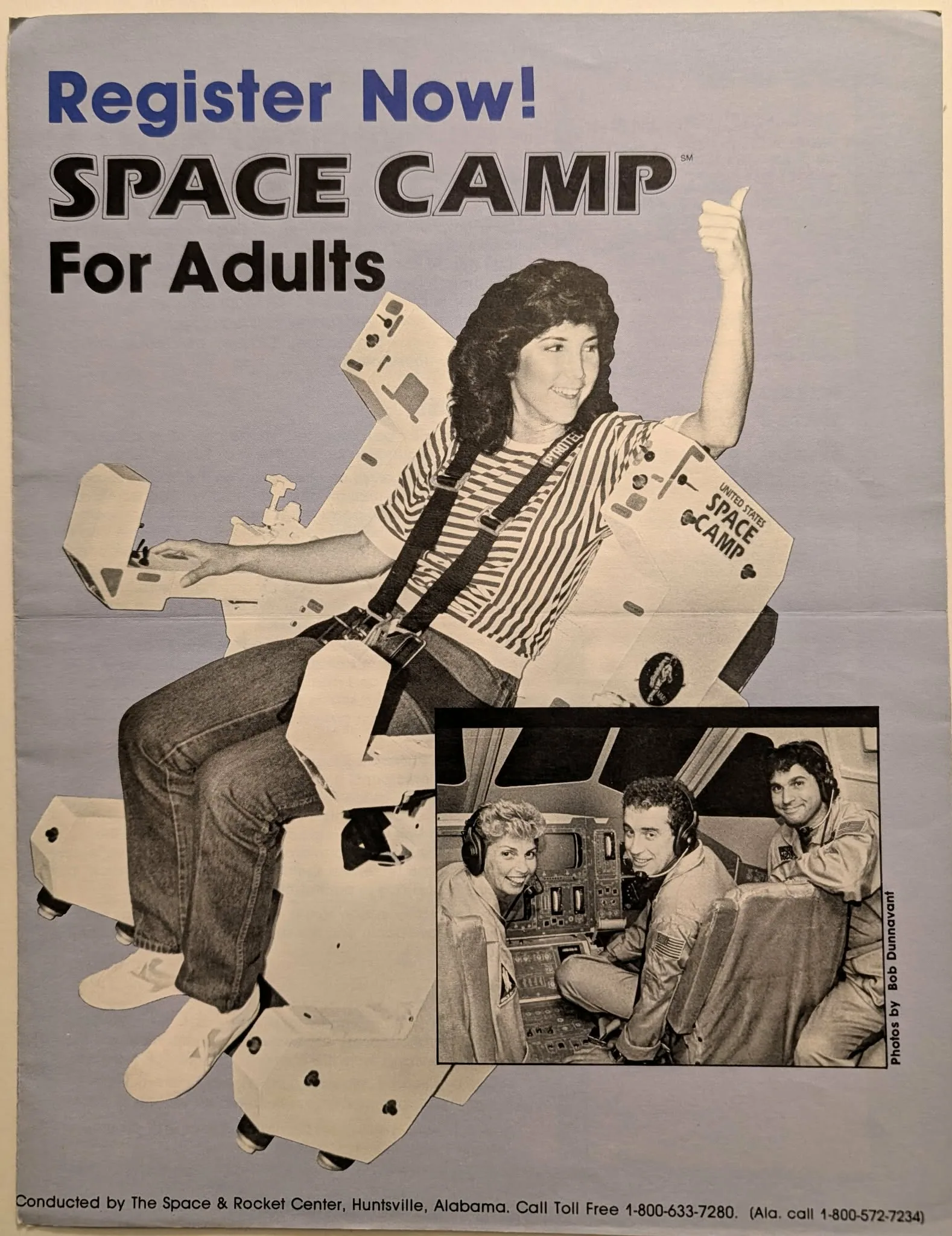
The Geopolitical Thaw and the Space Truck To understand this artifact, one must first isolate its temporal coordinates. The postmark stamped into the paper reads October 2, 1985. This date places the document at the absolute zenith of the Space Transportation System's (STS) operational optimism. The Space Shuttle was fully operational. NASA had successfully marketed the vehicle as the "space truck," a reliable, reusable workhorse that made low-Earth orbit a matter of routine logistics rather than exceptional exploration. During the Mercury and Apollo programs, astronaut training was a matter o
The Paper
The physical medium is a standard, lightweight uncoated offset paper, likely chosen for its cost-effectiveness in mass mailings. The substrate folds open into a multi-panel layout, a utilitarian design meant to present a dense volume of logistical information efficiently. The printing relies on a CMYK halftone process. This is most evident in the monochromatic photographs of the participants, where the structural grid of ink dots creates the illusion of depth and shadow. The background utilizes a flat, pale blue wash, providing a calm, clinical contrast to the dense text blocks. The most vital
The Rarity
Classification: Class S. While brochures for Space Camp are relatively common, intact adult program materials from the 1985 season, specifically bearing a pre-Challenger 1985 postmark, possess immense contextual rarity. Its value is derived entirely from its historical positioning. It is a primary source document capturing the peak of civilian space optimism. It is a sociological record of how a nation attempted to democratize the mechanics of orbit just before tragedy fundamentally altered the trajectory of human spaceflight.