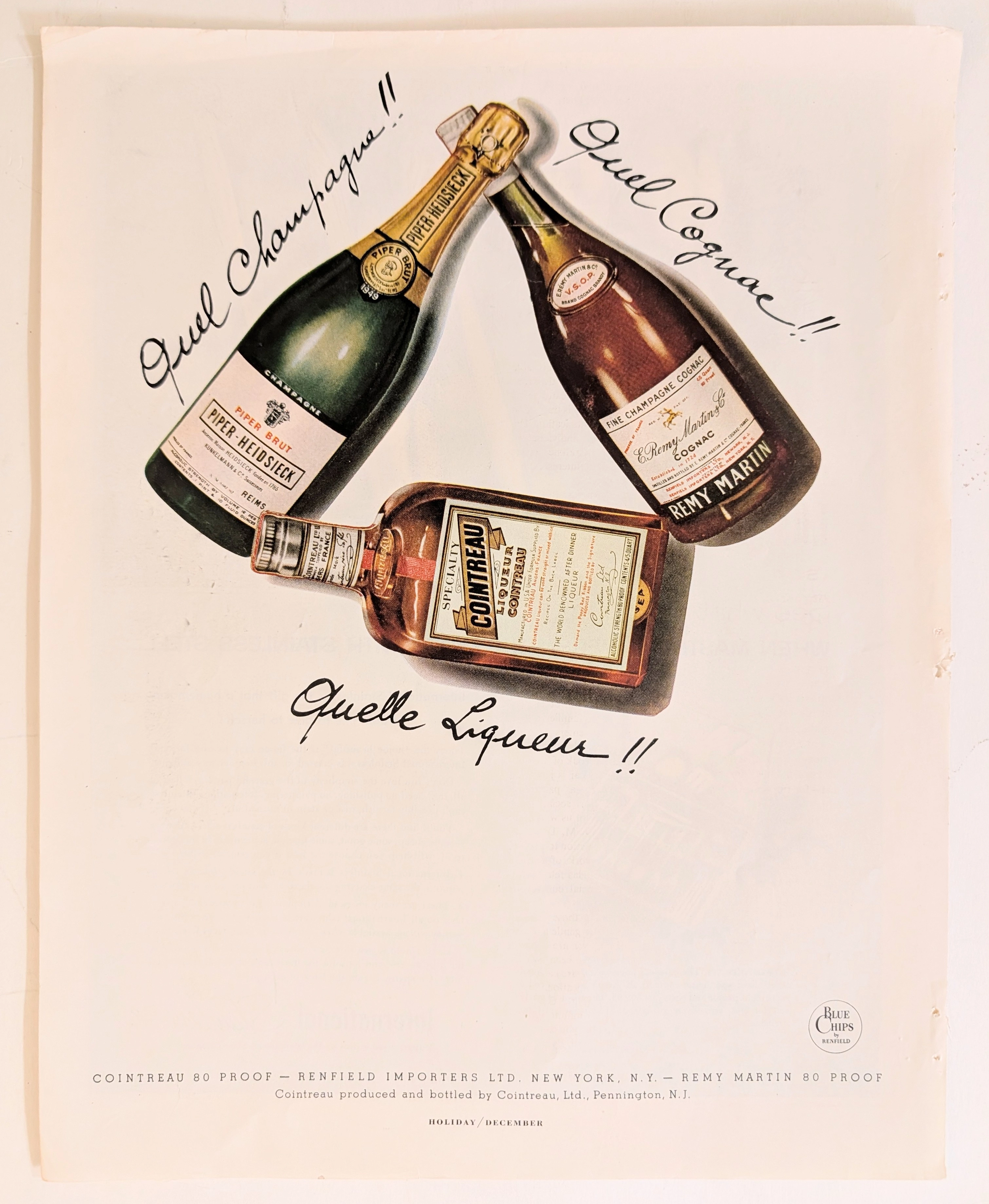
1950s Piper-Heidsieck, Remy Martin & Cointreau Vintage Advertisement
We chart human progress not just by the weapons we forge, but by the liquids we consume. Prior to the mid-twentieth century, luxury was bound by geography. The European aristocracy drank Champagne. The American working class drank beer and domestic whiskey. The ocean was a formidable barrier to the democratization of indulgence. Then came the post-war economic boom. A paradigm shift forged in surplus capital and a new global consciousness. This artifact is not merely a holiday advertisement. It is a documented socio-economic treaty. It is Renfield Importers declaring that European heritage could be commodified, imported, and utilized as social currency. The problem was a newly affluent American middle class desperate for cultural validation. The solution was the linguistic and physical importation of French sophistication, rebranded as a Wall Street asset.
Category: Beverage
The History
The Post-War Psychological Pivot The era is the mid-1950s. The theater is the American domestic landscape. The United States had emerged from the Second World War not just victorious, but economically dominant. The rationing of the 1940s was a fading memory. The industrial machine built for global warfare had pivoted to consumer goods. A massive, unprecedented middle class was born. They had suburban homes, they had televisions, and crucially, they had disposable income. However, wealth without pedigree often breeds insecurity. The newly affluent American consumer possessed the capital to purchase luxury, but lacked the historical framework to understand it. They were looking for instructions on how to be sophisticated. During the war, millions of American GIs had been exposed to European culture. They had seen Paris, they had tasted Cognac, they had walked through the vineyards of Champagne. Upon returning, there was a collective hunger to integrate that Old World elegance into the New World reality. The American market was primed for an influx of European heritage brands. But these brands could not be sold merely as beverages. They had to be sold as instruments of social elevation. This artifact captures the exact moment the advertising industry realized they were no longer selling alcohol; they were selling class identity. The Linguistic Passport Observe the primary copy framing the composition. "Quel Champagne!!" "Quel Cognac!!" "Quelle Liqueur!!" This is a highly deliberate, strategic use of foreign language. In the 1950s, French was the undisputed global language of diplomacy, gastronomy, and elite culture. By utilizing French exclamations—and ensuring grammatical accuracy with the feminine "Quelle" for Liqueur—the advertisement operates as a linguistic passport. It demands that the viewer step up to its level. It does not translate itself for the uneducated. Instead, it offers the American consumer a pre-packaged vocabulary of refinement. When the host served these bottles at a December holiday party, they were not just serving drinks. They were proving that they understood the nuances of the Continental lifestyle. The language acts as a barrier to entry, which makes the product infinitely more desirable. It transformed the act of buying liquor into an act of cultural acquisition. The "Blue Chip" Paradigm The most philosophically significant element of this artifact is the smallest. In the bottom right corner, a modest, circular seal reads: "BLUE CHIPS by RENFIELD." This is a profound shift in marketing psychology. In the financial sector, a "blue chip" refers to stock in a nationally recognized, well-established, and financially sound company. It implies safety, reliability, and guaranteed returns. Renfield Importers took a term from Wall Street and brutally applied it to European alcohol. This is the financialization of taste. By branding Piper-Heidsieck, Rémy Martin, and Cointreau as "Blue Chips," Renfield was bypassing the subjective nature of flavor. They were telling the consumer: You do not need to understand the terroir of the Cognac region. You do not need to understand the méthode champenoise. You only need to understand that buying these bottles is a safe investment in your social portfolio. If you serve these "Blue Chips" to your employer, your father-in-law, or your neighbors, your social return on investment is guaranteed. It removed the anxiety of choice for the newly rich. It commodified centuries of French viticulture into a standardized unit of American social security. The Illusion of Geography and The New Jersey Cointreau A close examination of the Cointreau bottle reveals the geopolitical realities of post-war commerce. The label reads: "MANUFACTURED IN USA UNDER FORMULA SUPPLIED BY COINTREAU ANGERS FRANCE." Below that, the producer is listed as: "Cointreau, Ltd., Pennington, N.J." This shatters the romantic illusion of the purely imported European luxury good. Importing heavy glass bottles filled with liquid across the Atlantic was astronomically expensive, heavily taxed, and logistically inefficient. To meet the explosive American demand, Cointreau executed a brilliant maneuver of globalized production. They exported the intellectual property—the formula, the orange peel ratios, the brand equity—but they localized the physical manufacturing in New Jersey. This is an early, highly successful instance of geographic decoupling in the luxury beverage sector. The American consumer believed they were drinking the spirit of Angers, France. In reality, they were drinking a meticulous reproduction engineered in a facility just outside of Trenton. The artifact documents the moment when a brand's aura became completely detached from its physical origin point. The name mattered more than the soil. The 1949 Vintage and The Reclaiming of the Earth The Piper-Heidsieck bottle prominently displays a neck label denoting the year: 1949. In the context of Champagne, a declared vintage is a rarity, reserved only for years of exceptional harvest. But the year 1949 carries an immense historical weight beyond agriculture. The Champagne region of France was devastated during World War II. Vineyards were destroyed, cellars were looted, and the earth was scarred by artillery. A 1949 vintage represents one of the first truly great harvests following the stabilization of Europe. It is the literal distillation of recovery. By the time this advertisement was printed in the mid-to-late 1950s (allowing for the aging and release of the '49 vintage), the bottle served as a quiet testament to survival. The earth that had recently absorbed the blood of global conflict was once again producing the ultimate symbol of celebration. The American consumer purchasing this bottle was buying a piece of the reclaimed European soil.
The Paper
Material Context: This artifact is printed on heavy, clay-coated magazine stock typical of premium American publications in the mid-1950s (such as Esquire, Holiday, or Town & Country). The clay coating provides a smooth, glossy finish designed specifically to prevent ink absorption and allow for high-fidelity photographic reproduction. We can estimate the weight at approximately 90 to 100 GSM. It is designed to feel substantial, mirroring the luxury of the products it advertises. Printing Pathology: The manufacturing process relies on advanced four-color rotary offset lithography (CMYK). A macro-level inspection reveals a remarkably tight halftone rosette pattern. The rendering of the glass reflections—the amber glow of the Cognac, the dark green of the Champagne bottle—requires precise ink trapping and registration. The printer successfully created the illusion of transparency and volume on a two-dimensional plane. Chronological Markers: The artifact exhibits minimal foxing, protected likely by the clay coating which acts as a barrier to oxygen. However, there is slight edge yellowing where the coating has degraded, exposing the underlying wood pulp to ambient light. The crispness of the black ink remains intact, locking the mid-century consumerist optimism in physical form.
The Rarity
Classification: Class A (High Cultural Documentation) Mid-century liquor advertisements are heavily circulated and widely preserved. However, this specific artifact transcends mere commercial ephemera due to the presence of the "Blue Chips by Renfield" seal and the Pennington, N.J. Cointreau label. It is an artifact of the exact moment Wall Street terminology merged with European luxury marketing. Its value is not defined by raw material scarcity, but by its utility as a sociological textbook. It is a primary source document capturing the mechanism of post-war social mobility, the globalization of intellectual property, and the psychological targeting of the new American middle class. It belongs in an archive analyzing the intersection of linguistics, economics, and consumer behavior.
Cite this article
- MLA
- Naodhinsuk, Ronin. “1950s Piper-Heidsieck, Remy Martin & Cointreau Vintage Advertisement.” The Record Institute, 11 April 2026, https://therecord.institute/journal/1950s-piper-heidsieck-remy-martin-cointreau-vintage-advertisement.
- APA
- Naodhinsuk, R. (2026, April 11). 1950s Piper-Heidsieck, Remy Martin & Cointreau Vintage Advertisement. The Record Institute. https://therecord.institute/journal/1950s-piper-heidsieck-remy-martin-cointreau-vintage-advertisement
- CHICAGO
- Naodhinsuk, Ronin. 2026. “1950s Piper-Heidsieck, Remy Martin & Cointreau Vintage Advertisement.” The Record Institute, April 11, 2026. https://therecord.institute/journal/1950s-piper-heidsieck-remy-martin-cointreau-vintage-advertisement.