Advertising in a Cigarette Pack: America's First Baseball Cards, 1887–1914
Before the baseball card was a collectible, it was an advertisement — a slip of printed card slipped into a cigarette pack to make a smoker buy the same brand twice. Between 1887 and 1914, American tobacco companies turned that slip into photographs, chromolithographs and coupon premiums, and children turned it into a hobby. The Library of Congress's Benjamin K. Edwards Collection preserves the whole arc.
The History
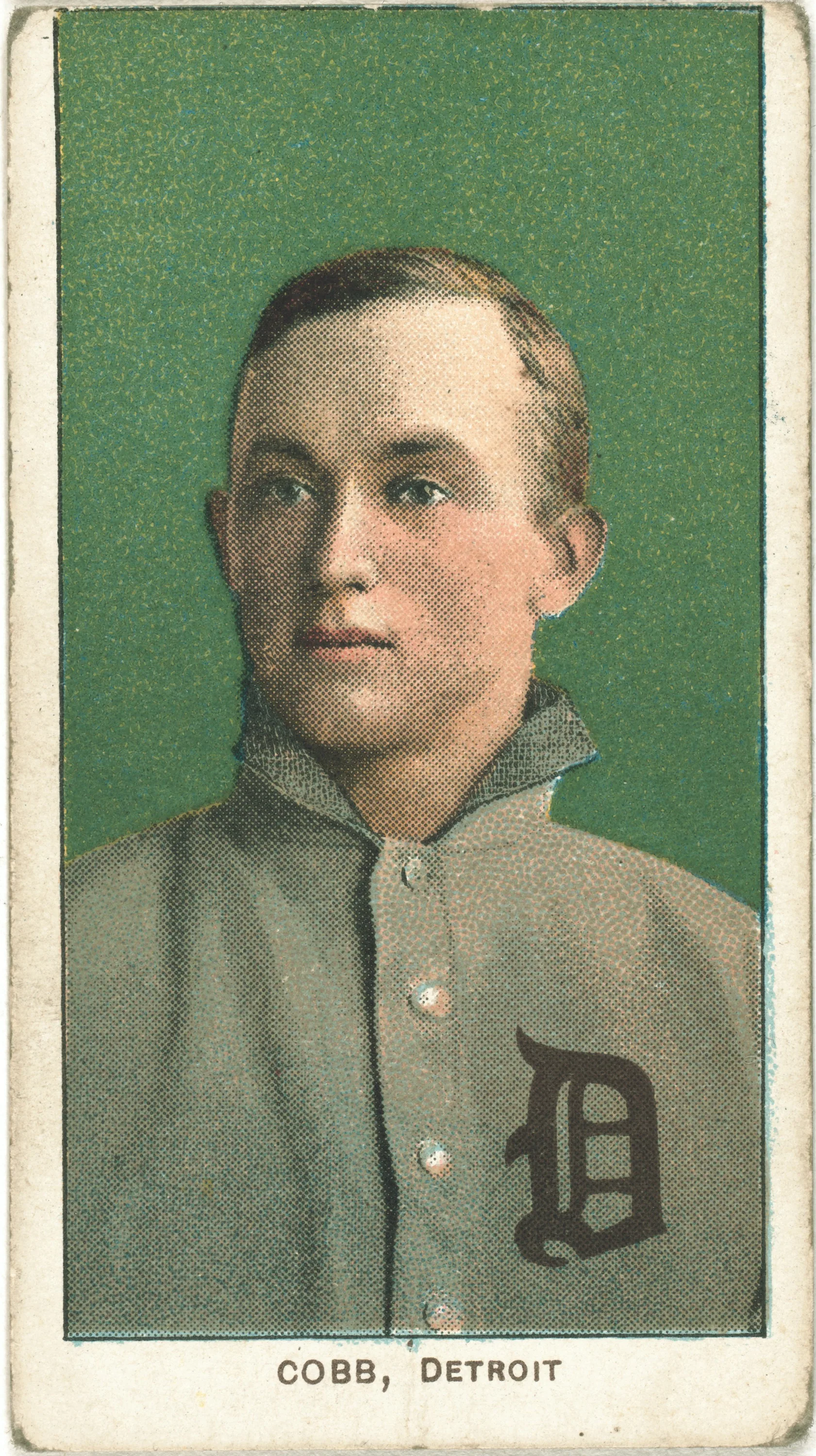
An advertisement you could hold in two fingers The baseball card did not begin as a keepsake. It began as a sales device: a small printed card placed inside a pack of cigarettes so that the next pack a smoker reached for would be the same brand as the last. The Library of Congress, whose Benjamin K. Edwards Collection holds some 2,100 baseball cards dated 1887 to 1914, is plain about the priority — the cards' primary function was advertising; stiffening the soft cigarette package was, at most, a secondary use that faded once more rigid "slide and shell" boxes arrived [S2]. The National Baseball Hall of Fame gives the stiffener role more weight [S7]. The two accounts are worth keeping side by side, because everything that followed — the photographs, the colour printing, the collecting — grew out of a piece of cardboard whose first job was to sell tobacco. Most of the cards are small, about 2⅝ by 1½ inches [S2]: a portrait on the front, and on the back — or, in the earliest years, on the front itself — the name of the product that paid for it. 1886–1890: photographs and chromolithographs Goodwin & Co. of New York began inserting cards into its Old Judge and Gypsy Queen cigarette packs in 1886, starting with players of the New York Giants; in 1887 the series expanded to every National League team and two American Association teams, and in 1888 further still, to minor-league teams and even an umpire. The Hall of Fame describes an 1888 poster advertising the Old Judge cards as evidence of "the first comprehensive set of trading cards depicting baseball players" [S7]. The Old Judge cards were not printed illustrations. They were albumen photographs — real photographic prints pasted onto card backing, each one measuring about 1½ by 2½ inches [S7]. The example reproduced here shows the era's most famous player-manager, Cap Anson of Chicago, photographed not in uniform but in a suit and polka-dot tie, his name hand-lettered across the image in white, with the brand held for the bottom edge: "Old Judge Cigarettes, Goodwin & Co., New York." The card carries its own small dating puzzle — the Library of Congress catalogues it to 1887, while the imprint printed on the card reads "Copyrighted by Goodwin & Co., 1888" [S8]. The Library's Old Judge holdings alone run to 476 prints covering more than forty major- and minor-league teams [S1]. Beside the photographs stood colour. Allen & Ginter of Richmond, Virginia, issued its World's Champions series in 1887 — described by the Library of Congress as "generally acknowledged as the first significant tobacco set issued" — in which ten baseball players appeared among sportsmen of six other sports [S1]. These were chromolithographs, and the advertising needed no back: John Clarkson's portrait carries the pitch on its face, his lace-up Boston jersey above the lines "Allen & Ginter's Cigarettes, Richmond, Virginia." The third technology of persuasion was size. The large cabinet cards — Goodwin's Old Judge Cabinets, about 4 by 6 inches — were never pack inserts. They were premiums: a buyer saved the coupon slips from cigarette packs, and twenty-five slips sent to Goodwin redeemed a cabinet of the buyer's choosing [S7]. Collecting, in other words, was not a side effect of the advertising. It was the mechanism of it. D. Buchner & Co. said so on the back of its Gold Coin cards in so many words: the pack would contain "the portraits of all the leading base ball players in the country, in full uniform," and the buyer was instructed to "continue to save the wrappers — they are valuable" [S8]. The first era ended in consolidation. Goodwin produced the Old Judge set until 1890, when it merged with Allen & Ginter, Kinney and Kimball to form the American Tobacco Company; the merged firm cut back its advertising, and the cards stopped [S7]. The quiet decade, and a new way to print Baseball cards largely disappeared during the 1890s [S6]. The Edwards Collection holds exactly one set from the decade, and it marks a technical turning point: Mayo's Cut Plug of 1895, whose portrait of pitcher Amos Rusie — the card misspells him "Russie" — is a photomechanical print, a halftone image worked with stencil colour [S1][S8]. It also changed the vehicle: Mayo's cards were distributed in tins of chewing tobacco, not cigarette packs [S2]. The halftone screen visible in the Rusie portrait is the same technology that would carry the far larger second era — the photograph no longer needed to be a photograph; it needed to be printable, cheaply, by the million. 1907–1914: the trust, the white borders, and the flood The second great era was a decision of the tobacco trust. In 1907 the American Tobacco Company, under George Washington Hill, revived pack inserts, premiums and coupons, a move the Smithsonian's National Postal Museum credits with "ushering in the second great era of American tobacco cards" [S5]. The timing was not innocent: in 1904–1910 the companies of the trust produced 88 percent of America's cigarettes, 75 percent of its smoking tobacco and 90 percent of its snuff, and the federal government had sued it under the Sherman Act in 1907 [S5]. In 1909, just after the 1908 season, the white-border set now catalogued as T206 appeared — "the defining set of the twentieth century," in the Postal Museum's judgement [S5][S6]. Its scale is still argued over in the sources themselves: the Postal Museum counts 523 cards issued between 1909 and 1911, the Library of Congress "nearly 525 color portraits" [S5][S1]. One card went into each pack, and the backs rotated through sixteen of the trust's brands — Sweet Caporal, Piedmont, American Beauty, Carolina Brights, El Principe De Gales among them — so that completing a set meant staying loyal across a portfolio of cigarettes [S5]. The images were printed by the American Lithographic Company of New York in layers of colour over photographic originals, portraits drawn from Carl Horner's photographs and action poses from Charles M. Conlon's, using high-quality dyes imported from Germany [S5]. Up close, the Ty Cobb portrait reproduced here shows the construction plainly: a young Cobb against a flat green field, his face built from the coarse dot screen of relief-and-halftone printing. The trust did not keep its monopoly. On 16 May 1911 the Supreme Court ruled the American Tobacco Company in restraint of trade; on 16 November 1911 it was broken up, Liggett & Myers taking 28 percent, P. Lorillard 15 percent and the rump American Tobacco 37 percent [S5]. Once the dissolution was finalised in 1912, the successor companies all advertised aggressively, with premium coupons and elaborate sets exploiting the new halftone reproduction [S6] — Frank Baker's Gold Borders of 1911, the hand-coloured Turkey Red cabinets redeemed by coupon the same year, the Brown Backgrounds of 1912 with player biographies printed on their backs, and finally the Fatima cards of 1913–14: gelatin silver photographs again, real photographic prints in the pack a quarter-century after Goodwin's albumen Old Judges [S1][S8]. Candy had already joined tobacco. The Nadja Caramel Company's 1910 set covered a single team, the champion Philadelphia Athletics — Eddie Collins's card among them — and was distributed with candy caramels rather than tobacco [S1]. The familiar gum card belongs to a later revival, the Goudey Gum Company of the early 1930s, beyond the years this collection covers [S5]. The children who kept them The promotion was aimed, in large part, at children. Allan Brandt's history of the cigarette century, quoted by Smithsonian Magazine, identifies children as the principal target of the collecting promotions; boys waited outside saloons and tobacco shops for cards, traded them, rescued discarded ones and took them from their parents' packs [S6]. The contemporary press noticed. In December 1888 the New York Times observed that manufacturers offered "premiums that enticed boys to excessive cigarette smoking"; in November 1895 the Ohio Democrat reported a boy named Willie Dreyfus buying and selling cigarette pictures at twenty-five cents per hundred, with special pictures fetching a cent apiece [S6]. It is because children saved them that the cards survive at all. Benjamin K. Edwards kept his in albums, alongside more than 12,000 other cards — actors, presidents, automobiles and aeroplanes, flags and flowers. After his death his daughter gave the albums to the poet Carl Sandburg, who donated them to the Library's Prints & Photographs Division in June 1954. The collection pictures more than a thousand major- and minor-league players, thirteen leagues and seventy-five cities in the United States and Canada [S2]. The Library notes a further function the cards served in their own time: before wire services and television, they were the only visual images many fans ever saw of most players [S2]. One name is missing, and the absence is itself a fact of the collection: there is no Honus Wagner card here, and no Babe Ruth — the two most famous names in the hobby stand outside the Edwards albums entirely [S2]. The collector who numbered them The codes used throughout this article — N28, N172, T206, E104 — are not the Library's invention. They descend from Jefferson Burdick, described by the Hall of Fame as "a pioneer in card collecting," who catalogued the Old Judge set in his American Card Catalog as N172: the N stood simply for "Nineteenth Century," and 172 was a reference number [S7]. More than 4,500 distinct Old Judge cards have since been identified, an estimate the Hall of Fame attributes to PSA [S7]. An advertising throwaway had acquired, within two generations, a taxonomy, a literature and a national archive. What the record does not tell us should be said plainly: no print-run figures for these sets survive in the sources consulted, so the cards' survival cannot be converted into numbers, and the prices the most famous examples command today belong to a different article. What can be said is visible on the cards themselves. A portrait on the front; a product on the back; and, in the space between the two, the invention of the collectible. References / Sources [S1] Library of Congress — Baseball Cards collection. https://www.loc.gov/collections/baseball-cards/ [S2] Library of Congress — About this collection: the Benjamin K. Edwards Collection. https://www.loc.gov/collections/baseball-cards/about-this-collection/ [S5] Stephen Wong, Smithsonian National Postal Museum — the T206 / Honus Wagner card. https://postalmuseum.si.edu/t206-honus-wagner-psa-5-baseball-card [S6] Peter Devereaux, Smithsonian Magazine (18 April 2024), excerpting Game Faces (Smithsonian Books, 2018). https://www.smithsonianmag.com/blogs/smithsonian-books/2024/04/18/how-the-tobacco-industry-lured-customers-with-baseball-cards/ [S7] Matthew Carter, National Baseball Hall of Fame — "#Shortstops: Judging Baseball Cards." https://baseballhall.org/discover/shortstops/judging-baseball-cards [S8] Library of Congress — item records for the twelve cards discussed.
Cite this article
- MLA
- Naodhinsuk, Ronin. “Advertising in a Cigarette Pack: America's First Baseball Cards, 1887–1914.” The Record Institute, 6 November 2026, https://therecord.institute/journal/advertising-in-a-cigarette-pack-americas-first-baseball-cards-18871914.
- APA
- Naodhinsuk, R. (2026, November 6). Advertising in a Cigarette Pack: America's First Baseball Cards, 1887–1914. The Record Institute. https://therecord.institute/journal/advertising-in-a-cigarette-pack-americas-first-baseball-cards-18871914
- CHICAGO
- Naodhinsuk, Ronin. 2026. “Advertising in a Cigarette Pack: America's First Baseball Cards, 1887–1914.” The Record Institute, November 6, 2026. https://therecord.institute/journal/advertising-in-a-cigarette-pack-americas-first-baseball-cards-18871914.