Fight or Buy Bonds: The War Bond Posters of Two World Wars
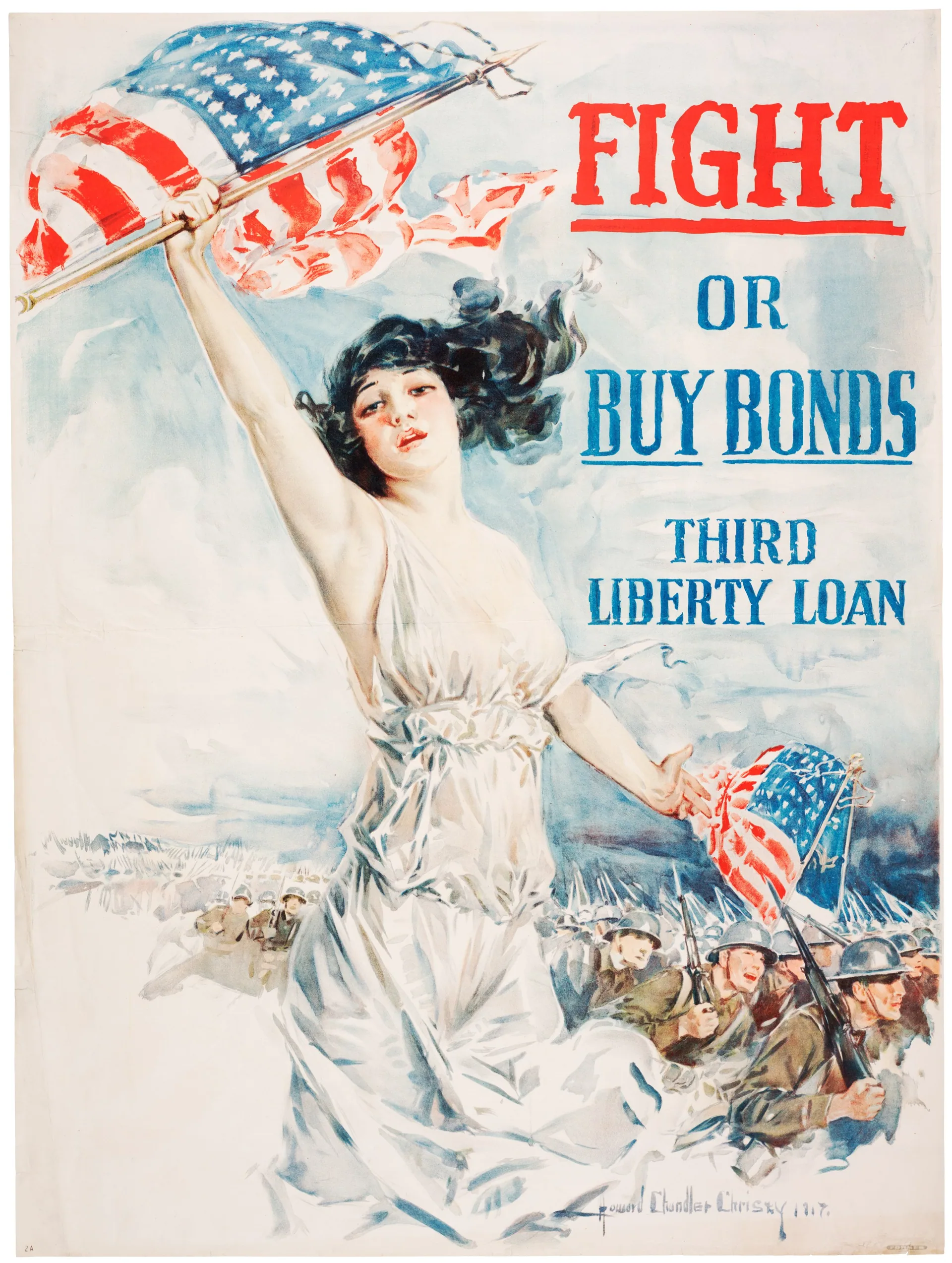
Twice in one generation, the United States paid for a world war by asking its citizens to lend — and both times it made the request on paper, in colour, on walls. Nine sheets from the National Archives follow the bond poster across both wars: Howard Chandler Christy's Columbia offering the stark choice of the Third Liberty Loan, Henry Patrick Raleigh's mother looking back over her shoulder, Charles Alston's cartoon bombs lettered with the names of the drives themselves, and a Gold Star mother whose three framed sons close the argument more quietly, and more completely, than any slogan.
The History
### The loan on the wall A war bond is a loan the citizen makes to the state, and a bond poster is that loan given a face. Twice in one generation the United States financed a world war this way — not only through banks and taxes, but through millions of small lenders recruited in public — at the post-office window, the factory gate, the theatre door. The recruiting sergeant was paper. Nine sheets in the National Archives, four from the First World War and five from the Second, preserve the full grammar of the appeal: the allegory, the atrocity, the soldier's challenge, the cartoon, the pay-packet pledge — and, at the end of the argument, a mother holding three framed photographs. ### 1917–1918: citizens into creditors The form was invented in 1917. Secretary of the Treasury William G. McAdoo chose to borrow the war's cost from the public, and the Liberty Loans were built to be bought by anyone: denominations ran as low as 50 dollars, and a bond could be paid for in installments, like furniture [S3][S4]. Four drives in 1917 and 1918 raised more than 17 billion USD; a fifth, the Victory Loan of 1919, carried the programme past 21 billion USD, and about twenty million Americans — in a nation of one hundred million — ended the war as their government's creditors [S3]. The posters had to make a financial instrument feel like an enlistment, and the four sheets in the Food Administration's poster file show the campaign learning how. Howard Chandler Christy's Columbia — young, in white drapery, the great flag held aloft and the infantry advancing at her hem — states the Third Liberty Loan as a fork in the road: "Fight or Buy Bonds" [S1][S5]. Christy signed and dated the plate 1917, ahead of the drive it served the following spring; there is no third option on the sheet. Lending, here, is simply fighting by other means. ### The darker register The other three sheets argue harder. Ellsworth Young's "Remember Belgium", for the Fourth Liberty Loan of autumn 1918, is all silhouette: on a flat green ground a spiked-helmet soldier drags a woman away, flames rising behind them, the whole indictment carried by two black shapes [S1][S2]. Henry Patrick Raleigh's "Hun or Home?" works in charcoal smudge — a mother clutching her children looks back over her shoulder at the soldier looming behind her, a fallen figure at the frame's edge [S1][S6][S7]. And Walter Whitehead, his plate signed and dated 1918, gives the home front a soldier's dare: a bloodied infantryman stands astride his fallen enemy, bayonet fixed, and calls out "Come On!" — the footline completing the thought in orange: "buy more Liberty Bonds" [S1]. Read together, the four divide the labour of persuasion. Christy offers honour, Young and Raleigh offer fear — of an enemy whose crimes in Belgium were the first war's defining story, carried to the American doorstep — and Whitehead offers shame: the man at the front has done his part of the bargain, and the sheet asks, from a wall in Ohio or Oregon, whether the reader has done theirs. ### 1941–1945: the loan becomes a system The second war industrialised what the first had improvised. The Series E bond went on sale on 1 May 1941 — Secretary Henry Morgenthau Jr. sold the first one to President Roosevelt — as a Defense Bond; after Pearl Harbor it was renamed the War Bond [S8][S9]. Its smallest denomination put the Treasury within everyone's reach: a 25-dollar bond sold for 18.75 dollars and matured to its full face in ten years, and one sheet in this set shows that certificate, made out to "John Doe", held in a gloved hand [S2][S9]. Above all, the sale never stopped: the Payroll Savings Plan carried the bond into the pay packet itself, a deduction pledged in advance, while eight War Loan drives between November 1942 and December 1945 supplied the crescendos [S8]. The drives raised more than 156 billion USD; the campaign as a whole sold 185.7 billion USD of securities to more than 85 million Americans — the Treasury's own history calls it unmatched, before or since [S8]. ### Back the attack The Third War Loan, in September 1943, was the system's showpiece: a goal of 15 billion USD, met and passed with sales of almost 19 billion, in a month when Kate Smith raised 39 million USD in a single day of bond broadcasting [S8]. Its slogan survives on two of these sheets. The printed poster shows the attack from underneath: a paratrooper landed, weapon ready, beneath a sky so full of descending canopies that the invasion seems to have happened overhead [S2]. The second sheet is not a poster at all but Charles Alston's original cartoon for the Office of War Information — signed "Alston", with "OWI" written beneath — in which the drives themselves become the ordnance: three bombs lettered FIRST, SECOND and THIRD WAR LOAN DRIVE fall toward two Axis leaders clinging to a rock while a third drowns beside them [S2][S10]. Alston, employed by the OWI to draw for the Black press, made more than a hundred cartoons; here his joke carries the campaign's real arithmetic — each drive another bomb, bought by subscription [S10]. ### The factory wall The last three sheets were made not for the street but for the plant. They belong to the War Production Board's poster series of 1942–1943, printed for the walls of the factories building the weapons [S2]. One sends a beaming Uncle Sam to the bench, cradling a money bag while a cartoon sailor points from his shoulder: "Don't Let Him Down! Buy War Bonds — Back up our Battleskies!" Another shows the payroll pledge itself — a gloved hand tipping wages and a bond down into the battleship below — under the order "Beat the Promise!": beat, that is, the quota of pay the plant had pledged [S2]. The third abandons cheer altogether. It is a photograph: an older woman in black holding three framed portraits of sons in naval uniform, billed by the sheet as America's first three-Gold-Star mother. "Her boys will not return", it says, and then asks the only question the whole campaign ever really asked: "Is any sacrifice of ours too much!" ### What the file kept The posters were printed to shout for a season and be pasted over. What kept them is filing: the First World War sheets survive because one agency kept another's campaign in its poster file, and the Second World War's because the bureaucracies of persuasion archived their own output, down to a cartoonist's pencil original [S1][S2]. A reader comparing the plates will notice one accident of that filing — the "Back the Attack" poster survives in the Archives' digital file only at small size, where its companions are large — and the readings above are taken from the file copies exactly as they stand. The loans themselves were long ago repaid. The paper that sold them, asking every passer-by to become a creditor of the republic, is still on duty. ### References / Sources [S1] National Archives and Records Administration, Catalog records NAID 512621, 512441, 512664, 512644, and series record NAID 512439, "World War I Posters" (Record Group 4) — titles, local identifiers 4-P-183/-2/-226/-206, coverage dates, restriction statuses, and the series scope. [S2] National Archives and Records Administration, Catalog records NAID 513920 (44-PA-451, RG 44), NAID 535644 (208-COM-131, RG 208; scope note "Incentive to buy war bonds"), and NAID 534106, 534065, 534076 (179-WP-257/-216/-227, RG 179, series "War Production Board", 1942–1943) — titles, local identifiers, dates, restriction statuses. [S3] Federal Reserve History, essay on the Liberty Loans — four wartime drives raising more than 17 billion USD, about twenty million purchasers, the 1919 Victory Loan carrying the programme above 21 billion USD, and the drives' dates. [S4] "Turning Citizens into Investors: Promoting Savings with Liberty Bonds During World War I", RSF: The Russell Sage Foundation Journal of the Social Sciences (2016) — denominations as low as 50 dollars, installment purchase, the volunteer seller army. [S5] Brigham Young University Museum of Art, collection note on Howard Chandler Christy (1873–1952), "Fight or Buy Bonds, Third Liberty Loan", 1917, offset lithograph. [S6] Detroit Institute of Arts, collection record F82.269 — Henry Patrick Raleigh (1880–1944), "Hun or Home? Buy More Liberty Bonds", 1918; printer Edwards & Deutsch Litho. Co., Chicago. [S7] Australian War Memorial, collection records ARTV00177, ARTV01318, ARTV02117 — "Hun or home? Buy more liberty bonds", maker Henry P. Raleigh, Division of Pictorial Publicity. [S8] Duke University Libraries, Ad*Access guide "Loans & Bonds", drawing on the Treasury War Finance Committees' history — the first Series E bond sold 1 May 1941; eight War Loan drives raising more than 156 billion USD; 185.7 billion USD of securities sold in total; more than 85 million American investors; the Third War Loan's 15 billion USD goal, almost 19 billion USD in sales, and Kate Smith's 39 million USD broadcast day, 21 September 1943. [S9] "Series E bond", reference summary of the Treasury programme — Series E sold at 75 percent of face value (18.75 dollars for a 25-dollar bond, redeemable at full face after ten years); Defense Bonds renamed War Bonds after Pearl Harbor. [S10] Smithsonian Magazine, "This African American Artist's Cartoons Helped Win World War II" (2017), reporting the National Archives' account — Charles Alston (1907–1977) employed by the Office of War Information to produce more than one hundred drawings for the Black weekly newspapers.
Cite this article
- MLA
- Naodhinsuk, Ronin. “Fight or Buy Bonds: The War Bond Posters of Two World Wars.” The Record Institute, 11 November 2026, https://therecord.institute/journal/fight-or-buy-bonds-the-war-bond-posters-of-two-world-wars.
- APA
- Naodhinsuk, R. (2026, November 11). Fight or Buy Bonds: The War Bond Posters of Two World Wars. The Record Institute. https://therecord.institute/journal/fight-or-buy-bonds-the-war-bond-posters-of-two-world-wars
- CHICAGO
- Naodhinsuk, Ronin. 2026. “Fight or Buy Bonds: The War Bond Posters of Two World Wars.” The Record Institute, November 11, 2026. https://therecord.institute/journal/fight-or-buy-bonds-the-war-bond-posters-of-two-world-wars.