Food Will Win the War: The Posters of the U.S. Food Administration, 1917–1918
America entered the First World War in April 1917 with an army to feed, allies to supply, and a Food Administrator who refused to print a single ration card. Herbert Hoover's U.S. Food Administration fought instead with paper: pledge cards, window displays, and posters by Edward Penfield, Harvey Dunn, Charles Livingston Bull and Charles E. Chambers — in English, and in the languages of the immigrants it asked to save the wheat. Five posters from the Library of Congress show the gentlest persuasion machine the United States ever built.
The History
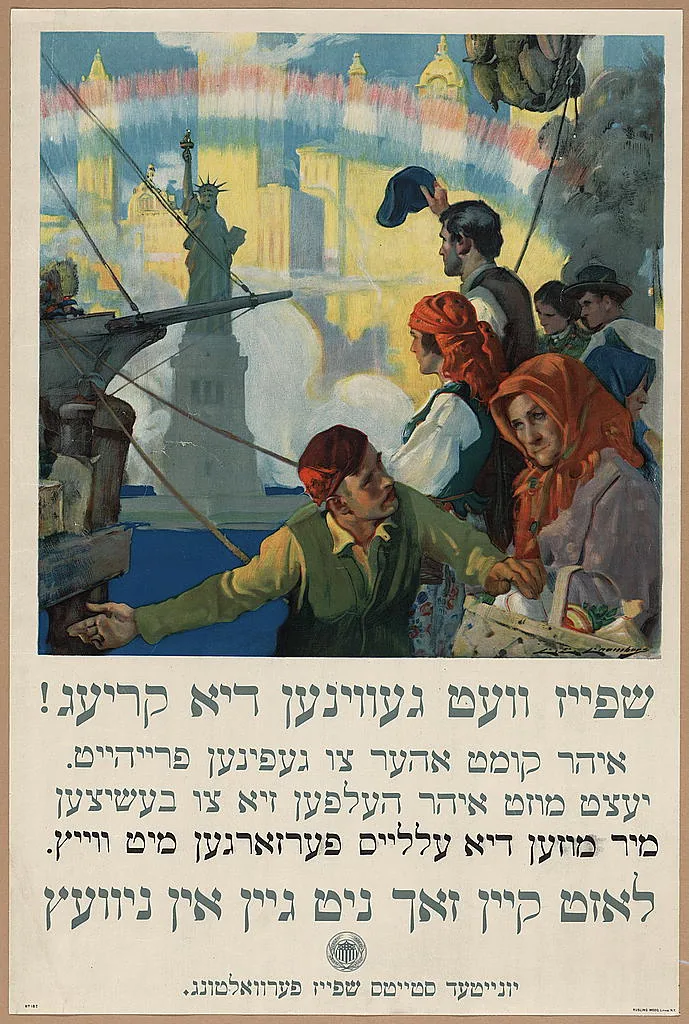
### A war declared on the dinner table When the United States entered the First World War in April 1917, its problem was not only soldiers. The Allied armies and the civilian populations behind them were fed, in large part, from American farms — and every bushel of wheat eaten carelessly in Chicago was a bushel that did not reach a trench in France. On 10 August 1917, under the Food and Fuel Control Act — the Lever Act — President Wilson signed Executive Order 2679-A and created the United States Food Administration, with Herbert Hoover as Food Administrator [S1][S3]. Hoover, who had organised the relief of occupied Belgium in 1914–15, understood food as logistics and morale at once. What he refused to do is as famous as what he did: America would have no ration cards. Conservation would be voluntary, enforced by publicity — by posters, pamphlets, pledge cards and window displays, distributed, in the Archives' phrase, to enroll the nation in a "food conservation army" [S3]. The five posters gathered here, all held by the Library of Congress with no known restrictions on publication [S2], are that army's recruiting prints. Between them they cover the whole strategy: save wheat, eat substitutes, waste nothing — and understand exactly whom your saving feeds. ### The machine: pledges, days, and a new verb The Administration's week was reorganised by poster and proclamation: meatless Tuesdays, wheatless Mondays and Wednesdays, porkless Saturdays — a porkless Thursday joined the list when the rules were tightened in January 1918 — the schedule adjusted as the campaign developed [S4]. Households signed a pledge card and displayed it in the window — the card itself a piece of printed ephemera, a badge of compliance the neighbours could audit at a glance. By November 1917 more than four million families had enrolled [S5]; American food shipments to the Allies doubled within a year, and household consumption in the United States fell by roughly fifteen percent between 1918 and 1919 [S4]. The campaign even minted a verb: to "Hooverize" was to save food, and the word reached the dictionary [S5]. The National Archives' own teaching materials, built from these same posters, present the campaign as the moment the federal government learned to speak directly to the kitchen [S6]. It is worth pausing on the means. The posters were not decoration for the campaign; in a country without rationing, they were the campaign — the entire enforcement mechanism of a continental food policy, printed in colour and pasted on walls. ### Five posters, five arguments Charles E. Chambers' "Food will win the war" (1917) is the campaign's thesis, and the copy preserved here is its most eloquent printing. The image shows immigrant families on the deck of an arriving ship, gazing at the Statue of Liberty and a New York skyline rendered as a city of gold. The text beneath, in the English original, reads: "You came here seeking freedom — you must now help to preserve it. Wheat is needed for the allies. Waste nothing." In this edition the words are set in Yiddish: the Administration printed its appeal in the languages of the people it addressed, and it addressed the newest Americans as debtors of freedom, honour-bound to repay in wheat. It is a remarkable piece of statecraft to find on a poster — persuasion that begins by telling the immigrant that the country is already his. Edward Penfield's "Will you help the women of France? Save wheat" (1918) makes the same debt visible. Three French women in headscarves are harnessed in chains to a plough, bent double over stony ground, doing the work of horses that war has taken. Penfield — the dean of the American magazine poster, whose Harper's covers had defined the 1890s — signed the sheet in the plate, lower left, and set the Administration's shield at the right like a seal. The poster asks its question of American women specifically: the saving was to be done by the people who cooked, and its image is of the people who, in France, were starving at the plough instead. Harvey Dunn's "They are giving all — Will you send them wheat?" (1918) closes the circuit. Dunn, an illustrator who went to the front as an official artist, draws American infantry climbing out of a snowy trench, rifles at the slope, into weather and fire. Below, in red capitals, the exchange is stated without ornament: they give everything; you are asked for wheat. The W. F. Powers Company of New York lithographed the sheet — the same commercial trade that printed theatre posters in peacetime [S2]. The remaining two posters work the quieter half of the doctrine: substitution. Charles Livingston Bull, the most celebrated American wildlife artist of his generation, painted golden fish suspended among green water plants for "Save the products of the land — Eat more fish — they feed themselves". The argument is pure Hoover: fish need no fodder, no pasture, no wheat; every fish eaten is land-food freed for export. And the campaign's arithmetic is reduced to a single gesture in the two-colour sheet signed with the monogram FGC, "Save a loaf a week — help win the war" (1917) : a hand, a knife, a loaf. One loaf, per household, per week — multiplied by a hundred million people, a harvest. ### What the paper did — and what it could not The voluntary system worked, by the measures its own administrators kept: shipments doubled, consumption fell, and the Allies were fed through the last year of the war [S4]. It also had a term. The Food Administration's enforcement powers were largely ended by proclamation on 1 January 1919, weeks after the Armistice [S3] — a persuasion machine switched off almost as quickly as it had been built. A generation later the machinery returned, centralised and numbered, in the Office of War Information's poster programme; the rhyme is exact enough that the Second World War's OWI Poster No. 58 is titled, simply, "Food Is a Weapon" — the subject of the Institute's companion record from the National Archives' 44-PA series. What survives of Hoover's gentler war is the paper: pledge cards in family Bibles, window cards in shopkeepers' albums, and posters like these five — state documents that were designed to be looked at for a season and thrown away, and that now carry the whole strategy of a government that chose, once, to ask rather than to compel. ### References / Sources [S1] Executive Order 2679-A and the Food and Fuel Control (Lever) Act, 10 August 1917; National Archives description of the U.S. Food Administration. [S2] Library of Congress, item records LOC 2002720472, 2002719421, 2002709049, 2002708881, 2002708923 — catalogue data and rights advisories ("No known restrictions on publication"). [S3] National Archives, U.S. Food Administration agency history (voluntary agreements, licensing system, pledge campaign, end of enforcement 1 January 1919). [S4] Scott County Historical Society, "Food Will Win The War" (2017) — conservation days; doubled shipments; consumption decline 1918–19. [S5] Buschman, N. O., "The United States Food Administration During World War I" (Auburn University thesis, 2013) — four million families enrolled by November 1917; "Hooverize". [S6] Simmons, L., "Sow the Seeds of Victory! Posters from the Food Administration during World War I", National Archives and Records Administration, 2000.
Cite this article
- MLA
- Naodhinsuk, Ronin. “Food Will Win the War: The Posters of the U.S. Food Administration, 1917–1918.” The Record Institute, 10 November 2026, https://therecord.institute/journal/food-will-win-the-war-the-posters-of-the-us-food-administration-19171918.
- APA
- Naodhinsuk, R. (2026, November 10). Food Will Win the War: The Posters of the U.S. Food Administration, 1917–1918. The Record Institute. https://therecord.institute/journal/food-will-win-the-war-the-posters-of-the-us-food-administration-19171918
- CHICAGO
- Naodhinsuk, Ronin. 2026. “Food Will Win the War: The Posters of the U.S. Food Administration, 1917–1918.” The Record Institute, November 10, 2026. https://therecord.institute/journal/food-will-win-the-war-the-posters-of-the-us-food-administration-19171918.