"Pilgrim Treasures Discovered": The Face and the Hand in The Literary Digest (1920)
Published during the 1920 Mayflower tercentenary, this magazine leaf distills fresh Dutch archival scholarship for a mass American audience. Through a rare life portrait and a newly authenticated signature, it captures a culture hungry for physical proof of its founding myths.
The History
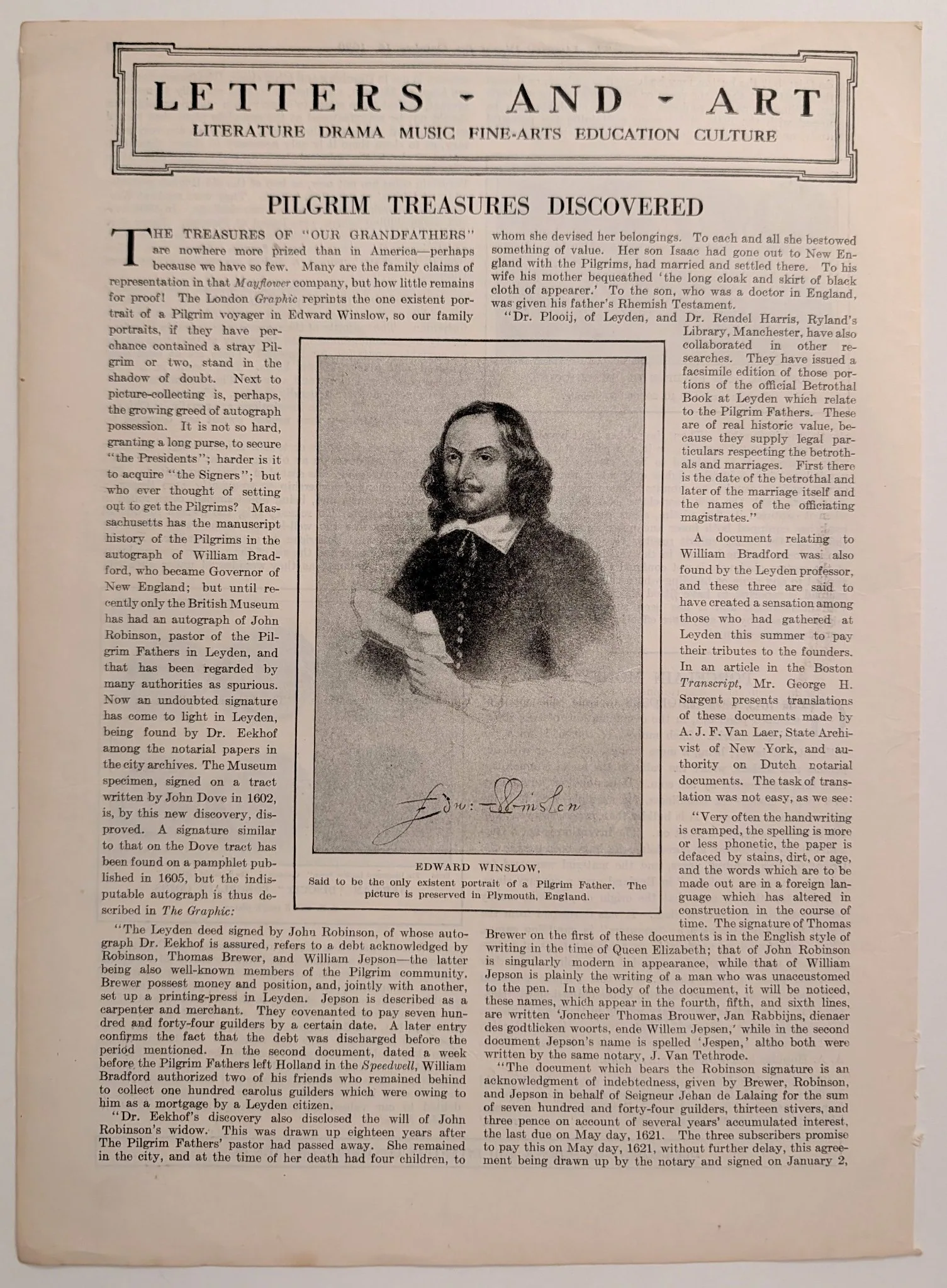
In the autumn of 1920, the United States was gripped by the tercentenary of the Mayflower voyage. Three hundred years had passed since the 1620 crossing, and the American public, increasingly invested in the narratives of its origins, sought tangible connections to the Pilgrim Fathers. Yet, as the October 16, 1920 issue of The Literary Digest noted in its "Letters and Art" section, there was a profound scarcity of physical traces. The article, headlined "Pilgrim Treasures Discovered," opens by acknowledging the American "greed of autograph possession" before lamenting just "how little remains for proof!" In an era defined by mass-circulation print culture, this single magazine tear sheet served as a transmission belt, converting fresh, specialized European archival scholarship into popular history for a broad weekly readership. The artifact presents two primary modes of historical authentication: a face and a hand. The face belongs to Edward Winslow (1595–1655), a Mayflower passenger, diplomat, and later governor of Plymouth Colony. The article features a prominent halftone photomechanical reproduction of Winslow, depicting him in a dark doublet and a white falling band collar, his long hair framing a severe, commanding expression. The original portrait was painted in London in 1651 by an unknown English artist, often attributed to the School of Robert Walker. Winslow had been joined in London by his son Josiah. Today, the painting is held by the Pilgrim Hall Museum in Plymouth, Massachusetts — which describes itself as the oldest continuously operating public museum in the United States, established in 1824. The museum describes the painting as "the only likeness of a Pilgrim made from life," a claim that echoes the 1920 article's caption: "Said to be the only existent portrait of a Pilgrim Father." A close reading of the 1920 caption reveals a plain error. The Literary Digest asserts that "The picture is preserved in Plymouth, England" — yet the portrait was already at Pilgrim Hall in Plymouth, Massachusetts by the late nineteenth century, documented in the Pilgrim Hall catalogue and noted in an 1865 Winslow family genealogy. The caption stands as a static artifact of the tercentenary moment, reflecting both the transatlantic circulation of the image — which the text notes the London Graphic reprints — and the period press's occasional carelessness with fact. If Winslow's portrait provides the face of the Pilgrims, the Leiden discoveries provide the hand. The body of the article shifts its focus to the Netherlands, reporting on "this summer" commemorations and recent archival triumphs in Leiden (spelled Leyden in the text), where the Pilgrims had lived before their voyage. The piece details the unearthing of a 1621 notarial deed bearing the signature of Reverend John Robinson, the pastor of the Pilgrim Fathers. This document, described as a debt acknowledgment for the sum of 744 guilders, 13 stivers, and 3 pence by Brewer, Robinson, and Jepson, was reportedly discovered among notarial papers in the Leiden city archives by the Dr. Eekhof named in the article. Alongside this deed, the article reports the discovery of the 1643 will of Robinson's widow, drawn up eighteen years after the pastor's death. These discoveries were not isolated events but part of a broader scholarly mobilization surrounding the tercentenary. The article highlights a facsimile edition of the Leiden Betrothal Book portions relating to the Pilgrims, issued by Dr. Daniel Plooij, a Leiden scholar, and J. Rendel Harris of the John Rylands Library in Manchester. Harris, a noted biblical scholar, would go on to co-author The Pilgrim Press with Stephen K. Jones in 1922, a work featuring contributions from Dr. Plooij. The transmission of these Dutch discoveries to the American public was facilitated by A. J. F. Van Laer, whose translations of the documents were presented by George H. Sargent in the Boston Transcript. Van Laer (1869–1955) was a pivotal figure in early American archival science. Serving as the archivist at the New York State Library, he was the preeminent translator and editor of Dutch-language New Netherland documents. His dedication to the physical record was legendary; in March 1911, according to the New York State Museum, he raced into the burning New York State Library and rescued numerous manuscripts from the fire. His involvement lent the Leiden discoveries an unimpeachable scholarly weight in the American press. Fascinatingly, the Literary Digest article frames these new discoveries not merely as additions to the historical record, but as necessary corrections. The text notes that a signature of John Robinson, previously accepted as authentic and housed on a 1602 John Dove tract in the British Museum, had been disproved by the newly found Leiden deed. This demonstrates early-twentieth-century popular media engaging in provenance correction in public. Skepticism is treated as a virtue; the unearthing of the true signature necessitates the discarding of the false relic. The magazine presents its readers with the mechanics of historical validation, where paper trails and comparative handwriting analysis overrule institutional assumptions.
The Paper
The physical artifact is a single leaf, exhibiting the distinct characteristics of early-twentieth-century mass-market periodical printing. The substrate is a cream-colored, aged magazine paper, showing light toning particularly at the edges, a natural result of the wood-pulp paper's oxidation over a century. The leaf comes from the magazine's interior; the paper's slight translucency is typical of the period's magazine paper stock. The layout utilizes a multi-column format, standard for The Literary Digest, framed at the top by a double-ruled art-nouveau border that encapsulates the department heading: "LETTERS - AND - ART", with the subtitle "LITERATURE DRAMA MUSIC FINE-ARTS EDUCATION CULTURE". The primary visual element, the halftone reproduction of the Winslow portrait, relies on a grid of tiny ink dots to simulate continuous tone, a photomechanical process that revolutionized the inclusion of photographs and fine art in affordable weekly magazines.
The Rarity
Rarity Class: C (Uncommon). Condition: Very Good — light edge toning consistent with age; no major tears or text loss visible; halftone portrait remains distinct. As a product of The Literary Digest, which enjoyed massive circulation during its run from 1890 to 1938, published by Funk & Wagnalls for most of that span (until 1937), this physical page is not inherently unique. Complete bound volumes of the 1920 issues survive in numerous institutional libraries and private collections. However, as an isolated tear sheet, its survival is contingent on the specific interests of past readers who chose to excise and preserve it. Single leaves featuring the Edward Winslow portrait and discussing the tercentenary Leiden discoveries hold a niche collectibility for those focused on Pilgrim historiography, early American portraiture, or the history of archival science. Given the high original print run but the inherent fragility of the magazine paper medium, this artifact is best classified as uncommon rather than exceedingly rare.
Cite this article
- MLA
- Naodhinsuk, Ronin. “"Pilgrim Treasures Discovered": The Face and the Hand in The Literary Digest (1920).” The Record Institute, 14 October 2026, https://therecord.institute/journal/pilgrim-treasures-discovered-the-face-and-the-hand-in-the-literary-digest-1920-1791998658338.
- APA
- Naodhinsuk, R. (2026, October 14). "Pilgrim Treasures Discovered": The Face and the Hand in The Literary Digest (1920). The Record Institute. https://therecord.institute/journal/pilgrim-treasures-discovered-the-face-and-the-hand-in-the-literary-digest-1920-1791998658338
- CHICAGO
- Naodhinsuk, Ronin. 2026. “"Pilgrim Treasures Discovered": The Face and the Hand in The Literary Digest (1920).” The Record Institute, October 14, 2026. https://therecord.institute/journal/pilgrim-treasures-discovered-the-face-and-the-hand-in-the-literary-digest-1920-1791998658338.