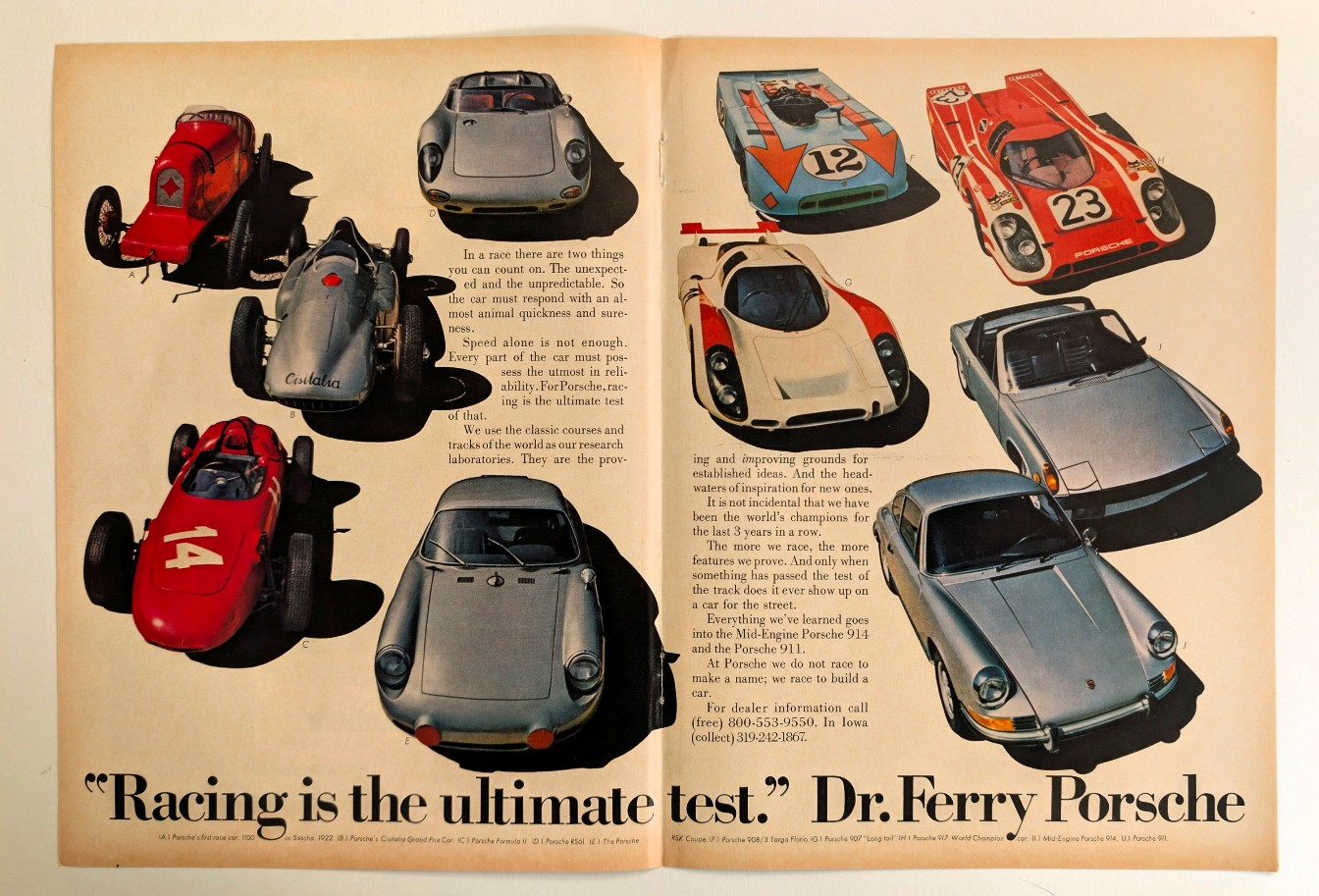
"The Bloodline of Champions: Ferry Porsche's Ultimate Test"
The History
The race track is an unforgiving laboratory. This historical manifesto chronicles over half a century of Porsche's evolution, tracing the bloodline from the 1922 Sascha to the world-conquering 917. Dr. Ferry Porsche famously stated that speed alone is insufficient; absolute endurance and reliability are paramount. The mid-engine innovations and aerodynamic mastery forged under the brutal conditions of endurance racing were directly transferred to the consumer-ready Porsche 914 and the iconic 911. This is not just automotive design; it is the definitive blueprint of a racing dynasty.
The Archive Continues
Continue the Exploration

Norge · Technology
The Time Traveller's Dossier : Norge - Automating the Home Front
The artifact before us is a profound intersection of domestic engineering and global conflict, originally published on October 2, 1943. It was distributed within the widely circulated pages of The Saturday Evening Post. It captures a civilization locked in a state of deep, irreversible transition. Then: The grueling necessity of total global war. The forced reallocation of traditional gender roles. The tedious, physical friction of manual thermal management in the domestic sphere. Now: The nascent, conceptual promise of total domestic automation. The conceptual birth of the machine as an independent, vigilant guardian. The societal problem was acute. A nation desperately needed its women to perform what was previously classified strictly as "man’s work" to support the kinetic war effort, while simultaneously demanding they manage the unyielding physical labor of the home. The proposed solution was the Norge "Night Watch". This was an exclusive, specialized device designed to patrol the relentless accumulation of ice. It performed this automated task so the human operator did not have to. This document is not merely a commercial advertisement for a household appliance. It is a foundational manifesto on the reallocation of human energy and the philosophical shift toward autonomous technology during a period of supreme existential crisis.

Renault · Automotive
The Time Traveller's Dossier : Renault's Turbo Gamble - Anatomy of a Revolution
In the annals of motorsport, true revolutions are rarely born from immediate success. They are usually forged in the fires of public humiliation, mechanical failure, and stubborn, visionary persistence. Before the modern era of ultra-efficient hybrid power units, Formula One was dominated by a single, reliable philosophy: the 3.0-liter naturally aspirated engine (most notably the ubiquitous Ford Cosworth DFV). Then came Renault. In 1977, the French manufacturer did not enter F1 to conform; they entered to disrupt. They chose a loophole in the rulebook that allowed for 1.5-liter forced-induction engines—a path so complex and fraught with reliability issues that the established British teams dismissed it entirely. The artifact before us—a page from the March 1980 issue of Motor Trend magazine—captures the precise historical moment when the laughter stopped. It documents the vindication of the turbocharged V6. This magnificent technical cutaway illustrates not just a car, but the blueprint of a paradigm shift that would permanently alter the trajectory of global motorsport.

Marantz · Entertainment
The Time Traveller's Dossier: The Alchemy of Acoustics – Marantz "Discover Gold" Advertisement (1981)
History is not an accidental sequence of events; it is a meticulously engineered illusion crafted by those who command the aesthetic and cultural narratives of their time. Long before digital algorithms could sterilely dictate consumer preferences, the ultimate manifestation of psychological manipulation and corporate alchemy was executed through the calculated precision of the offset printing press and the absolute mastery of analog darkroom photography. The historical artifact before us is not merely a disposable page torn from a vintage magazine. It is a perfectly weaponized blueprint of audio-exoticism, a visual declaration of extreme consumer luxury, and an unwavering testament to an era where electronic hardware was sold not merely as a functional utility, but as a precious, excavated commodity. This museum-grade, academic archival dossier presents an exhaustive, microscopic deconstruction of a 1981 print advertisement for the Marantz "Solid Gold" audio equipment line. Operating on a profound and ruthless binary structure, this document records a calculated paradigm shift within the global consumer electronics industry. It captures the precise historical fracture where silicon, copper, and plastic were conceptually transmuted into a literal, physical embodiment of a precious metal. Through the highly specialized lens of late-analog commercial artistry and stringent visual forensics, this document serves as a masterclass in psychological marketing. It established the foundational archetype for selling technology as a high-yield status symbol—an archetype that unconditionally dictates the visual and strategic totems of the modern high-end audiophile industry today.