The Silence Posters: Careless Talk on Both Sides of the Atlantic
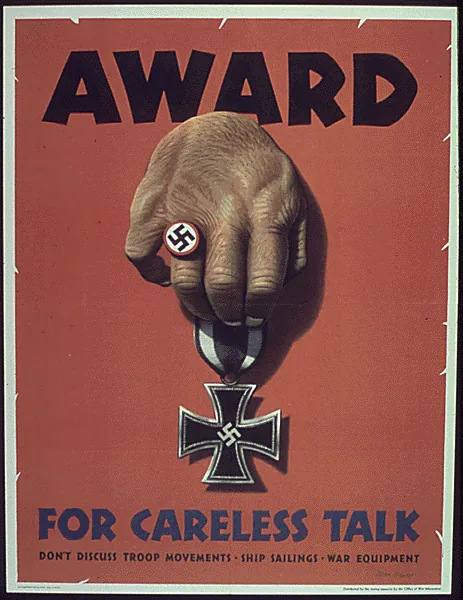
In the Second World War, two governments told their citizens the same thing in the same words: careless talk costs lives. Britain said it first, in February 1940, through Fougasse's jokes — Hitler drawn listening at the window while neighbours gossiped. America followed under the Office of War Information, in a grimmer voice: a medal offered by the enemy's hand, a rattlesnake called less dangerous than a loose tongue, a mother weeping into a cloth. Seven posters from the National Archives — four American, and the allied sheets Washington kept on file beside them — show one slogan system at work on both sides of the Atlantic.
The History
### Two capitals, one command The Second World War was fought, in part, against conversation. A sailor's sailing date mentioned in a bar, a factory's output repeated at a bus stop, a paratrooper's drop zone guessed aloud — any of it could travel, and the governments of the English-speaking world built poster campaigns to stop it travelling. They even shared the wording. Britain's Ministry of Information launched "Careless Talk Costs Lives" in February 1940 [S7]; after Pearl Harbor the United States followed, and the Office of War Information — created in June 1942 — issued its own security posters under borrowed and home-grown slogans alike: "loose lips sink ships", and the British line itself, "careless talk" [S5]. The two campaigns survive side by side in one archive. Record Group 44 in Washington holds the posters the OWI's Division of Public Inquiries assembled to promote the American war effort [S1] — and, in a companion series, the foreign posters that allied information offices produced, which the same bureaucracy kept on file [S2]. Seven sheets from those two series, four American and three filed from abroad, show what one slogan system looked like in the hands of two — in the event, three — governments. Their audience, it is worth noting, was never the soldier. It was everyone who might ever speak within a soldier's hearing: the bartender, the shipyard worker's wife, the man gossiping in a telephone box. The home front itself was the listening post, and the posters were its sentries. ### The American register: consequence The American posters do not joke. Stevan Dohanos's "Award for Careless Talk" offers the talker a decoration: an Iron Cross on its ribbon, held out by a hand that wears a swastika ring, over the flat instruction "Don't discuss troop movements · ship sailings · war equipment", on a sheet the Office of War Information distributed for the issuing agencies [S1][S3]. The wit is of the bitterest kind: the only medal careless talk can earn is the enemy's, presented by the enemy's hand. Albert Dorne's contribution, credited to him in the Archives' own record [S1], is a coiled rattlesnake in a Nazi band, fangs bared — "Less dangerous than careless talk". The snake, at least, announces itself; the talker does not. The same three forbidden subjects run along the foot of both sheets, like a charge sheet. Herbert Morton Stoops painted the cost. In "Careless Talk Got There First" a paratrooper lies slumped over his rifle under a burning sky while his comrades come down behind him into the ambush the talk prepared [S3][S6]; the United States Holocaust Memorial Museum exhibits the poster today as the OWI's warning made flesh [S5]. And Harry Anderson — his signature sits in the plate, lower right — brought the bill home: "Americans Suffer when careless talk kills!", an elderly couple holding each other up in a front room, the framed service flag on the wall behind them carrying its single star [S6]. Medal, snake, battlefield, parlour: the American series argues in a single grim syllogism, that words spoken safely at home land somewhere else as grief. ### The British register: the joke with teeth Britain had made the opposite choice two years earlier, and made it deliberately. Fougasse — Cyril Kenneth Bird (1887–1965), cartoonist and art editor of Punch — persuaded the Ministry of Information that humour would carry the warning further than fear, and he drew a series of eight "Careless Talk Costs Lives" posters for it without payment [S4][S7]. His enemy is not a tempter with a medal but a ridiculous eavesdropper who keeps turning up where gossip happens: in the best-known sheet, fourteen little Hitlers peer around a telephone box at the man chatting inside it [S4]. Washington's file holds the quietest of the eight. Two men lean together beneath a window — "Strictly between you & me...." — while a third figure, unnoticed, listens from the window above; Bird's signature, "Fougasse", stands at the upper left of the sheet, and the V&A and the Australian War Memorial both hold the design as published in February 1940, one of the eight issued by the Ministry [S4][S7]. The copy in the American file is black-and-white where the issued poster is a colour lithograph — a working reference copy, kept so that Washington could study how London was doing it. In Britain the eight designs were printed in formats for walls indoors and out, and they proved so popular that the V&A credits them with setting a new tone for official communication altogether [S4]: the state had learned to ask with a smile. The same foreign file holds a British-side answer in the other register. A hand lifts a telephone receiver beside a hillside of war graves, crosses rising into a smoke-streaked sky, an aircraft falling: "Careless Talk", signed "Moorey" and dated by its imprint to September 1942. Nothing about it jokes. Whoever filed it in Washington placed London's laughter and London's mourning in the same folder — the two tones of a single argument. ### The file's third voice The folder was wider than two empires. Its third sheet here is not British at all: a plain text notice from Ottawa — "Warning: Careless Talk May Help the Enemy" — issued by Canada's Director of Public Information under the authority of the Minister of National War Services, as both the Archives' record and the sheet's own imprint state [S2]. It has no picture at all, only a boxed list of forbidden subjects — ship movements, defence plans, munitions factories, troop movements, harbour facilities, aircraft production, supply stores — that reads like the American footline expanded into a table, and the closing order "Be on your guard". Even the filing tells the story: the record group is that of the Office of Government Reports, the White House information office consolidated into the OWI in 1942 [S2] — the keeper of the file and the author of the American campaign were, in the end, the same institution. That is the real subject these seven sheets preserve. Silence in the Second World War was not a national habit but an allied system, drafted in shared language, borrowed across an ocean, and filed — by the very office charged with running the American half of it — as one body of paper. The posters were printed to be pasted up for a season and scraped off again. What the archive kept instead is the comparison itself: fear and ridicule, medal and rattlesnake, a joke at a window and a grave on a hill, all saying the same four words. A reader comparing the plates will notice one further accident of filing: the four American sheets survive in the National Archives' digital file only at small size, while the foreign file copies are large — the readings above are taken from the file copies exactly as they stand. ### References / Sources [S1] National Archives and Records Administration, Catalog records NAID 513602, 513556, 513578, 513805, and series record NAID 513498, "World War II Posters" (Record Group 44) — titles, local identifiers 44-PA-156/-103/-130/-355, coverage dates, restriction statuses, the Albert Dorne contributor entry, and the series scope note. [S2] National Archives and Records Administration, Catalog records NAID 44266350, 44267909, 44266352, and series record NAID 516330, "World War II Foreign Posters" (Record Group 44) — including the scope note on NAID 44267909: "Country: Canada. Contributor: Director of Public Information; Minister of National War Services." [S3] Australian War Memorial, collection records for Stevan Dohanos, "Award: For Careless Talk" (ARTV02556, ARTV02815) and Herbert Morton Stoops, "Careless Talk Got There First" (ARTV02554), Office of War Information / U.S. Government Printing Office. [S4] Victoria and Albert Museum, Explore the Collections: "'Strictly between you and me…' / Careless Talk Costs Lives" (E.2170-1946) and the Fougasse series records (E.1561-2004, E.413-1998) — Cyril Kenneth Bird, the set of eight posters, Ministry of Information, 1940. [S5] U.S. Holocaust Memorial Museum, "Careless talk… got there first" — the Office of Facts and Figures and OWI poster programme; slogans "Loose lips sink ships" and "Careless talk costs lives". [S6] University of New Hampshire Library, U.S. World War II Posters, 1939–1947 (MC 386) — Herbert Morton Stoops, "Careless Talk… Got There First" (1944-O-593271); Harry Anderson, "Americans Suffer When Careless Talk Kills!" (1943-O-558552), signed in the plate. [S7] Australian War Memorial, collection record C98002, "Careless talk costs lives: Strictly between you and me…" — the series first published February 1940, one of eight designs issued by the Ministry of Information; Cyril Kenneth Bird (1887–1965), who produced his wartime posters without pay.
Cite this article
- MLA
- Naodhinsuk, Ronin. “The Silence Posters: Careless Talk on Both Sides of the Atlantic.” The Record Institute, 11 November 2026, https://therecord.institute/journal/the-silence-posters-careless-talk-on-both-sides-of-the-atlantic.
- APA
- Naodhinsuk, R. (2026, November 11). The Silence Posters: Careless Talk on Both Sides of the Atlantic. The Record Institute. https://therecord.institute/journal/the-silence-posters-careless-talk-on-both-sides-of-the-atlantic
- CHICAGO
- Naodhinsuk, Ronin. 2026. “The Silence Posters: Careless Talk on Both Sides of the Atlantic.” The Record Institute, November 11, 2026. https://therecord.institute/journal/the-silence-posters-careless-talk-on-both-sides-of-the-atlantic.