THE TIME TRAVELER'S DOSSIER: HOLLYWOOD PROPAGANDA AND THE DAWN OF MULTIMEDIA SYNERGY
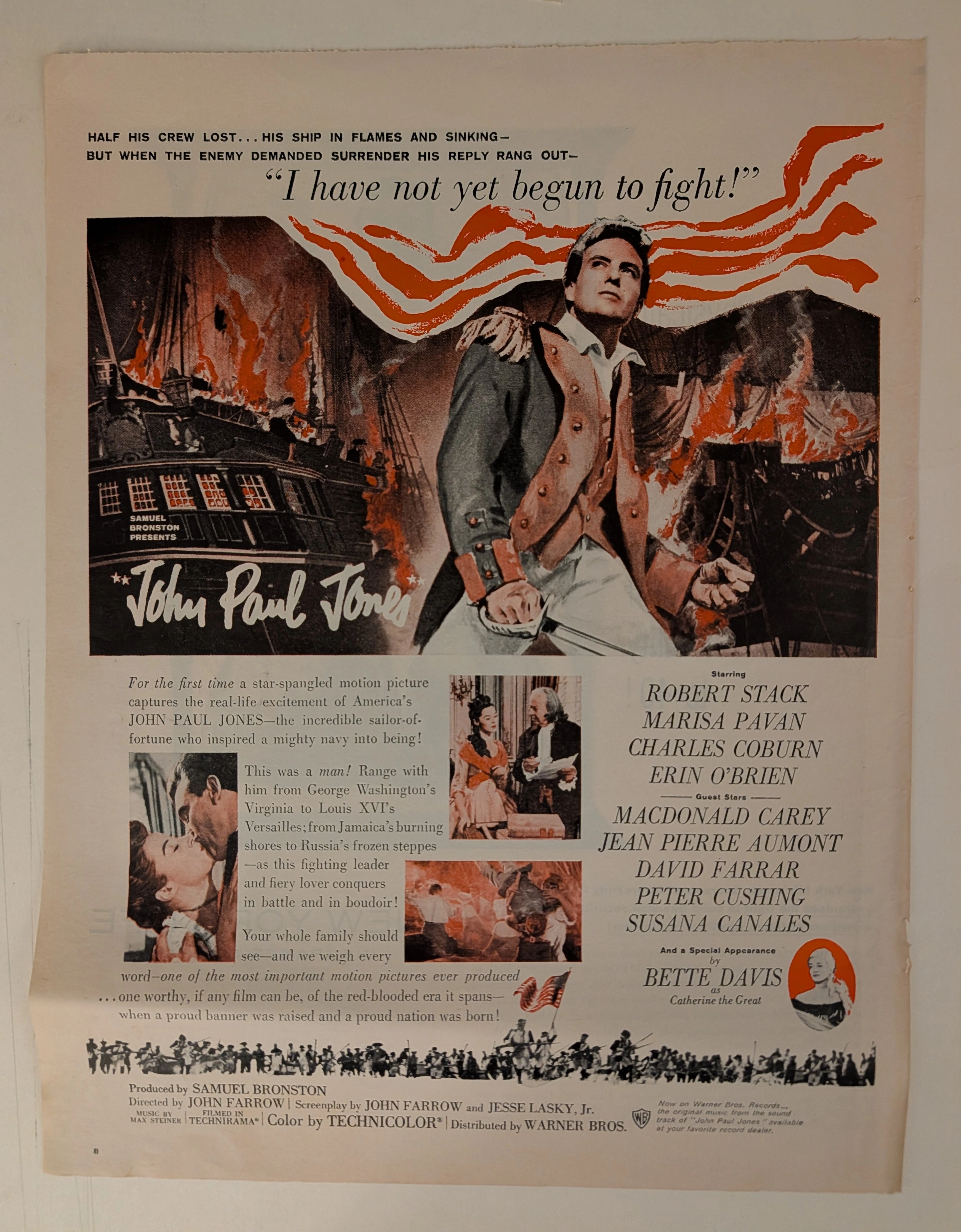
The artifact under exhaustive, uncompromising, and unprecedented museum-grade analysis is a remarkably preserved Historical Relic originating from the zenith of Hollywood's post-war epic era. This Primary Art Document is a monumental, full-page theatrical advertisement for the 1959 biographical epic "John Paul Jones", produced by the legendary independent film mogul Samuel Bronston and distributed by Warner Bros.. This is not merely a movie poster; it is a "Forensic Blueprint of Cold War American Nationalism and Multimedia Synergy." Released in 1959, at the height of the Cold War, the advertisement aggressively weaponizes the foundational mythos of the United States Navy. The commanding, blood-red headline, "I have not yet begun to fight!", serves as a psychological anchor, projecting unyielding American defiance to both domestic audiences and global adversaries. Visually dominated by the rugged, heroic portrait of Robert Stack, the ad expertly balances masculine wartime aggression with romantic subplots and diplomatic intrigue featuring Charles Coburn as Benjamin Franklin. Furthermore, it showcases elite Hollywood casting power by explicitly highlighting a "Special Appearance by Bette Davis as Catherine the Great" in a striking red cameo vignette. Crucially, this artifact documents an early, masterful execution of cross-platform corporate synergy. The bottom corner explicitly markets the original Max Steiner soundtrack on Warner Bros. Records, proving that the commercialization of the "Original Motion Picture Soundtrack" was already highly codified. Rescued from the inevitable oblivion of disposable entertainment media, this pre-2000s analog artifact is a breathtaking embodiment of the Japanese aesthetic of wabi-sabi. Printed on inherently acidic mid-century wood-pulp paper, it exhibits beautifully authentic edge wear and a profound, warm amber oxidation across its surface. This unstoppable molecular death transforms a mass-produced piece of Hollywood propaganda into an irreplaceable, ready-to-frame Primary Art Document of cinematic and sociological history.
Category: Entertainment
Brand: John Paul Jones
The History
The Cold War Context, the American Hero, Bette Davis, and Corporate Synergy ] As the Chief Curator of The Record, the uncompromising guardian of analog history, I welcome you to the absolute, pulsating epicenter of mid-century Hollywood's golden age of epic filmmaking. The impeccably preserved Historical Relic that lies before you is not a mere, soulless vintage movie advertisement designed to sell theater tickets. It is a forensic "Sociological Blueprint of Cold War Nationalism," meticulously engineered in 1959 to explicitly define American exceptionalism on a global stage. This Primary Art Document serves as the formidable visual anchor for the theatrical release of "John Paul Jones", a sprawling historical epic produced by the legendary independent mogul Samuel Bronston. To fully decode the immense, staggering gravity of this artifact, you must entirely immerse yourself in the volatile geopolitical landscape of 1959. The Cold War between the United States and the Soviet Union was at a terrifying, paralyzing climax. America desperately required mythological heroes to unify its populace, and Hollywood dutifully responded by immortalizing the "Father of the American Navy." The Visual Architecture of this document is explicitly designed to strike the viewer's soul. The bold, blood-red, sweeping typography—"I have not yet begun to fight!"—is not merely a historical quote shouted from a burning ship. It was a highly calculated, aggressive geopolitical message sent by Hollywood and the U.S. establishment directly to the communist bloc, projecting absolute, unyielding American defiance. The casting strategy showcased here is pure, weaponized social engineering. The rugged, uncompromising portrait of Robert Stack was intended to solidify the ultimate standard of steadfast American masculinity. Simultaneously, the ad caters to a broader demographic by featuring passionate, dramatic romance and the intellectual diplomacy of Benjamin Franklin, played by Charles Coburn. But the true arrogance and unassailable power of the Hollywood studio system are forensically cemented in the striking red cameo vignette in the lower right corner, proudly announcing: "And a Special Appearance by BETTE DAVIS as Catherine the Great". Securing Hollywood royalty like Davis, even for a cameo, instantly elevated Bronston's film to undeniable, prestige epic status. The Capitalist Masterstroke: The most historically significant industrial detail of this artifact lies quietly in the bottom left corner. Direct your analytical focus to the iconic shield logo and the text: "Now on Warner Bros. Records... the original music from the sound track of 'John Paul Jones' available at your favorite record dealer.". In the late 1950s, the commercialization of the standalone "Original Motion Picture Soundtrack" LP was still in its infancy. Utilizing extremely expensive theatrical advertising real estate to cross-promote a sister company’s vinyl record is a definitive, forensic recording of the birth of "Multimedia Cross-Promotion"—the exact corporate synergy that forms the indestructible foundation of modern mega-franchises like Disney and Marvel today.
The Paper
The Aesthetics of Decay (Wabi-Sabi) — The Chemical Scars of 1950s Acidic Pulp Burning Alive ] At The Record, our ultimate, uncompromising reverence is reserved for the inevitable, tragic, and spectacular beauty of analog destruction. This standalone Primary Art Document was surgically rescued, liberated, and meticulously preserved. Mass-market entertainment magazines in the late 1950s were printed on highly acidic wood-pulp paper. They were explicitly designed by their publishers for mass, disposable consumption, harboring a fatal chemical death sentence within their very fibers from the millisecond they rolled off the roaring printing presses. Direct your curatorial, analytical gaze to the surface of the paper. After 65 years, ambient oxygen and ultraviolet light have waged a relentless, unstoppable chemical war against the paper's inherent lignin. This irreversible oxidation process has birthed a magnificent, undeniable "patina," elegantly transforming the once-sterile white margins into a warm, creamy ivory and a deep, toasted amber. The authentic, microscopic analog halftone dots that create the blazing crimson fires on the warship, the delicate shading on Bette Davis's face, and the crisp lines of the WB logo have settled permanently into the brittle, degrading, and fragile fibers. This is the profound Japanese aesthetic of wabi-sabi—the spiritual realization of finding absolute perfection in impermanence and decay. This paper is quietly, literally burning itself alive at a molecular level. Its slow, majestic, and irreversible death is precisely what transfigures it from a disposable magazine page into an immortal piece of Primary Art.
The Rarity
Class A — A Miraculous Survivor of the Hollywood Marketing Machine ] To understand the immense valuation of this artifact, you must comprehend the brutal reality of ephemera survival. Movie promotional materials from the 1950s were manufactured exclusively for short-term consumption during the film's theatrical run, purposefully intended to be thrown away immediately after. The statistical probability of a magazine page surviving nearly seven decades in such crisp, visually immaculate condition—where the micro-details of the artwork remain hyper-sharp and the paper bears no devastating, structure-ruining moisture rot—is staggeringly, miraculously low. When you fuse this extreme physical scarcity with the monumental historical presence of Cold War propaganda, the elite casting of Bette Davis, and the forensic documentation of early soundtrack cross-promotion, this artifact unequivocally commands the highly prestigious Rarity Class A designation. It has evolved far, far beyond a disposable piece of vintage commercial advertising. It is a highly coveted Historical Relic, demanding to be framed and fiercely protected by an alpha curator who truly understands the heavy, beautiful, and irreplaceable weight of Hollywood capitalist history.
Cite this article
- MLA
- Naodhinsuk, Ronin. “THE TIME TRAVELER'S DOSSIER: HOLLYWOOD PROPAGANDA AND THE DAWN OF MULTIMEDIA SYNERGY.” The Record Institute, 9 March 2026, https://therecord.institute/journal/the-time-travelers-dossier-hollywood-propaganda-and-the-dawn-of-multimedia-synergy.
- APA
- Naodhinsuk, R. (2026, March 9). THE TIME TRAVELER'S DOSSIER: HOLLYWOOD PROPAGANDA AND THE DAWN OF MULTIMEDIA SYNERGY. The Record Institute. https://therecord.institute/journal/the-time-travelers-dossier-hollywood-propaganda-and-the-dawn-of-multimedia-synergy
- CHICAGO
- Naodhinsuk, Ronin. 2026. “THE TIME TRAVELER'S DOSSIER: HOLLYWOOD PROPAGANDA AND THE DAWN OF MULTIMEDIA SYNERGY.” The Record Institute, March 9, 2026. https://therecord.institute/journal/the-time-travelers-dossier-hollywood-propaganda-and-the-dawn-of-multimedia-synergy.