THE TIME TRAVELER'S DOSSIER: PAN AM - THE ARCHITECTURE OF THE AMERICAN TOURIST
Click any image to view in high resolution
The History
[ PART I: THE PSYCHOLOGY OF THE "OFF-SEASON" ELITE ]
Welcome to the velvet-roped departure lounges of mid-century American aristocracy. To merely glance at this document is a severe dereliction of curatorial duty; we must forensically interrogate its psychological intent. In the post-WWII era, America was experiencing an unprecedented economic explosion. International travel, previously reserved for ocean-liner-bound elites, was becoming accessible to the upper-middle class via aviation.
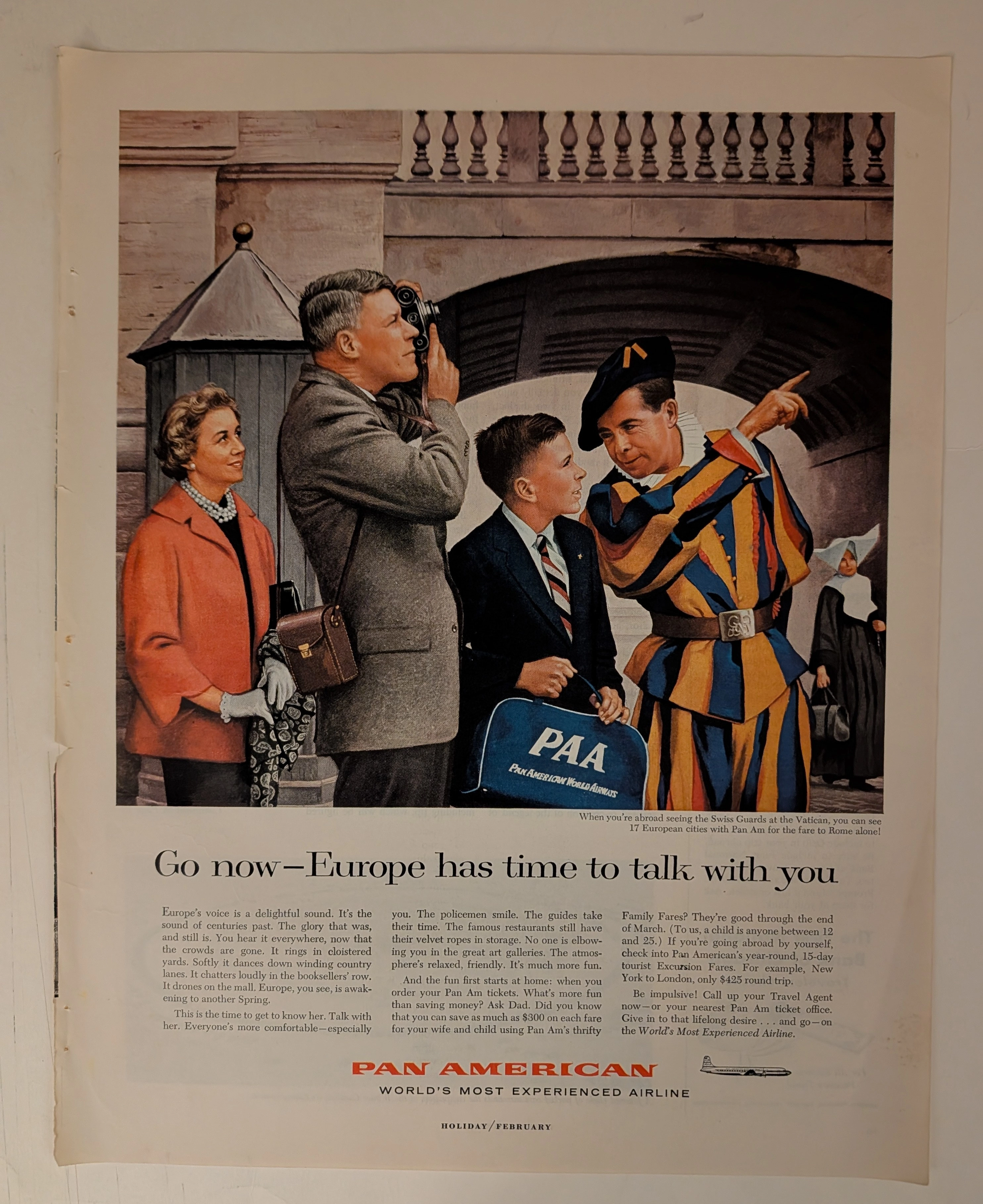
This advertisement is the ultimate sociological mechanism designed to promote "off-season" European travel. Examine the headline: "Go now—Europe has time to talk with you". This is a masterful psychological hook. It leverages the inherent snobbery of the leisure class. It implies that traveling during the crowded summer is for amateurs; traveling in the winter or early spring (noted by the "HOLIDAY / FEBRUARY" imprint) allows for an exclusive, intimate, and highly privileged interaction with the "Old World," unbothered by the masses. The image of the Swiss Guard pointing and personally guiding the young American boy reinforces this illusion of VIP access.
[ PART II: FORENSIC ICONOGRAPHY AND MACRO DETAILS ]
At The Record, our curatorial gaze penetrates down to the molecular level. Direct your attention to the extreme macro crop of the boy's hands holding the flight bag.
The PAA (Pan American Airways) flight bag was not merely luggage; it was the ultimate mid-century status symbol. Carrying this bright blue bag through an airport or down a European street was a loud, visible broadcast of wealth, sophistication, and global mobility. The artist/photographer has ensured the logo is perfectly legible, completely unwrinkled, and facing the camera—a flawless piece of product placement.
Furthermore, examine the microscopic illustration at the very bottom of the page. This is not a generic airplane. The distinct four-engine configuration, the shape of the tail, and the faint lettering "DC-7B" and "PAA" on the vertical stabilizer forensically identify the aircraft as a Douglas DC-7B. This specific detail acts as a precise historical timestamp. The DC-7B was Pan Am's premier piston-engine airliner in the mid-1950s, utilized for transatlantic routes just before they ushered in the Jet Age with the Boeing 707 in 1958. This dates the artifact to the final, golden years of propeller-driven luxury flight.
[ PART III: THE ALCHEMY OF COPYWRITING ]
The typography and copywriting at the base of the page project absolute hegemonic dominance. It declares in bold, unyielding red lettering: "PAN AMERICAN". Directly beneath it, the legendary, unchallenged slogan: "WORLD'S MOST EXPERIENCED AIRLINE".
During this era, Pan Am was not just a company; it was the unofficial flag carrier of the United States, an instrument of American soft power projecting technological and economic supremacy across the globe. The copy does not beg the consumer to fly; it instructs them. It assumes the reader has the financial capital to be "impulsive" and to take advantage of "Family Fares" and "15-day tourist Excursion Fares".
The Paper
The physical medium of this artifact is just as historically profound as the photographic art it carries. We must maintain an absolute, uncompromising reverence for the inevitable, tragic beauty of analog destruction.
Examine the extreme left edge of the entire canvas. You will notice a deeply jagged, uneven, and violently torn perimeter running vertically from top to bottom. Amateurs and sterile perfectionists might view this as damage. At The Record, we view this as the "Scar of Liberation." It is the undeniable physical proof that this high-quality page was forcefully and purposefully ripped from the metal staples of a thick, original issue of Holiday magazine.
More importantly, observe the surface of the paper itself. Over the course of roughly seven decades, ambient oxygen and ultraviolet light have waged a relentless chemical war against the paper's inherent wood-pulp lignin. This irreversible oxidation process has birthed a magnificent, undeniable "patina." What was once a sterile, bright white background has gracefully degraded into a deep, warm, toasted Antique Ivory.
This slow, majestically tragic molecular decay is precisely what drives the extreme market value of this artifact. These magazines were printed on highly acidic paper, explicitly designed for immediate, disposable consumption. They were never meant to survive the century. The fact that this delicate, highly flammable, and chemically self-destructing sheet of analog paper has survived intact is a statistical miracle. No modern digital reprint, no high-resolution scan, can ever replicate the tactile fragility, the distinct olfactory signature, or the authentic "Wabi-Sabi" soul of this dying 1950s pulp. In the global market of high-end ephemera, it is this very impermanence—the fact that the paper is quietly burning itself alive—that elevates it from a piece of vintage commercial trash to a highly coveted, irreplaceable Primary Art Document.
The Rarity
To understand the immense, almost incalculable valuation of this artifact, one must comprehend the brutal reality of aviation ephemera survival. The post-war era was defined by rapid consumption; travel magazines were read on airplanes or in country club lounges and immediately discarded.
The statistical probability of a full-page, highly detailed Pan American advertisement from Holiday magazine surviving seven decades with its colors so vividly saturated, its typography perfectly intact, and its precise DC-7B historical data preserved is staggeringly low.
When you fuse this pristine physical preservation with the monumental sociological signaling of the American tourist class, the mythological iconography of the Vatican Swiss Guard, the forensic evidence of mid-century aviation technology, and the breathtaking wabi-sabi degradation of its torn, highly acidic paper stock, this artifact unequivocally commands the absolute highest Rarity Class S designation. It has evolved far beyond a disposable piece of vintage commercial advertising. It is a highly coveted Historical Relic, a museum-grade testament to transatlantic commerce and American post-war supremacy, demanding to be framed and fiercely protected by an alpha curator who understands the heavy, beautiful weight of analog history.
Visual Impact
The Visual Impact of this vertical canvas is a masterclass in establishing a transatlantic cultural bridge while asserting American economic dominance. The architectural layout utilizes a brilliant juxtaposition of the "Old World" and the "New World."
In the foreground and midground, we see the archetypal post-WWII American nuclear family. The father, armed with a high-end 35mm rangefinder camera, captures the moment; the mother, impeccably dressed in a vibrant salmon coat and pearls, watches with serene pride; the son, dressed in a sharp blazer and tie, acts as the focal point of interaction. They are actively engaging with a Vatican Swiss Guard, whose striking, colorful Renaissance-era uniform (traditionally attributed to Michelangelo or Raphael) provides a massive visual anchor on the right side of the canvas.
The psychological brilliance of the composition lies in the boy's grip on the vivid blue "PAA - PAN AMERICAN WORLD AIRWAYS" flight bag. It rests at the dead center of the lower interaction zone. The bright white lettering against the Pan Am blue acts as a powerful corporate flag planted firmly on European soil. The violently torn left edge of the page provides a brutal, physical frame to this scene of high-society educational tourism, anchoring the illusion firmly to the tragic reality of physical decay.
Exhibition Halls
The Archive Continues
Continue the Exploration

"The Bloodline of Champions: Ferry Porsche's Ultimate Test"
Uncovering the historical lineage of Porsche's motorsport dominance, from the 1922 Sascha to the legendary 917, and how track technology forged the 911.

Ford · Automotive
THE TIME TRAVELER'S DOSSIER:CULTURE WEAPONIZATION — "IT'S THE GOING THING"
The artifact under exhaustive, unprecedented museum-grade analysis is a profoundly preserved Historical Relic excavated from the absolute bloodiest battlefield of the American Muscle Car wars. This Primary Art Document is a monumental, two-page centerfold magazine advertisement for the 1969 Ford Mustang. Forensically and undeniably dated to 1969 by the explicit license plate stamped squarely on the rear bumper of the red Mach I, this document masterfully weaponizes Ford's dual-pronged sociological marketing strategy. It expertly captures the affluent bourgeoisie with the refined "Rare luxury" of the Grandé, while simultaneously ensnaring the rebellious, adrenaline-addicted youth with the "Raw power" of the Mach I. Grounded by extreme focal details like the iconic Mach 1 winged gas cap and the definitive 1960s pop-culture choir singing "FORD: It's the going thing!", this artifact's physical battle scars—specifically its authentic center crease and profound chemical paper degradation—elevate it to an irreplaceable Primary Art Document of Rarity Class A.

Vintage 70s Crown Royal Ad: Vanishing Analog Art | The Record
An in-depth look at the priceless 1970s Crown Royal "Have you ever seen a grown man cry?" advertisement. A masterpiece of authentic analog photography on degrading vintage paper, driving up the value of this original print as global supply inevitably shrinks.