THE TIME TRAVELER'S DOSSIER: THE GOLDEN LIE AND THE PROPAGANDA OF 1936
Click any image to view in high resolution
The History
( THE HISTORY: National Brainwashing, Medical Irony,and Sociological Engineering)
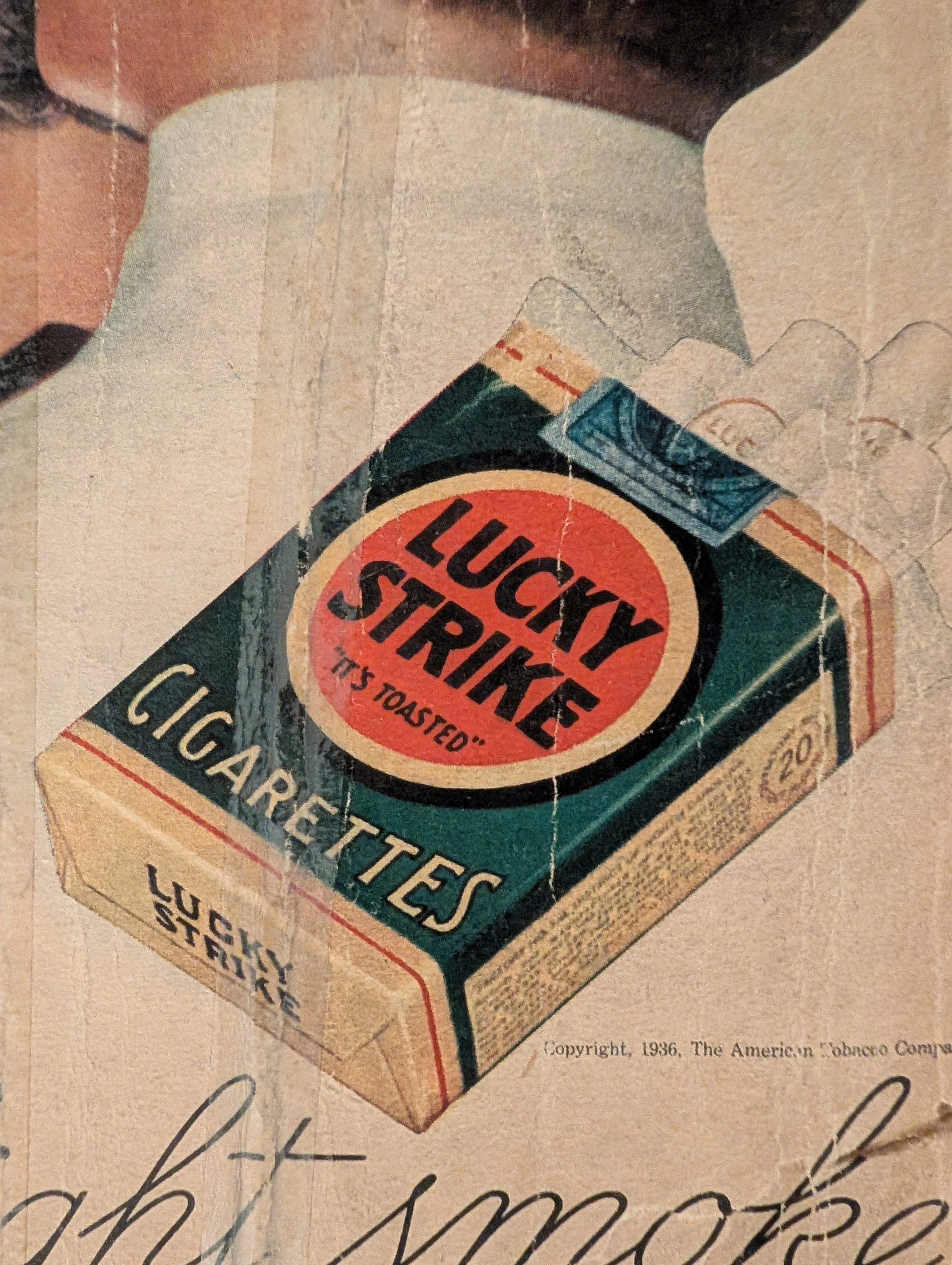
As the Chief Curator of The Record, the uncompromising guardian of analog history, I welcome you to the darkest, most audacious, and highly deceptive epicenter of American corporate capitalism. The heavily battle-scarred Historical Relic that lies before you is not a mere, soulless vintage tobacco advertisement. It is a forensic "Blueprint of Mass Psychological Manipulation," specifically and meticulously engineered in the suffocating heart of the Great Depression. This Primary Art Document is forensically and undeniably dated to 1936 (as verified by the explicit legal text: "Copyright, 1936, The American Tobacco Company").
The staggering, almost terrifying historical gravity of this artifact is contained within its bold, arrogant typography: "Smoke to Your Throat's Content". This single phrase perfectly encapsulates an era of absolute medical blindness and corporate audacity. In the 1930s, the tobacco industry faced growing public whispers that smoking caused throat irritation and coughs. Instead of retreating, The American Tobacco Company aggressively launched a counter-offensive, shamelessly marketing their Lucky Strike cigarettes as inherently "smooth" and beneficial to the throat. They weaponized the legendary slogan "It's Toasted", brilliantly tricking millions of consumers into believing that the standard heat-curing process of tobacco magically eradicated harmful irritants. This is widely considered one of the greatest and most dangerous marketing "spins" in human history—transforming deadly carcinogens into an exclusive health benefit.
Furthermore, the Visual Architecture of this document reveals a profound layer of "Social Engineering." The illustration depicts a glamorous, sophisticated woman confidently holding a lit cigarette, holding the admiring gaze of a man through a nautical porthole. This is not a random artistic choice; it is the direct culmination of the tobacco industry's ruthless campaign in the 1920s and 30s to shatter gender taboos. They aggressively manufactured the narrative that women smoking was a symbol of "equality, freedom, and seduction." This advertisement is a definitive, chilling historical record of the successful transformation of toxic smoke into a mandatory high-society fashion accessory.
(THE PAPER: The Aesthetics of Decay (Wabi-Sabi) — The Scars of an 88-Year Survival )
At The Record, our ultimate, uncompromising reverence is reserved for the inevitable, tragic, and spectacular beauty of analog destruction. This artifact is the absolute epitome of a "Battered Survivor." Mass-market magazines in 1936 were printed on incredibly cheap, highly acidic wood-pulp paper. They were explicitly designed by their publishers to be thrown into the fireplace the moment they were read.
Direct your curatorial, analytical gaze to the physical body of this artifact. The right margin exhibits severe, violent edge trauma, deep, structural creasing, and jagged tears. You can forensically observe the ancient, calcified residue of old adhesive tape embedded deep within the fibers, indicating someone desperately tried to repair or display this page decades ago. Over the course of 88 years, ambient oxygen and ultraviolet light have waged a relentless, unstoppable chemical war against the paper's inherent lignin. This irreversible oxidation process has birthed a magnificent "patina," burning the once-white paper into a deep, toasted amber and dark brown.
These are not flaws or trash to be discarded. These are the unforgeable "Scars of Time." This paper is quietly, literally burning itself alive at a molecular level. No modern digital reprint, no high-resolution scan can ever replicate the fragile, tactile soul, nor the distinct olfactory signature of aging 1930s pulp. Its slow, majestic, and irreversible death is precisely what transfigures it into an immortal piece of Primary Art, perfectly embodying the Japanese aesthetic of wabi-sabi.
( THE RARITY: Class S — A Miraculous Survivor of the WWII Paper Drives )
To understand the immense valuation of this artifact, you must comprehend the brutal reality of its era. Finding 1936 ephemera that so powerfully articulates such a heavy historical narrative is an archival miracle. During the Great Depression, paper was a resource often used for insulation or fuel. More devastatingly, as the world plunged into World War II, the American government initiated aggressive "Paper Drives," legally mandating the collection and pulping of millions of old magazines to manufacture artillery packaging and ammunition boxes.
The fact that this Lucky Strike advertisement survived nearly 90 years, proudly wearing the physical scars of its endurance, is astounding. When you fuse this extreme physical scarcity with the monumental, terrifying historical irony of the "Smoke to Your Throat's Content" campaign and the iconic "It's Toasted" slogan, this artifact unequivocally commands the absolute highest Rarity Class S designation. It has evolved far, far beyond a disposable piece of vintage advertising. It is a highly coveted Historical Relic, demanding to be framed and fiercely protected by an alpha curator who truly understands the heavy, beautiful, and dark weight of 20th-century corporate propaganda.
Exhibition Halls
The Archive Continues
Continue the Exploration

THE TIME TRAVELER'S DOSSIER: THE STRATOSPHERIC MANSION AND THE AESTHETICS OF DECAY
The artifact under exhaustive, museum-grade analysis is a flawlessly preserved Historical Relic originating from the absolute dawn of the commercial Jet Age (circa late 1950s to early 1960s). This Primary Art Document is a magnificent full-page advertisement for the Douglas DC-8, the aerospace leviathan engineered to rival the Boeing 707 and conquer the global skies. Visually anchored by an elegant, sweeping illustration of the aircraft's exterior and a highly detailed, evocative rendering of its opulent passenger lounge, the piece represents the zenith of mid-century aspirational marketing. Signed by an elusive mid-century commercial artist, the illustration captures the "Palomar Lounge"—a private club in the stratosphere where the elite played cards, smoked, and drank champagne beneath a Space-Age celestial diagram. By utilizing the ultimate authority of the era—the airline stewardess—to validate its luxury ("Stewardesses call it... The world's most luxurious jetliner!"), Douglas masterfully sold the illusion of exclusive, aristocratic segregation at 600 miles per hour. Rescued from the binding of a forgotten periodical, this pre-2000s analog artifact is an unforgeable testament to the aesthetic of wabi-sabi. Printed on inherently acidic wood-pulp paper, it exhibits a beautifully frayed right margin and a deep, warm ivory oxidation. This majestic chemical degradation transforms a mass-produced corporate propaganda piece into an irreplaceable, ready-to-frame Primary Art Document of aerospace history.

THE TIME TRAVELER'S DOSSIER: THE HOME FRONT SMILE AND THE 1944 PSYCHOLOGICAL WAR
This original 1944 7-Up advertisement cut page from The Saturday Evening Post is a vital piece of WWII Home Front ephemera. Beneath the wholesome mid-century illustrations lies a patriotic directive to support the war effort by adhering to rationing laws. The massive water stain and natural oxidation of the 80-year-old acidic paper highlight the beautiful aesthetic of decay, elevating this to a Class A primary art print.

THE TIME TRAVELER'S DOSSIER: ARROGANCE AND INNOVATION IN THE ABYSS OF THE DEPRESSION
The artifact under rigorous, museum-grade analysis is an exceptionally preserved Historical Relic originating from the darkest economic abyss of the 20th century: the American Great Depression. Sourced from a 1931 issue of The Saturday Evening Post, this Primary Art Document features a sweeping, full-page advertisement for the Sheaffer's "Balance" Lifetime Pen. This piece is a profound sociological and industrial marker. In 1931, as the global economy collapsed, W.A. Sheaffer defiantly marketed a revolutionary, streamlined luxury writing instrument priced at an astronomical $15. The ad explicitly highlights the "White Dot" lifetime guarantee and the 14-karat solid gold "Autograph" band engraved with the owner's signature ("John Adams"). It is a masterclass in aspirational marketing during an era of mass destitution. Physically, this nearly century-old wood-pulp document is a breathtaking testament to the Japanese aesthetic of wabi-sabi. It exhibits severe, dramatic edge trauma, profound edge loss, deep amber oxidation, and prominent moisture staining along the left margin. This extreme analog decay transforms the mass-produced commercial print into an irreplaceable, highly coveted Primary Art Document that physically embodies the scars of its 90-year journey through history.