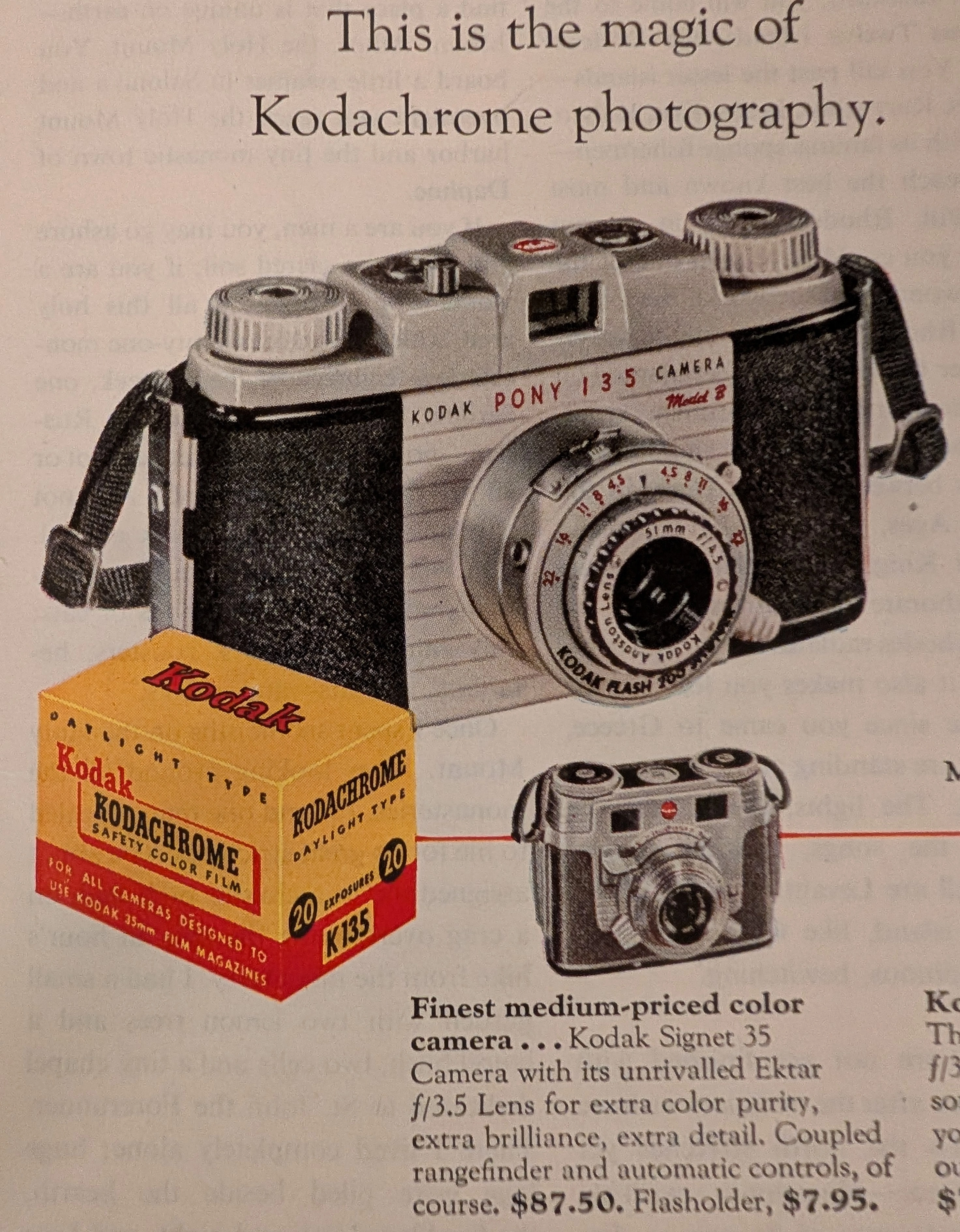
(THE HISTORY: The Golden Age of Kodachrome, 1950s Consumerism, and the "Slide Night" Ritual) As the Chief Curator of The Record, the uncompromising guardian of analog history, I welcome you to the absolute, breathtaking epicenter of mid-century American technological supremacy. The heavily scarred, magical Historical Relic that lies before you is not a mere, soulless vintage camera advertisement. It is a forensic "Sociological Architecture of Memory," meticulously engineered in the mid-1950s (circa 1954-1955) to completely revolutionize how humanity documented, viewed, and remembered its own past. This Primary Art Document is the formidable work of the Eastman Kodak Company, the absolute global sovereign of the photographic empire. The staggering, immense historical gravity of this artifact explodes from its bold, confident typography: "This is the magic of Kodachrome Photography". Prior to the post-WWII boom of the 1950s, color photography was an expensive, incredibly complex medium reserved strictly for high-end professionals, commercial advertising, or Hollywood. The average American family documented their lives exclusively in black and white. Kodak annihilated this paradigm by heavily pushing "Kodachrome"—the legendary 35mm color reversal film (perfectly symbolized by the iconic, hyper-recognizable yellow and red K135 box)—into the hands of the booming, prosperous middle class. This is not just advertising; it is profound "Social Engineering." Kodak wasn't just selling a roll of film or a camera; they were aggressively manufacturing and selling a completely new cultural ritual: the "Slide Night." The ad masterfully paints this picture: "When your pictures come back they're color slides... breathtakingly beautiful when you project them on a home screen". Kodak dictated that the suburban living room should be transformed into a private cinema. The visceral image of the glowing projection screen displaying a vivid red barn against a rich blue sky, paired with the sacred red cardboard slide mount explicitly stamped "KODACHROME TRANSPARENCY", became the ultimate pop-culture symbols of 20th-century family archiving. Technologically, this document serves as an industrial catalog of liberation. It introduces the Kodak Pony 135 Camera, Model B, priced at a highly accessible $34.75. This specific camera was the primary weapon that democratized the 35mm format for amateurs. For the discerning enthusiast, the ad also features the Signet 35 ($87.50) with its revered Ektar lens. This tiered pricing strategy is a textbook example of mid-century capitalist brilliance, designed to ensure every American could participate in the "magic" of color. (THE PAPER: The Aesthetics of Decay (Wabi-Sabi) — The Violent Liberation from the 1950s ) At The Record, our ultimate, uncompromising reverence is reserved for the inevitable, tragic, and spectacular beauty of analog destruction. This artifact is the absolute epitome of a "Beautiful Survivor." Extracted from a June issue of HOLIDAY magazine (as verified by the microscopic "HOLIDAY/JUNE" text at the very bottom edge), this page was printed on incredibly cheap, highly acidic wood-pulp paper. It was explicitly designed by its publisher to be read, discarded, and forgotten. Direct your curatorial, analytical gaze to the physical body of this artifact. The left margin exhibits a violent, jagged, and severely frayed edge tear. This is not a flaw; it is the forensic, physical evidence of its dramatic rescue—surgically and forcefully liberated from the glued and stitched binding of a decaying magazine destined for the incinerator. Over the course of nearly 70 years, ambient oxygen and ultraviolet light have waged a relentless, unstoppable chemical war against the paper's inherent lignin. This irreversible oxidation process has birthed a magnificent "patina," burning the once-sterile white paper into a deep, warm, toasted amber and creamy ivory. The miraculous paradox of this piece is that while the paper structurally degrades, the authentic analog halftone dots of the cyan skies, the crimson barn, and the yellow film box have settled permanently into the brittle fibers. These are the unforgeable "Scars of Time." This paper is quietly, literally burning itself alive at a molecular level. No modern digital reprint, no high-resolution scan can ever replicate the fragile, tactile soul, nor the distinct olfactory signature of aging 1950s pulp. Its slow, majestic, and irreversible death is precisely what transfigures it into an immortal piece of Primary Art, perfectly embodying the profound Japanese aesthetic of wabi-sabi. ( THE RARITY: Class A — A Highly Coveted Holy Grail of Photographic Ephemera ) To understand the immense valuation of this artifact, you must comprehend the religious reverence that surrounds the word "Kodachrome" in the global photographic community. Kodachrome film was officially and permanently discontinued in 2009, instantly elevating all vintage materials associated with it from mere nostalgia to highly sought-after "Historical Treasures." Finding intact, mass-market ephemera from the mid-1950s that retains such vibrant, bleeding color fidelity without devastating moisture rot or mold is an archival miracle. The fact that this specific advertisement—featuring the iconic vintage logo "Kodak - a trade-mark since 1888" and the legendary yellow/red film box—survived nearly seven decades, proudly wearing the violent physical scars of its endurance, is astounding. When you fuse this extreme physical scarcity with the monumental history of the color photography revolution, this artifact unequivocally commands the highly prestigious Rarity Class A designation. It has evolved far, far beyond a disposable piece of vintage advertising. It is a highly coveted Historical Relic, demanding to be framed and fiercely protected by an alpha curator who truly understands the heavy, beautiful weight of analog history that can never be reproduced.
THE TIME TRAVELER'S DOSSIER: THE MAGIC OF COLOR AND THE REVOLUTION OF HUMAN MEMORY
The artifact under exhaustive, uncompromising, and unprecedented museum-grade analysis is an exceptionally preserved Historical Relic originating from the absolute golden age of mid-century American consumer technology. This Primary Art Document is a monumental, full-page advertisement for Eastman Kodak Company, specifically promoting the legendary Kodachrome Film and its ecosystem of 35mm miniature cameras. Based on the featured camera models—the Kodak Pony 135 Model B, the Kodak Signet 35, and the Bantam RF—this artifact is forensically dated to the mid-1950s, specifically circa 1954–1955, extracted from a June issue of HOLIDAY magazine. This is not a mere camera advertisement; it is a profound "Sociological Blueprint of the Post-War American Dream." The headline, "This is the magic of Kodachrome Photography", encapsulates the technological democratization of color memory. Prior to this era, color photography was the exclusive domain of elite professionals. Kodachrome, with its iconic yellow and red box, transformed ordinary suburbanites into archivists of their own vibrant lives. The ad brilliantly sells not just hardware, but a deeply emotional ritual: the "home screen" slide projection. Visually anchored by the hyper-realistic red cardboard mount of the "KODACHROME TRANSPARENCY", the document is a masterclass in aspirational marketing. Rescued from the inevitable oblivion of disposable mass media, this pre-2000s analog artifact is a breathtaking embodiment of the Japanese aesthetic of wabi-sabi. Printed on inherently acidic wood-pulp paper, it exhibits a beautifully authentic jagged left binding edge, microscopic structural creasing, and a profound, warm amber oxidation across its entire surface. This unstoppable molecular death transforms a piece of mass-produced corporate propaganda into an irreplaceable, ready-to-frame Primary Art Document of photographic and sociological history.
Cite this article
- MLA
- Naodhinsuk, Ronin. “THE TIME TRAVELER'S DOSSIER: THE MAGIC OF COLOR AND THE REVOLUTION OF HUMAN MEMORY.” The Record Institute, 8 March 2026, https://therecord.institute/journal/the-time-travelers-dossier-the-magic-of-color-and-the-revolution-of-human-memory.
- APA
- Naodhinsuk, R. (2026, March 8). THE TIME TRAVELER'S DOSSIER: THE MAGIC OF COLOR AND THE REVOLUTION OF HUMAN MEMORY. The Record Institute. https://therecord.institute/journal/the-time-travelers-dossier-the-magic-of-color-and-the-revolution-of-human-memory
- CHICAGO
- Naodhinsuk, Ronin. 2026. “THE TIME TRAVELER'S DOSSIER: THE MAGIC OF COLOR AND THE REVOLUTION OF HUMAN MEMORY.” The Record Institute, March 8, 2026. https://therecord.institute/journal/the-time-travelers-dossier-the-magic-of-color-and-the-revolution-of-human-memory.