The Time Traveller's Dossier : 1917 America - The Engine of Total Mobilization
Before the emergence of this specific editorial spread, the American landscape was defined by fragmented regionalism, agrarian neutrality, and a deep-seated isolationist restraint. Then came the spring of 1917. This document represents the precise, violent turning point of a continent. It is the visual record of a decentralized nation reprogramming its civilian infrastructure, its raw materials, and its own citizenry into a centralized machine of total global warfare. The problem of the era was a fractured, reluctant populace hesitant to shed blood on foreign soil. The solution, engineered meticulously across these dual pages of Leslie's Weekly, was the normalization of mass conscription, industrial acceleration, and absolute domestic conformity. It packaged the sudden militarization of a democracy not as a tragedy, but as inevitable, mechanized progress.
Category: Other
The History
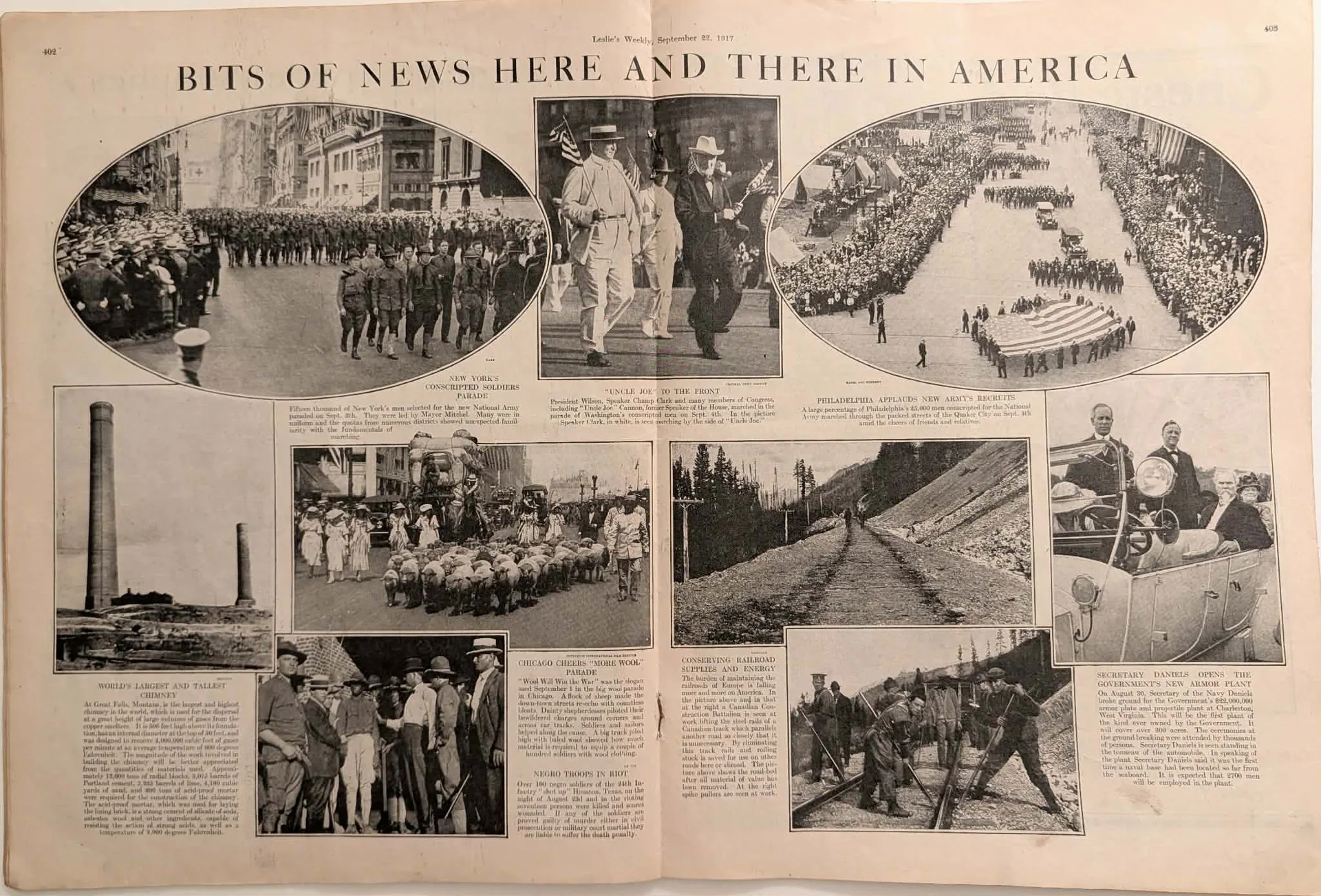
The Annihilation of Isolationism The date is September 22, 1917. The United States had officially entered the First World War merely five months prior, terminating decades of geopolitical isolationism. To understand the profound architectural function of this specific periodical spread, one must first map the psychological landscape of the audience consuming it. The American public was submerged in an environment of unprecedented existential shock. The transition from peace to a total war economy required a massive psychological operation to manufacture consent. This two-page layout, titled "Bits of News Here and There in America," is not a random assortment of weekly events. It is a highly curated, strategically deployed instrument of mass persuasion. It serves to overwhelming the reader with the sheer scale of the national effort, rendering individual dissent mathematically insignificant. The Geometry of the Hive Observe the dominant imagery occupying the upper hemisphere of the spread. We are presented with sprawling, borderline infinite columns of men in New York and Philadelphia. These are the "Conscripted Soldiers Parades." The visual language here is critical. Before 1917, the American standing army was remarkably small; the very concept of a federal draft was met with intense suspicion and hostility. To counteract this, the photographic framing deliberately strips away individual identity. The men are reduced to geometric patterns, a unified hive mind of marching flesh. The text notes that "Fifteen thousand of New York's men selected for the new National Army paraded." They are flanked by cheering crowds, establishing a psychological baseline for the reader: conformity is celebrated, and resistance is abnormal. The presence of prominent political figures, such as President Wilson and Speaker Champ Clark marching alongside the conscripts in Washington, serves to democratize the sacrifice. The message is clear: the apparatus of the state is moving, and it is consuming all classes equally. The individual is dead; the collective mechanism has been born. Altars of the Industrial Age If the upper half of the document establishes the conscription of flesh, the lower half establishes the conscription of earth and iron. The photograph on the far left depicts the "World's Largest and Tallest Chimney" at a copper smelter in Great Falls, Montana. Standing 506 feet high and handling 4,000,000 cubic feet of toxic gases per minute at 600 degrees Fahrenheit, this structure is not merely a piece of infrastructure. In the context of 1917, it is an altar to the new gods of metallurgy and chemical processing. Copper was the nervous system of the war effort, essential for shell casings and communication wires. Directly opposing this, we see Secretary of the Navy Daniels breaking ground for a $22,000,000 armor plate and projectile plant in West Virginia. Meanwhile, a Canadian Construction Battalion is shown ripping up existing railroad tracks to conserve steel for the European front. The entire continent is being strip-mined, repurposed, and fed into the transatlantic furnace. The editorial choice to place these industrial behemoths alongside the marching soldiers creates a chilling equivalence: men and steel are simply raw resources, equally necessary to feed the engines of the Western Front. The Fracture in the Facade Yet, amidst this highly controlled narrative of unified patriotic momentum, a profound societal fracture bleeds through the ink. Tucked quietly in the bottom center is a small, un-illustrated text box titled "Negro Troops in Riot." It details the Houston Riot of August 1917, where racial tensions and brutal policing led to a mutiny by soldiers of the all-Black 24th Infantry Regiment, resulting in seventeen deaths. The editorial detachment here is striking. The clinical, almost apathetic description of impending military court martials and death penalties is violently juxtaposed against the adjacent image of a whimsical parade in Chicago, where "dainty shepherdesses" march with sheep under the slogan "Wool Will Win the War." This juxtaposition exposes the fundamental paradox of 1917 America. The nation was mobilizing to fight for global democracy abroad, while simultaneously enforcing a brutal, violently segregated racial hierarchy at home. The periodical flattens this massive domestic tragedy, reducing a complex explosion of racial trauma into a mere "bit of news" to be consumed alongside updates on wool production and chimney construction. The Dormant Kinetic Framework To the modern observer, this artifact exists in a state of suspended kinetic energy. The precise, isolated vignettes—the marching columns receding into the vanishing point, the towering geometry of the industrial chimney, the rhythmic lifting of the steel rails—are not merely static photographs. They operate as dormant storyboard frames, expertly calibrated for extraction. This specific page begs to be severed from its acidic paper matrix and reconstructed as a living 2D artwork. The stark contrast of the halftone prints provides perfect masking boundaries for layered parallax animation. By assigning a digital skeletal rig to the marching conscripts and generating atmospheric smoke simulations for the Great Falls chimney, the rigid paralysis of the print medium dissolves. To anchor this resurrection, the sequence demands the application of strict, period-appropriate audio. The heavy, synchronized thud of leather boots striking cobblestone, the low, metallic grind of early industrial copper smelting, and the faint, analog crackle of a distant 1917 brass band would shatter the temporal barrier entirely. The physical medium of the magazine is degrading, but the historical velocity captured within these frames remains permanently viable, awaiting the technology of the future to press play.
The Paper
This document is a fragile survivor of early 20th-century transient engineering. It was printed on a low-GSM mechanical wood pulp paper, a highly acidic medium explicitly designed by industrial engineers for immediate mass consumption and rapid disposal. It was never intended to survive the century. The inherent lignin within the wood pulp has reacted aggressively with decades of atmospheric oxygen and ultraviolet radiation, resulting in severe and permanent oxidation. This cellular breakdown manifests as the deep, irregular sepia discoloration that floods the margins and the creeping brittleness of the page's edges. The ink transfer process utilizes standard web-fed rotary printing. Under microscopic inspection, the black ink reveals the distinct, mathematical rosette patterns of the halftone screens used to reproduce the original silver gelatin photographs. The paper now possesses a dry, porous tooth that absorbs and flattens light. This physical degradation is not a flaw; it is an integral data point. The creeping yellowing is the visual measurement of time passing, acting as a slow-burning chronometer that records the decades through its own cellular disintegration.
The Rarity
Pages from Leslie's Weekly during the World War I era are relatively common in antique ephemera markets. However, this specific leaf achieves a strict Class A designation due entirely to its staggering contextual density. Its rarity is not defined by its financial auction value, but by its flawless historical cross-section. It simultaneously documents the apex of domestic military mobilization, the peak of industrial hyper-expansion, the specific mechanics of wartime resource conservation, and the grim reality of domestic racial conflict via the Houston Riot text. It is an unadulterated, highly complex slice of the American cultural psyche, captured on a very specific day in human history, offering a complete diagnostic of a nation in violent transition.
Cite this article
- MLA
- Naodhinsuk, Ronin. “The Time Traveller's Dossier : 1917 America - The Engine of Total Mobilization.” The Record Institute, 28 July 2026, https://therecord.institute/journal/the-time-travellers-dossier-1917-america-the-engine-of-total-mobilization.
- APA
- Naodhinsuk, R. (2026, July 28). The Time Traveller's Dossier : 1917 America - The Engine of Total Mobilization. The Record Institute. https://therecord.institute/journal/the-time-travellers-dossier-1917-america-the-engine-of-total-mobilization
- CHICAGO
- Naodhinsuk, Ronin. 2026. “The Time Traveller's Dossier : 1917 America - The Engine of Total Mobilization.” The Record Institute, July 28, 2026. https://therecord.institute/journal/the-time-travellers-dossier-1917-america-the-engine-of-total-mobilization.