The Time Traveller's Dossier : 1942 Celotex - Engineered Silence
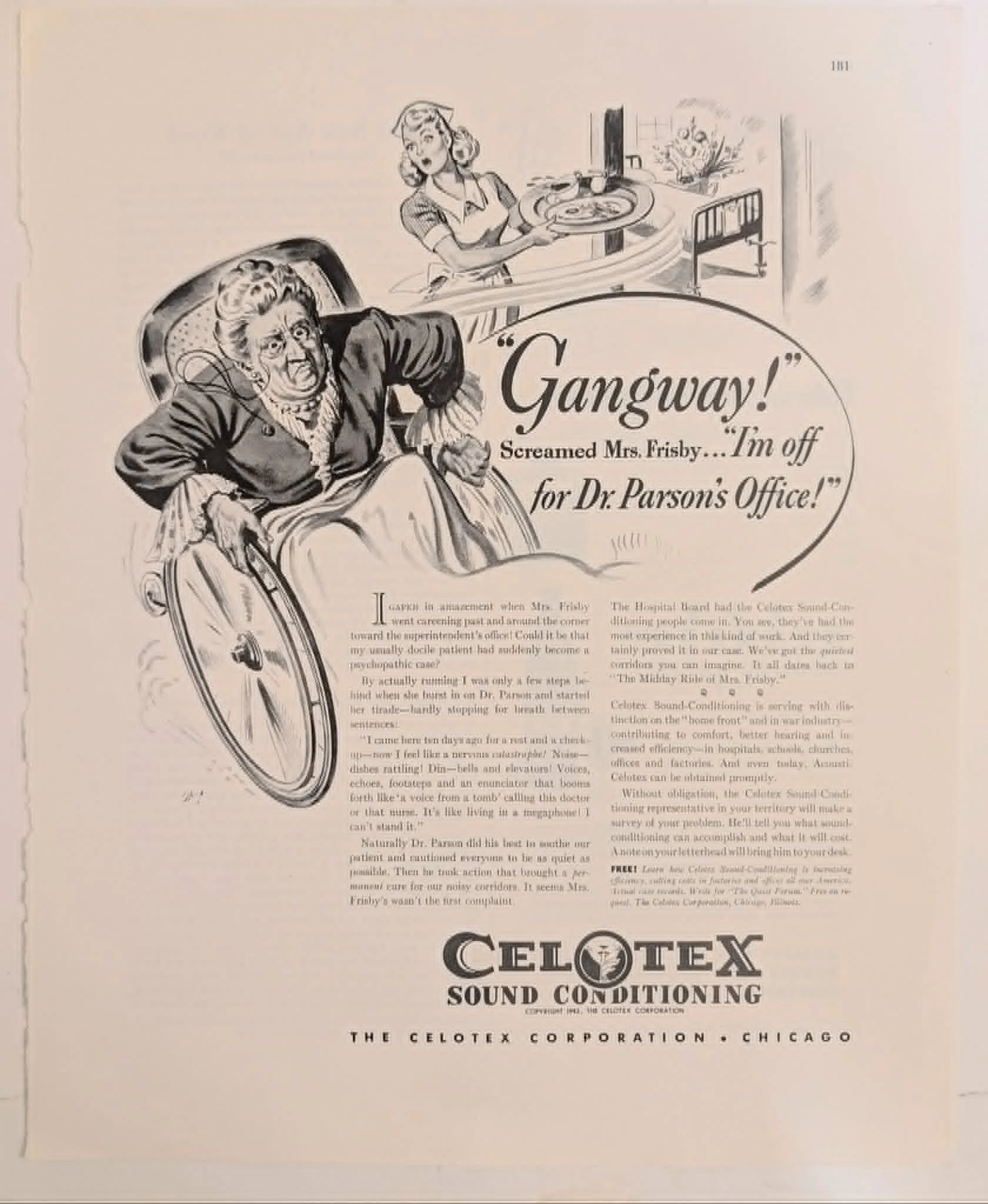
The artifact before us is a diagnostic report on the unintended consequences of modernity. Published in 1942, this Celotex advertisement captures a profound architectural and societal crisis. It is not merely selling a building material. It is documenting the exact historical moment when silence ceased to be a natural, free condition and became a manufactured, engineered commodity. The core problem was the rapid modernization of institutional architecture. The transition to sterile, hard, and hygienic surfaces in the early 20th century inadvertently transformed hospitals, schools, and factories into massive acoustic amplifiers. The modern world was deafening itself. Celotex Corporation stepped into this sensory chaos with a radical solution: "Sound Conditioning." By weaponizing agricultural waste into porous acoustic tiles, they offered to install synthetic quiet into spaces where natural quiet had been eradicated. This document records the birth of acoustic management as an industrial necessity.
Category: Technology
Brand: Crlotex
The History
The Death of Natural Quiet To understand the gravity of this artifact, we must analyze the acoustic environment of the early 20th century. Prior to the industrial revolution, human architecture was inherently absorptive. Traditional building materials—thick timber, heavy tapestries, soft furnishings, and uneven plaster—naturally dampened sound waves. The ambient environment possessed a baseline of acoustic deadness. Silence was simply the default state of an unoccupied room. Modernity violently dismantled this baseline. The rise of industrial architecture prioritized efficiency, durability, and hygiene. Architects embraced concrete, structural steel, expansive glass windows, ceramic tiles, and linoleum floors. These materials are acoustically reflective. They do not absorb kinetic energy; they bounce it back. Consequently, the modern building became an echo chamber. A single footstep, a dropped tool, or a spoken word was no longer an isolated acoustic event. It was multiplied, fragmented, and sustained as reverberation. The modern world was a marvel of visual hygiene, but an absolute nightmare of auditory pollution. The Architecture of the Megaphone The crisis was most acutely felt in environments dedicated to healing and concentration. The hospital, in particular, underwent a radical physical transformation in the 1920s and 1930s. The old model of the quiet, isolated sanatorium with heavy curtains and wooden floors was replaced by the modern medical facility. These new hospitals were designed like hygienic factories. Surfaces had to be easily washed and sterilized. This meant endless corridors of hard plaster walls, terrazzo floors, and metal beds. The copy in this artifact perfectly captures the resulting trauma. The protagonist, Mrs. Frisby, describes the hospital as a "megaphone." The text lists the specific acoustic triggers: "dishes rattling! Din—bells and elevators! Voices, echoes, footsteps and an enunciator that booms forth like 'a voice from a tomb'." This was not an exaggeration. The hard surfaces of the modern hospital corridor essentially functioned as a wave-guide. Without absorptive materials to dissipate the acoustic energy, the sound of a rattling dish on a metal cart would travel unimpeded down a hallway, bouncing off the walls, ceiling, and floor with near-zero energy loss. The hospital, designed to cure the body, was actively assaulting the nervous system. The Physiological Assault of Reverberation The advertisement frames Mrs. Frisby’s reaction humorously—an elderly woman fleeing in a wheelchair—but the underlying medical reality is entirely serious. The copywriter uses the phrase "nervous catastrophe." This is a precise description of auditory fatigue. Sound is a mechanical wave. It transfers kinetic energy into the human ear, vibrating the tympanic membrane. When a person is trapped in a highly reverberant environment, their auditory system is subjected to a constant barrage of overlapping waveforms. The brain struggles to process speech intelligibility over the background din. This continuous subconscious filtering requires immense cognitive load. In a hospital setting, this acoustic chaos triggers biological stress responses. Constant, unpredictable noise elevates cortisol levels, increases heart rates, and disrupts the critical REM sleep necessary for patient recovery. The modern architecture of 1942 was actively delaying the healing process. The doctors could prescribe medication, but the building itself was keeping the patients sick. The acoustic environment had become a pathogenic vector. The Mechanics of Engineered Silence The solution presented by The Celotex Corporation represents a brilliant intersection of material science and agricultural upcycling. Celotex did not invent silence; they invented a way to install it. The core technology behind Celotex acoustic tiles was bagasse. Bagasse is the dry, pulpy fibrous residue that remains after sugarcane stalks are crushed to extract their juice. Historically, this was considered agricultural waste, often burned or discarded. Celotex engineers discovered that by processing bagasse fibers into lightweight, rigid boards, they could create a material with extraordinary microscopic porosity. When a sound wave strikes a hard plaster ceiling, almost 100% of the energy is reflected. When a sound wave strikes a Celotex tile, the oscillating air molecules are forced into the microscopic interconnected pores of the bagasse fiber matrix. As the air moves through these tiny channels, friction occurs. The kinetic energy of the sound wave is converted into a microscopic, harmless amount of thermal energy. The sound is not destroyed; it is transformed into heat. This is the technical reality behind the marketing term "Sound Conditioning." They were selling an energy conversion system that neutralized the architectural flaws of the modern building. The Geopolitics of Noise on the Home Front The artifact must also be placed firmly in its temporal context. The copyright date is 1942. The United States was fully mobilized for World War II. The text explicitly states: "Celotex Sound-Conditioning is serving with distinction on the 'home front' and in war industry—contributing to comfort, better hearing and increased efficiency..." During a total war economy, inefficiency is a form of sabotage. The massive factories producing munitions, aircraft, and tanks were chaotic environments filled with the deafening roar of heavy machinery. Factory managers quickly realized that acoustic trauma was degrading worker performance. High reverberation led to misheard instructions, increased accident rates, and severe worker fatigue. By installing Celotex acoustic treatments, industries were not providing a luxury; they were optimizing human capital. Sound conditioning became a strategic industrial asset. The control of ambient noise was marketed as a patriotic duty to ensure maximum output for the war effort. The advertisement pivots seamlessly from the comical plight of a hospital patient to the grim reality of wartime industrial efficiency. The Philosophical Shift: The Commodification of the Unseen The ultimate significance of this document lies in its philosophical implications. This advertisement marks the formal commodification of silence. For thousands of years, silence was a free, naturally occurring phenomenon. It was the background radiation of existence. But human progress, through the aggressive deployment of steel, concrete, and machinery, successfully eradicated natural silence from the urban environment. Having destroyed the acoustic equilibrium, the capitalist system then formulated a method to sell it back to the public. Silence was packaged. It was branded. It was measured in square feet and installed by technicians. Celotex was not selling fiberboard; they were selling the absence of chaos. They were selling the restoration of sanity. This artifact proves that by 1942, humanity had grown so loud, so reflective, and so mechanically violent, that we had to begin engineering synthetic quiet just to survive our own architecture.
The Paper
The physical artifact is printed on standard mid-century magazine stock. It lacks the heavy gloss of contemporary luxury advertising, reflecting wartime rationing and the economic realities of mass-market publishing in 1942. The reproduction of the illustration relies heavily on halftone printing. By varying the size and spacing of microscopic black ink dots, the printer created the optical illusion of continuous tonal gradients. The frantic motion lines around the wheelchair and the shading on Mrs. Frisby’s dress are achieved through this mechanical translation of art into geometry. Close inspection reveals minor degradation. The edges are unevenly torn, suggesting manual extraction from a bound volume. There is mild oxidative yellowing of the paper matrix, typical of the lignin breakdown in mid-century pulp over eight decades. In one of the close-up archival scans, a tiny, erratic ink smudge is visible—a microscopic flaw in the high-speed printing process, locking a fraction of a second of mechanical imperfection permanently into the historical record.
The Rarity
Classification: Class C (Societal Context Artifact) This is not a highly sought-after collector's item with a massive financial valuation. It is a Class C artifact. Its value lies entirely in its contextual and historical utility. Mass-produced advertisements for building materials from the 1940s are relatively common. However, finding one that so perfectly articulates the specific intersection of medical architecture, acoustic engineering, and wartime industrial psychology is rare. It serves as a vital primary source for architectural historians studying the evolution of modern sensory environments. It is a humble document with monumental implications.
Cite this article
- MLA
- Naodhinsuk, Ronin. “The Time Traveller's Dossier : 1942 Celotex - Engineered Silence.” The Record Institute, 20 May 2026, https://therecord.institute/journal/the-time-travellers-dossier-1942-celotex-engineered-silence.
- APA
- Naodhinsuk, R. (2026, May 20). The Time Traveller's Dossier : 1942 Celotex - Engineered Silence. The Record Institute. https://therecord.institute/journal/the-time-travellers-dossier-1942-celotex-engineered-silence
- CHICAGO
- Naodhinsuk, Ronin. 2026. “The Time Traveller's Dossier : 1942 Celotex - Engineered Silence.” The Record Institute, May 20, 2026. https://therecord.institute/journal/the-time-travellers-dossier-1942-celotex-engineered-silence.