The Time Traveller's Dossier : 1943 Interwoven Socks - The Fabric of Wartime Endurance
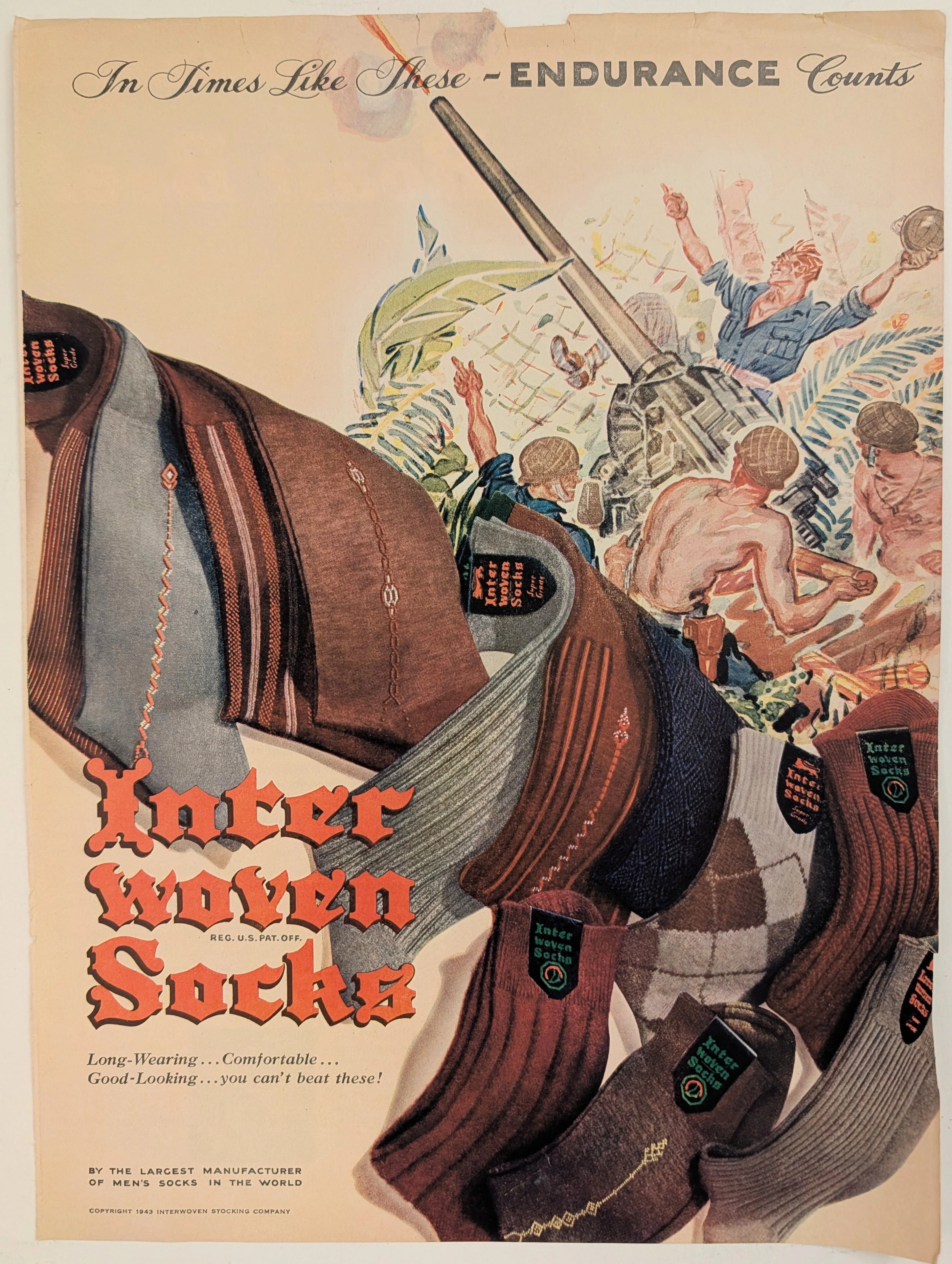
Then, apparel was a matter of aristocratic vanity. Now, it is a calculus of survival. The problem in 1943 was not the pursuit of fashion; it was the absolute degradation of the human body in the brutal, unforgiving theaters of global war. Trench foot. Jungle rot. The relentless, humid friction of the Pacific front. The solution, as framed by the Interwoven Stocking Company, was not merely a woven textile. It was engineered morale. It was endurance. This artifact is a portal. It transports us to a specific socio-economic and psychological pivot: the exact moment consumer goods were weaponized as tools of patriotic resilience. It is an advertisement, yes. But deeper than that, it is a strategic blueprint of how a society in total war convinced itself that ordinary comforts could conquer extraordinary horrors.
Category: Fashion
Brand: Interwoven Sock
The History
The Crucible of 1943: A World on Fire and the Logistics of Survival The year is 1943. The globe is fractured by the mechanized slaughter of the Second World War, a conflict that rewired the global economy. The Allied forces are deeply entrenched in the Pacific Theater, fighting an enemy that is as much the hostile environment as it is the opposing armies. The jungles of Guadalcanal and New Guinea present a waking nightmare of humidity, malaria, and physical decay. In this theatre of absolute, grinding attrition, the human foot—the fundamental unit of infantry mobility and combat readiness—becomes one of the most vulnerable and critical assets of the entire war effort. This is the exact historical and psychological landscape into which the Interwoven Stocking Company launched its "In Times Like These - ENDURANCE Counts" campaign. Before the war, Interwoven, alongside elite competitors like Arrow Shirts and Kuppenheimer Suits, dominated the visual culture of American masculinity. Guided by legendary illustrators like J.C. Leyendecker, peacetime advertising had sold the image of the suave, aristocratic gentleman lounging in ivy-draped clubs. But the bombs of Pearl Harbor shattered that gilded illusion permanently. The Great Shift: From Peacetime Vanity to Wartime Utility The historical shift captured in this artifact is profound. The advertising industry was forced to pivot overnight from a rhetoric of luxury to a rhetoric of stark utility and survival. Vanity was suddenly deemed unpatriotic; durability was elevated to the status of heroism. The artifact before us illustrates this societal transition with startling clarity. It represents a masterclass in psychological recalibration. The Interwoven Stocking Company did not just sell socks to men; they sold the conceptual framework of endurance to a terrified nation. They explicitly aligned the structural integrity of their tightly woven heels and toes with the moral and physical integrity of the American soldier fighting overseas. Notice the stark juxtaposition designed by the agency: the foreground features pristine, impeccably patterned socks—complex argyles, sturdy ribbed wools, and heavily reinforced cottons—floating ethereally as objects of desire. The background, however, is a chaotic, pastel-washed nightmare of an anti-aircraft artillery crew in the sweltering Pacific jungle. The men are shirtless, muscular, barking orders, and feeding massive shells into a gun pointed at an unseen threat in the sky. The underlying message is not subtle, but it is highly effective and emotionally manipulative: the men on the front lines are enduring unimaginable hell, and the very least the civilian on the home front can do is purchase and maintain goods that reflect that exact same indestructible spirit. The Engineering of Wartime Textiles and the Supply Chain Crisis To analyze this artifact, one must understand the severe supply chain and engineering crisis of the World War II era. By 1943, the United States government's War Production Board had severely rationed all essential materials under strict regulations, such as the famous L-85 orders which dictated the exact amount of fabric that could be used in civilian clothing. Silk, previously sourced heavily from Japan, was entirely unavailable due to the war. Nylon, the miracle fiber introduced by DuPont in 1939, was immediately commandeered by the military for parachutes, tow ropes, and tire cords. Civilian apparel manufacturers were left to frantically innovate with whatever raw materials were permitted—primarily cotton, wool, and early rayon blends. Interwoven’s prominent claim at the bottom of the page as "The Largest Manufacturer of Men's Socks in the World" was not just an empty marketing boast; it was a vast logistical reality. They possessed the massive industrial machinery and capital required to rapidly experiment with reinforced stitching techniques, specifically developing wear-resistant heel and toe structures that could withstand prolonged friction. The prominent copy phrasing "Long-Wearing... Comfortable... Good-Looking... you can't beat these!" is heavily weighted toward longevity over aesthetics. In a tightly controlled rationing economy where everyday consumers were issued government coupon books for clothing and footwear, a pair of socks that wore through in a single month was considered a critical financial and patriotic failure. The internal engineering of the sock had to perfectly match the aggressive messaging of the ad: it simply had to survive the elements. The Societal Mirror: Consumer Guilt and the Aesthetics of Resilience Beneath the surface of the vivid ink and paper lies a highly complex societal mechanism: the weaponization of consumer guilt. The home-front civilian in 1943 lived in a constant state of perpetual anxiety and relative safety, reading about the unimaginable horrors of the Pacific island-hopping campaigns in the evening newspapers or hearing about them via crackling radio broadcasts. Brands like Interwoven masterfully tapped into this vulnerable psychological state by artificially bridging the gap between the safe domestic buyer and the distant, suffering soldier. By purchasing an Interwoven sock, the civilian was artificially convinced they were not merely buying a basic garment; they were buying a microscopic piece of the overall war effort. They were engaging in a silent pact of economic sacrifice, a tangible connection to the mud and blood of the front lines. They were actively participating in the aesthetics of resilience. The advertisement implicitly, yet forcefully, asks the consumer: "Our boys are standing strong under heavy enemy fire in the jungle. Can your wardrobe stand the test of a wartime economy?" This psychological shift fundamentally altered the core DNA of American marketing. It effectively birthed the modern concept of "brand purpose"—the idea that a massive corporation must stand for something morally larger than its physical product, a philosophy that continues to dominate the global advertising industry to this very day. The Competitors and the Risky Market Landscape During this turbulent era, prominent competitors like Holeproof Hosiery, Phoenix Socks, and Esquire were attempting similar patriotic pivots, but very few executed the visual dichotomy as aggressively or as effectively as Interwoven. While other brands conservatively focused on safe illustrations of handsome soldiers merely smiling in clean uniforms while on leave, Interwoven made the deliberate choice to depict the raw, sweaty, chaotic reality of active combat. It was a remarkably risky maneuver for a clothing brand. Bringing the visceral, terrifying reality of anti-aircraft warfare into a men's fashion advertisement could have easily been perceived by the public as being in poor taste or excessively morbid. Yet, it succeeded strategically because it did not trivialize the war effort; rather, it elevated the humble sock to a vital talisman of survival and national duty. This 1943 advertisement is the absolute, perfect nexus of mid-century capitalism and global conflict. It represents a fleeting, high-stakes era where the survival of a corporation was inextricably linked to the survival of the free world itself. It is the exact, quantifiable moment when the consumer textile industry ceased to be a provider of mere fashion and temporarily transformed into an active arm of the military-industrial complex's massive public relations machine. It stands today as a paper monument to the resilience of both the human spirit and the relentless industrial looms of the 20th century. The Enduring Legacy of the "Endurance Counts" Campaign Ultimately, the "Endurance Counts" campaign left a permanent, indelible scar on the timeline of global advertising history. It definitively proved to Madison Avenue that in times of deep, collective societal trauma, the most effective marketing strategy is unflinching realism paired with an absolute promise of structural reliability. The artifact does not just sell a pair of argyles; it meticulously documents the psychological armor an entire nation had to wear to survive its darkest, most uncertain years. It is a true masterwork of commercial propaganda, a textile promise of victory made to a deeply fractured world.
The Paper
This artifact is a profound physical manifestation of mid-century mass communication and wartime industrial limits. The paper stock itself is a classic wartime magazine lightweight coated sheet, likely hovering around a delicate 60 to 70 GSM. Due to severe wartime rationing of bleaching agents and high-quality wood pulp, paper quality across the publishing industry suffered immensely, leading to a much higher acidity in the base pulp. This chemical reality explains the distinct, warm yellowing—a slow burning process known to archivists as foxing and acid degradation—that now gracefully frames the margins, transforming the page from a simple disposable advertisement into a true, fragile temporal artifact that records the passage of eighty years. The printing method utilized is a high-speed, web-fed offset lithography, highly characteristic of major, widely circulated publications of the era. When examined closely under a jeweler's loupe, one can observe the distinct, microscopic CMYK halftone rosette patterns that make up the images. The imperfect ink absorption reveals the mechanical limitations of 1943 printing technology; the edges of the bold, red "Interwoven Socks" typography exhibit a very slight ink spread or "bleed" into the surrounding coarse paper fibers. The tactile nature of this page—brittle, slightly textured, and carrying the faint, unmistakable dusty scent of oxidized cellulose and old ink—is a direct, sensory recording of the strict industrial constraints and the urgent, rapid dissemination of information during the height of World War II.
The Rarity
Classification: Class A (Archival Significance - High Contextual Value) While millions of these magazines were originally printed and distributed across America in 1943, the actual survival rate of intact, vibrant, and contextually profound advertisements from the absolute peak of the war is steadily and inevitably declining. The rarity of this piece does not stem from a prohibitively high monetary auction value, but rather from its immense, irreplaceable contextual value. It is an un-sanitized, highly strategic primary source document of World War II home-front psychological propaganda. Its true worth is deeply academic and historical—it serves as a perfect, preserved specimen of the exact moment consumer advertising flawlessly merged with military survivalism. Finding a specimen where the complex colors of the chaotic jungle combat and the intricate textile patterns remain this vibrant elevates it strictly and undeniably to Class A archival status within any serious historical collection.
Cite this article
- MLA
- Naodhinsuk, Ronin. “The Time Traveller's Dossier : 1943 Interwoven Socks - The Fabric of Wartime Endurance.” The Record Institute, 17 April 2026, https://therecord.institute/journal/the-time-travellers-dossier-1943-interwoven-socks-the-fabric-of-wartime-endurance.
- APA
- Naodhinsuk, R. (2026, April 17). The Time Traveller's Dossier : 1943 Interwoven Socks - The Fabric of Wartime Endurance. The Record Institute. https://therecord.institute/journal/the-time-travellers-dossier-1943-interwoven-socks-the-fabric-of-wartime-endurance
- CHICAGO
- Naodhinsuk, Ronin. 2026. “The Time Traveller's Dossier : 1943 Interwoven Socks - The Fabric of Wartime Endurance.” The Record Institute, April 17, 2026. https://therecord.institute/journal/the-time-travellers-dossier-1943-interwoven-socks-the-fabric-of-wartime-endurance.