The Time Traveller's Dossier : 1944 Hoover Ad - The Gamification of Sacrifice
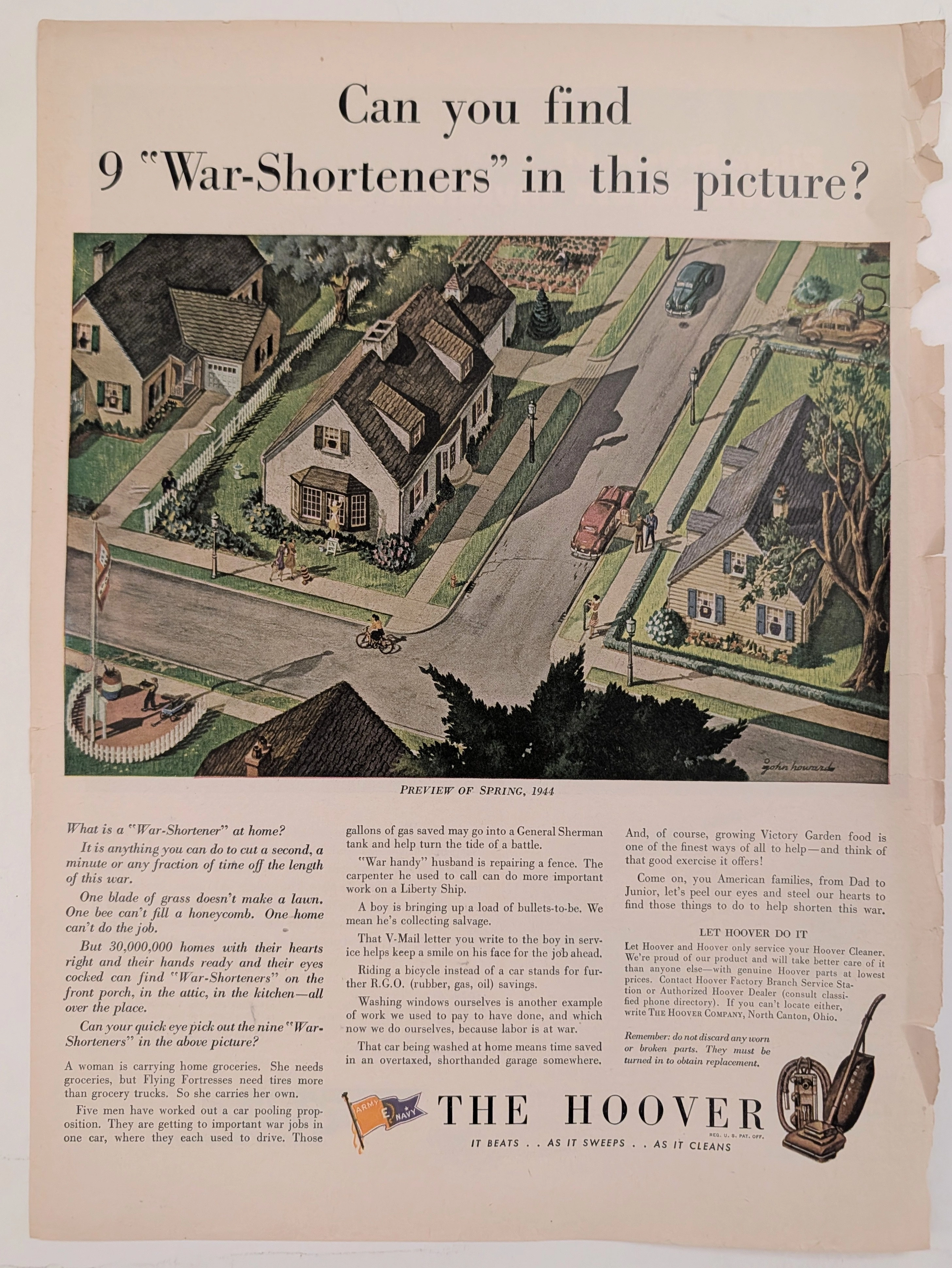
The front line was everywhere. By the spring of 1944, the theater of war was no longer confined to the bloody atolls of the Pacific or the frozen mud of Eastern Europe. It had systematically relocated to the American driveway. Before this artifact was printed, domestic life was defined by the steady, automated acceleration of convenience. The modern household was a consumerist sanctuary. Then came the absolute logistical mathematics of a global conflict. This advertisement represents a precise psychological mechanism. It addresses a stark present reality: the total depletion of civilian resources and the agonizing psychological burden of waiting for the war to end. Simultaneously, it sells a behavioral solution: the gamification of civic duty. The immediate problem was that The Hoover Company had zero vacuum cleaners to sell; their production lines had been drafted into military service. The proposed solution was to transform the civilian housewife and the suburban father into active tactical assets. By finding the "War-Shorteners," mundane domestic chores were weaponized, trading civilian inconvenience for the accelerated return of their enlisted sons.
The History
The Geography of the Domestic Battlefield To comprehend the sheer sociological weight of this artifact, one must understand the unprecedented mobilization of the United States economy by 1944. Human history had never witnessed such a rapid and total realignment of industrial output. The civilian perception of the war was an exercise in chronic anxiety and systemic deprivation. New cars were non-existent. Gasoline was strictly rationed. Rubber was a precious commodity. The battlefield was not merely a distant geographic location; it was a daily economic reality. The government required a mechanism to prevent civilian fatigue. They needed to connect the mundane, often frustrating realities of rationing directly to the kinetic violence of the war effort. This Hoover advertisement serves as a masterwork of that specific psychological bridge. It reframes the loss of convenience not as a punishment, but as a direct contribution to global liberation. The American suburb was philosophically redefined as an auxiliary supply line. The Gamification of Scarcity and Sacrifice The structural genius of this artifact lies in its interactive architecture. It does not merely dictate instructions to the reader; it invites them to participate in a visual puzzle. "Can you find 9 'War-Shorteners' in this picture?" This is the gamification of scarcity. By turning wartime restrictions into a hidden-picture game, the advertisement bypasses the natural human resistance to austerity. It engages the viewer's intellect before delivering its ideological payload. A "War-Shortener" is a brilliantly constructed piece of neuro-linguistic programming. It takes a massive, uncontrollable geopolitical terror—the indefinite length of the Second World War—and promises the civilian that they possess the micro-agency to compress its timeline. Every second saved, every drop of oil conserved, theoretically brings a soldier home a fraction of a second sooner. It is a potent, emotional metric. The Micro-Economics of the "War-Shortener" The artifact meticulously deconstructs nine specific civilian behaviors, linking each directly to a piece of heavy military hardware. This is where the macro-economics of global war meet the micro-economics of the domestic sphere. The Woman Carrying Groceries: She is not merely walking; she is saving rubber tires. Following the Japanese seizure of the Dutch East Indies, the Allied supply of natural rubber was decimated. The artifact explicitly links her aching arms to the landing gear of a Boeing B-17 Flying Fortress. The Carpooling Men: Five men in one car represents a direct conservation of gasoline. The artifact calculates that the fuel saved in the American suburb is directly transferred into the fuel tanks of a General Sherman tank advancing through European theater. The Husband Repairing the Fence: The civilian labor shortage was critical. By doing his own carpentry, the husband frees a skilled laborer to work on the Liberty Ships—the massive, hastily built cargo vessels that formed the logistical backbone of the Allied effort. The Boy Collecting Salvage: Scrap metal drives were a cornerstone of the home front. The bicycle basket is full of "bullets-to-be," transforming childhood chores into literal ammunition. V-Mail: The letter being mailed represents Victory Mail. To save cargo space on transatlantic flights, letters were microfilmed, shipped, and blown back up on the other side. It saved thousands of tons of shipping weight for actual munitions. Riding a Bicycle & Washing Windows/Cars: These actions are grouped under "R.G.O." (Rubber, Gas, Oil) savings and labor conservation. The garage mechanic and the window washer have been drafted; the civilian must absorb their labor. The Victory Garden: The agricultural supply chain was stretched to its absolute limits feeding multiple armies. The civilian backyard was drafted into agricultural service to prevent domestic famine and free up commercial rations for the front lines. The Industrial Pivot and the Phantom Product The entity funding this advertisement adds the most profound layer of historical irony to the artifact. The Hoover Company built its empire on the promise of domestic labor reduction. Yet, in this document, they are explicitly telling the consumer to work harder, walk further, and labor longer. This is because Hoover had become a manufacturer of phantom products. By 1944, the assembly lines in North Canton, Ohio, were not producing upright sweepers. They had been completely retooled to manufacture M-52 point-detonating fuzes for artillery shells, parachute hardware, and plastic helmet liners. How does a brand survive when it has legally ceased to produce its defining product? It advertises its patriotism. The artifact features the "Army-Navy 'E' Pennant" prominently in the lower-left corner of the brand block. This was the Army-Navy Production Award for Excellence, an honor granted to roughly only five percent of war plants. Hoover was not selling vacuums; they were selling their absolute competence in manufacturing the machinery of death. They were reminding the American public that while their floors might be dirty today, the company was actively destroying the Axis powers, and would return to clean their carpets in the utopian, post-war future. The Philosophy of Mandatory Conservation The final, crucial element of this history is the doctrine of maintenance. The copy strictly dictates: "Let Hoover and Hoover only service your Hoover Cleaner... Remember: do not discard any worn or broken parts. They must be turned in to obtain replacement." This is the absolute antithesis of post-war consumer capitalism. There was no planned obsolescence in 1944. There was mandatory, systemic conservation. Raw materials like aluminum, copper, and steel were entirely diverted to the military. If a vacuum belt snapped or a motor burned out, it could not simply be replaced with a new unit. The broken component had to be physically surrendered to the manufacturer so the raw materials could be reclaimed and recycled. This artifact documents a brief, hyper-efficient window in American history where the concept of "disposable" was legally and morally outlawed.
The Paper
The physical substrate of this artifact perfectly reflects the austerity it preaches. It is printed on a mid-century, machine-made magazine stock characterized by a high mechanical wood pulp content. Because the paper relies heavily on unrefined pulp, it contains a significant volume of lignin. Over eight decades, this lignin has oxidized under ambient light, resulting in a pronounced, warm acidification that is visible as a brittle yellowing along the right, torn margin. The printing utilizes a standard four-color offset lithography process. When examined under magnification, the lush greens of the suburban lawns and the reds of the brickwork break down into a precise matrix of cyan, magenta, yellow, and black halftone dots. The paper lacks the heavy clay coating seen in late-1930s publications; it is a porous, utilitarian surface that absorbs the ink deeply, dulling the vibrancy but ensuring the mass production of the message across millions of periodicals despite severe supply chain rationing.
The Rarity
Classification: Class B (Societal Marker). This specific page was mass-produced, likely circulating in the millions through popular home and lifestyle magazines in the spring of 1944. The paper drives of the era consumed the vast majority of these publications, pulping them down to create cardboard boxes for military rations. Its rarity is not defined by physical scarcity, but by its dense contextual utility. It is an impeccably preserved Rosetta Stone of wartime domestic psychology. Finding a specimen where the color registration remains sharp, the artist's signature is legible, and the specific gamified copy is intact elevates it from a common vintage clipping to a crucial piece of archival evidence detailing the exact mechanisms of corporate wartime propaganda.
Cite this article
- MLA
- Naodhinsuk, Ronin. “The Time Traveller's Dossier : 1944 Hoover Ad - The Gamification of Sacrifice.” The Record Institute, 18 April 2026, https://therecord.institute/journal/the-time-travellers-dossier-1944-hoover-ad-the-gamification-of-sacrifice.
- APA
- Naodhinsuk, R. (2026, April 18). The Time Traveller's Dossier : 1944 Hoover Ad - The Gamification of Sacrifice. The Record Institute. https://therecord.institute/journal/the-time-travellers-dossier-1944-hoover-ad-the-gamification-of-sacrifice
- CHICAGO
- Naodhinsuk, Ronin. 2026. “The Time Traveller's Dossier : 1944 Hoover Ad - The Gamification of Sacrifice.” The Record Institute, April 18, 2026. https://therecord.institute/journal/the-time-travellers-dossier-1944-hoover-ad-the-gamification-of-sacrifice.