The Time Traveller's Dossier : 1957 France - Engineered Escape
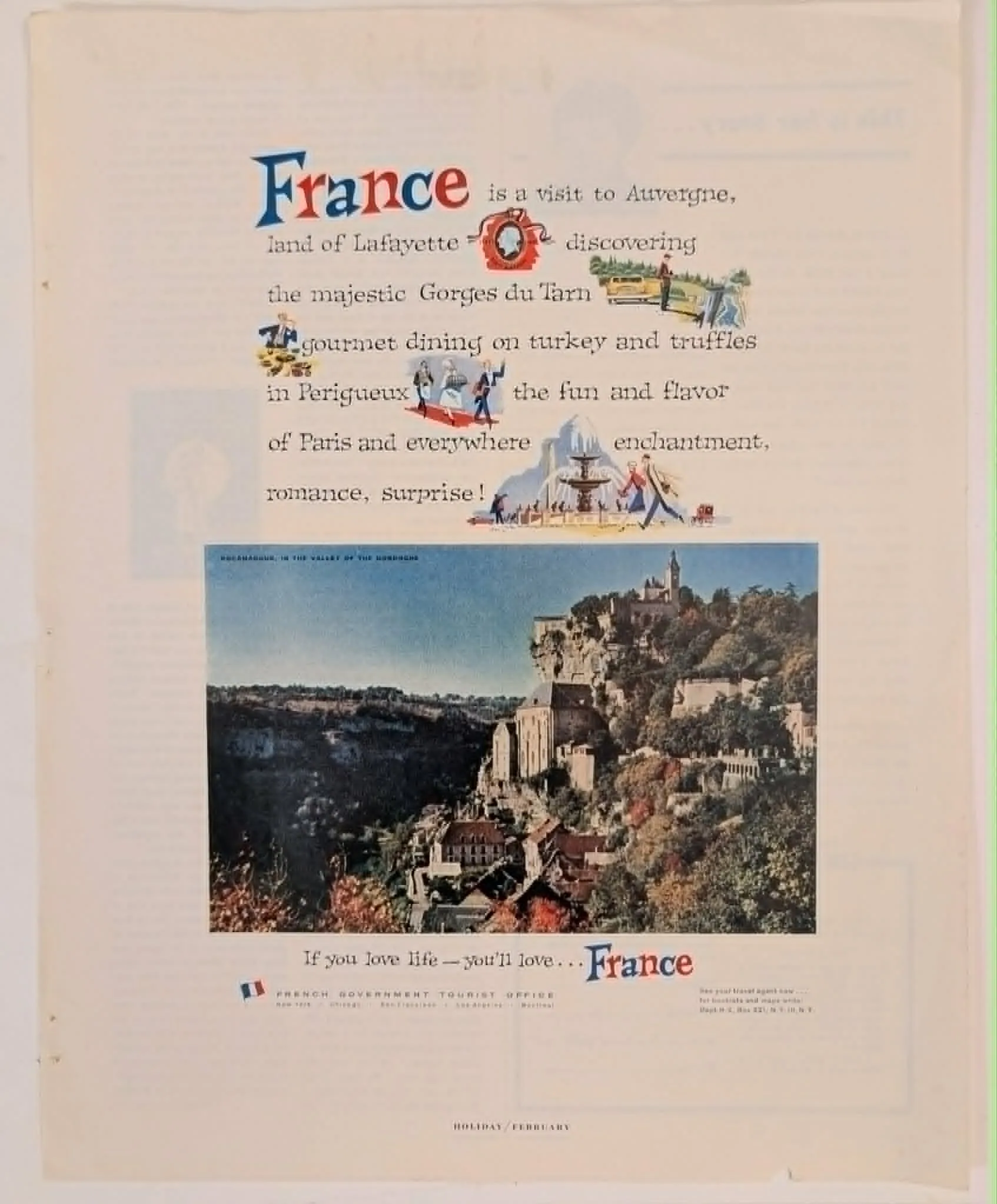
For centuries, international travel was an ordeal of survival. To cross an ocean was to endure weeks of physical peril. To navigate a foreign continent was an exercise in geopolitical risk. The world was vast, fractured, and fiercely guarded. The concept of crossing a border purely for the pursuit of pleasure was a privilege reserved exclusively for the hyper-elite, the aristocrats of the Grand Tour who possessed both infinite time and infinite capital. Then came the psychological shift of the post-war era. This artifact, an archival imprint published in February 1957 by the French Government Tourist Office, documents the precise moment the old world decided to commodify its own history. It represents a monumental pivot in human expectation. The trauma of the Second World War was fading in the rearview mirror of the American economic miracle. A new class of consumer had emerged, armed with unprecedented disposable income, paid vacations, and a hunger for cultural acquisition. This document is not merely an advertisement. It is an instruction manual for escapism. It highlights a conceptual problem: a war-weary Europe needing an influx of foreign capital. It provides the solution: the manufacturing of an idyllic, sanitized dreamscape. France ceased to be merely a nation with complex political realities; it was reformatted into a luxury product, promising enchantment and romance to anyone willing to purchase the ticket.
Category: Travel
The History
The Geopolitical Canvas: The Dawn of Mass Leisure To understand the profound weight of this artifact, one must analyze the geopolitical and economic landscape of 1957. The mid-twentieth century was a crucible of transition. The Marshall Plan had successfully rebuilt the physical infrastructure of Western Europe, but the psychological and economic healing was still ongoing. Across the Atlantic, the United States was experiencing the zenith of the Eisenhower era—a period defined by explosive industrial growth, suburban expansion, and the sudden democratization of wealth. Simultaneously, the mechanics of distance were collapsing. While the luxurious ocean liners like the Île de France still plied the Atlantic, the dawn of the commercial Jet Age was imminent. The world was shrinking rapidly. The European powers realized that their greatest export was no longer just industrial goods or raw materials; it was their heritage. Competitors in the region were already vying for the American dollar. Italy sold the classical romance of ancient ruins and cinematic vespa rides. Great Britain sold the stoic continuity of its royalty. France, however, chose a different psychological anchor. They sold an abstract lifestyle. They sold the very concept of joie de vivre. This advertisement is a calculated strike in that cultural war. It bypasses the trauma of the recent past—the occupation, the rationing, the rebuilding—and presents a timeless, unblemished version of the nation. It is a masterpiece of geopolitical rebranding, turning a complex, recovering country into a pristine playground for the American middle class. The Lafayette Bridge: Engineering Diplomatic Nostalgia The most strategically brilliant element of this artifact is the subtle inclusion of the cameo at the top center: the 200th birthday of the Marquis de Lafayette (1757-1957). This is not a mere historical footnote; it is a calculated psychological bridge. Lafayette, the French aristocrat who fought alongside George Washington in the American Revolutionary War, is the ultimate symbol of the Franco-American alliance. By centering this bicentennial, the French Government Tourist Office was executing a sophisticated diplomatic maneuver. They were subtly reminding the American public of a historical debt. The message, wrapped in the cheerful imagery of tourism, was profound: We bled for your independence; now, come celebrate your prosperity on our shores. It transformed a vacation from a frivolous indulgence into a patriotic pilgrimage. The American tourist was not just spending money; they were returning to the "land of Lafayette" to honor a shared heritage. This bridging of international relations through the vehicle of consumer leisure is a defining characteristic of mid-century soft power. History was flattened, sanitized, and repurposed as an itinerary. The Decentralization of the Tourist Gaze Prior to this era, the American concept of France was almost entirely monolithic: France was Paris. The capital city absorbed the vast majority of the tourist influx, leaving the regional provinces economically disconnected from the post-war travel boom. This artifact represents a deliberate, strategic attempt to decentralize the tourist gaze and distribute foreign capital across the broader landscape. Examine the copy carefully. Paris is mentioned only once, and it is buried in the middle of the text. The primary focus is aggressively regional. The advertisement directs the prospective traveler to the volcanic, rugged terrain of Auvergne. It promises the discovery of the "majestic Gorges du Tarn." It seduces the reader with the promise of "gourmet dining on turkey and truffles in Perigueux." Finally, it grounds the entire composition with a massive, dominant photograph of Rocamadour in the valley of the Dordogne. This is an architectural restructuring of the tourist map. The French government was actively attempting to push the American traveler out of the Parisian cafes and into the deep countryside. They were selling the authenticity of the provinces, the ancient stones of pilgrimage sites, and the deep culinary traditions of the southwest. It was a logistical necessity dressed up as a romantic adventure. The Birth of the Lifestyle Commodity and the Ultimate Ultimatum The philosophical core of this document is located at the very bottom, in a piece of copy that functions as both a promise and a threat: "If you love life - you'll love... France." This is a breathtakingly arrogant and ultimately successful piece of branding. It elevates the nation from a geographical destination to a biological imperative. The advertisement establishes a binary paradigm. To visit France is to affirm your love for existence itself. Therefore, to ignore France, to travel elsewhere, or to stay home, is to admit a deficiency in one's capacity to enjoy life. It equates the consumption of French culture—the truffles, the gorges, the romance—with the fundamental human desire for happiness. This is the exact moment when the "lifestyle brand" was born on a national scale. France was no longer just a place on a map; it was an emotional state of being, available for purchase. The Preservation Protocol: A Living Archive To truly understand the weight of this artifact today, it must be rescued from its static paralysis. It demands to be resurrected as a living 2D artwork. However, the sprawling, loose horizontal composition typical of mid-century print media diffuses its focused impact. To analyze the psychological isolation of this engineered dreamscape, the document requires a strict vertical orientation. A portrait crop forces the modern eye to reconcile the whimsical, floating illustrations at the top directly with the heavy, unyielding stone of Rocamadour at the bottom. The observer must remain locked in place to absorb the scene. A completely static camera, firmly fixed on a tripod, must hold the frame. There can be no modern visual interference—no sweeping 3D pans, no artificial digital zooms. The artifact demands the objective observation of engineered time. Within this rigid, vertical window, the illustration must breathe. The waiter in Perigueux, proudly carrying his covered dish, must exhibit natural character movement. We must observe the subtle, rhythmic rise and fall of his chest, the slow, natural blink of his eyes as he anticipates the gourmet service. The water in the Parisian fountain must cascade in an organic, continuous loop. If the figures in the vignette are to speak, they require precise, era-appropriate lip-synchronization, perfectly matching the clipped, transatlantic cadence of a 1950s voiceover. This visual illusion is entirely dependent on a period-accurate audio landscape. We should not hear the modern roar of jet engines. Instead, the scene is defined by the faint, hollow crackle of a 1950s vacuum-tube radio playing a distant accordion melody. Beneath that, the muted, rhythmic clinking of heavy silverware against fine china, and the ambient, echoing footsteps on ancient cobblestones. This is how the historical shift is preserved: not as a dead, yellowing page, but as a meticulously constructed, breathing terrarium of mid-century ambition.
The Paper
This document is a physical manifestation of mid-century mass communication. Printed on medium-weight, coated magazine stock, it carries the specific GSM (Grams per Square Meter) typical of premium 1950s publications like Holiday magazine. The artifact was created using classic web offset lithography. Upon microscopic inspection, the CMYK (Cyan, Magenta, Yellow, Key/Black) registration is clearly visible, particularly in the dense, saturated photograph of Rocamadour. The halftone dot pattern deconstructs the ancient stone architecture into thousands of tiny, overlapping ink drops—an optical illusion that forces the human brain to construct a cohesive reality from fragmented data. The slow, relentless oxidation of the lignin within the wood pulp has shifted the paper from its original crisp white to a warm, mottled ivory. The edges are fragile, carrying the microscopic abrasions of human handling. This chemical degradation serves as a silent metronome. The artifact is a physical vessel of time, slowly decaying even as the psychological concepts it pioneered—the lifestyle brand, the commodified vacation—remain permanent fixtures of the modern human experience.
The Rarity
Classification: Class B This document is not a solitary masterpiece. It was a mass-produced insert, printed in tens of thousands of copies, designed to be quickly consumed and subsequently discarded by the American middle class. However, its rarity is derived entirely from its immense contextual value. Finding an advertisement that so perfectly bridges the gap between post-war economic recovery, the bicentennial of a Revolutionary War hero, and the deliberate creation of a national lifestyle brand is historically significant. It acts as a Rosetta Stone, translating the complex geopolitical needs of a recovering European nation into the accessible, cheerful language of consumer tourism. Its true value lies not in market scarcity, but in its profound capacity to educate.
Cite this article
- MLA
- Naodhinsuk, Ronin. “The Time Traveller's Dossier : 1957 France - Engineered Escape.” The Record Institute, 7 June 2026, https://therecord.institute/journal/the-time-travellers-dossier-1957-france-engineered-escape.
- APA
- Naodhinsuk, R. (2026, June 7). The Time Traveller's Dossier : 1957 France - Engineered Escape. The Record Institute. https://therecord.institute/journal/the-time-travellers-dossier-1957-france-engineered-escape
- CHICAGO
- Naodhinsuk, Ronin. 2026. “The Time Traveller's Dossier : 1957 France - Engineered Escape.” The Record Institute, June 7, 2026. https://therecord.institute/journal/the-time-travellers-dossier-1957-france-engineered-escape.