The Time Traveller's Dossier : 1964 Studebaker Specialty Lineup - The Desperate Birth of the Niche Vehicle — The Record Institute JournalThe Time Traveller's Dossier : 1964 Studebaker Specialty Lineup - The Desperate Birth of the Niche Vehicle — The Record Institute JournalThe Time Traveller's Dossier : 1964 Studebaker Specialty Lineup - The Desperate Birth of the Niche Vehicle — The Record Institute JournalThe Time Traveller's Dossier : 1964 Studebaker Specialty Lineup - The Desperate Birth of the Niche Vehicle — The Record Institute Journal
1 / 4

✦ 4 Photos — Click any image to view in high resolution

April 5, 2026

The Time Traveller's Dossier : 1964 Studebaker Specialty Lineup - The Desperate Birth of the Niche Vehicle

AutomotiveBrand: StudebakerIllustration: Raymond Loewy (Avanti) & Brooks Stevens (Hawk / Wagonaire)
Archive Views: 3
Heritage AdvertisementsAutomotiveCars

The History

The Oligopoly’s Stranglehold and the Strategy of the Fringe
To understand the profound weight of this document, one must analyze the unforgiving mechanics of the American automotive market in 1964. The post-war era of endless expansion had solidified into an impenetrable oligopoly. General Motors, Ford, and Chrysler dictated the desires of the American public. They achieved this through economies of scale, producing millions of broadly appealing, deeply conventional vehicles. They owned the center of the bell curve.

Studebaker, operating from aging, multi-story brick factories in South Bend, Indiana, possessed dwindling capital and a shrinking dealer network. They could not out-produce Detroit, nor could they out-price them. The strategy, authorized by their dying president Sherwood H. Egbert, was one of radical differentiation. If they could not capture the center, they would attempt to dominate the fringes.

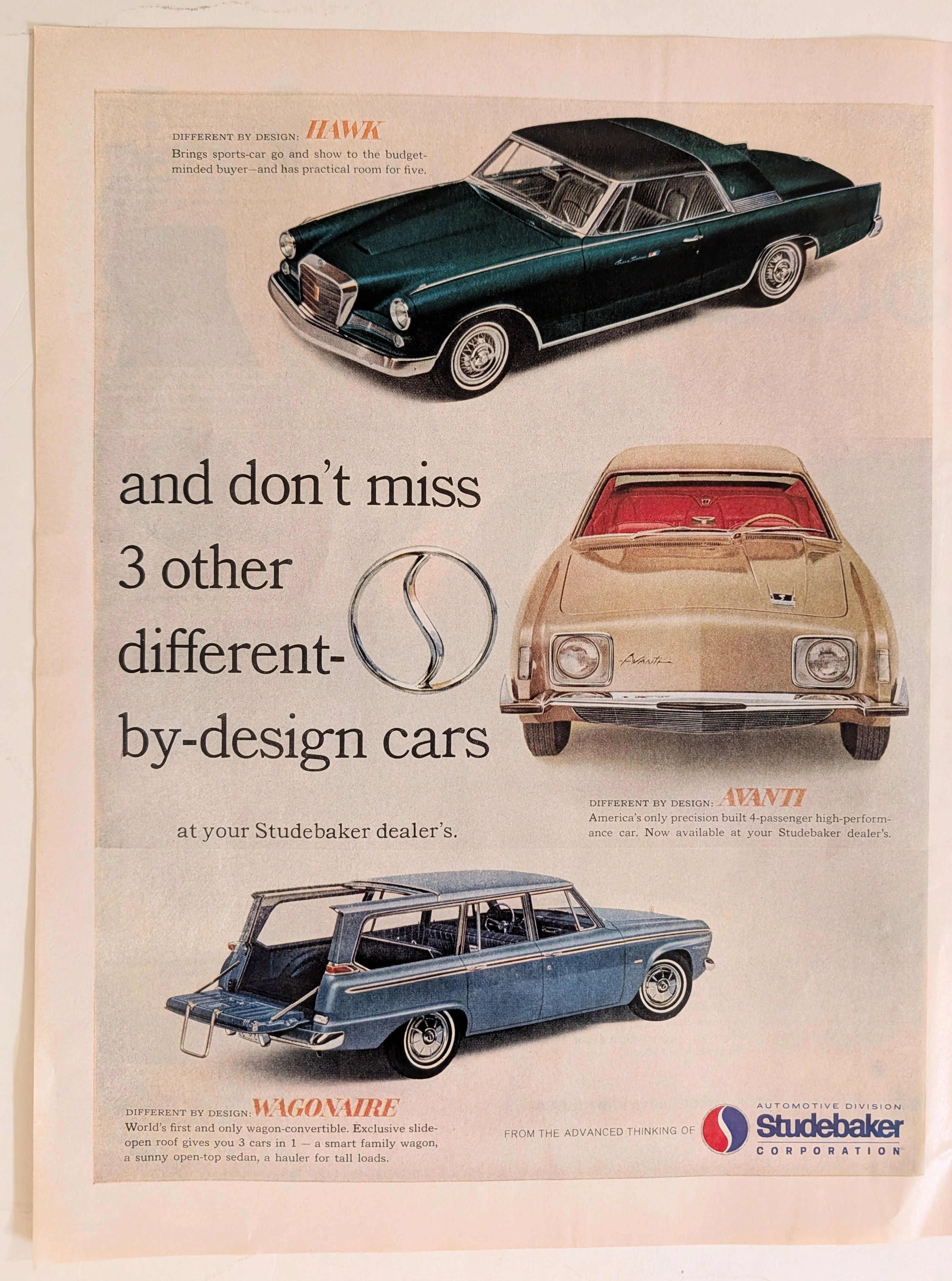
This single page of advertising perfectly encapsulates this doctrine. Under the unified banner of "DIFFERENT BY DESIGN," the company presented three vehicles that shared virtually no aesthetic lineage. They were not a cohesive family of cars; they were a collection of highly specific tools engineered to capture fragmented subsets of the consumer base. This was the birth of hyper-segmentation. Studebaker was attempting to survive by becoming a boutique manufacturer of oddities.

The Avanti: A Fiberglass Fever Dream in a Steel World
Anchoring the right side of the page, bathed in a muted metallic gold, is the Studebaker Avanti. The text audaciously labels it "America’s only precision built 4-passenger high-performance car." The Avanti was not merely a car; it was a desperate Hail Mary pass thrown by a dying executive.

Sherwood Egbert, realizing the brand needed a massive injection of excitement, contracted the legendary industrial designer Raymond Loewy. Loewy, assembling a small team in a rented house in Palm Springs, California, designed the Avanti in a matter of weeks. The resulting vehicle was a violent departure from anything on the road.

Analyze the image provided in the artifact. The Avanti has no traditional grille. It breathes from the bottom, an aerodynamic concept decades ahead of its time. The hood features an asymmetrical bulge to clear the supercharger of the Studebaker V8 engine. The body was constructed entirely of fiberglass, molded by the same company that produced the early Chevrolet Corvette bodies. This was done not just for weight reduction, but because Studebaker lacked the massive capital required to tool up for complex steel stampings.

The Avanti was a rolling paradox. It utilized a heavy, antiquated chassis from the Studebaker Lark, yet it featured a built-in roll bar, padded interiors, and standard caliper disc brakes. It was a high-speed grand tourer built on the bones of an economy car, wrapped in a space-age composite shell. It was designed to capture the wealthy, idiosyncratic buyer who rejected the bloated chrome of the Cadillac or the Lincoln. It failed to save the company, primarily due to fiberglass production delays, but it succeeded in becoming one of the most significant industrial designs of the 20th century.

The Hawk: European Pretensions on a Midwestern Budget
Situated at the top of the page, rendered in a deep, formal green, is the Studebaker Hawk. The accompanying text pitches it as bringing "sports-car go and show to the budget-minded buyer." This vehicle represents a completely different survival tactic: the art of the masterful facelift.

The underlying architecture of the Hawk dated back to 1953. To keep the car relevant a decade later with almost zero research and development budget, Studebaker turned to another titan of industrial design, Brooks Stevens. Stevens was the man who ironically coined the term "planned obsolescence," yet here, his task was to fight against it.

Stevens took the swooping, curvaceous lines of the 1950s Hawk and modernized them through subtraction and squaring. He grafted a formal, squared-off roofline reminiscent of the Ford Thunderbird. Most notably, he redesigned the front fascia. Look closely at the grille in the illustration. It is a tall, upright, heavily chromed centerpiece. At the time, Studebaker was the distributor for Mercedes-Benz in the United States. Stevens deliberately mimicked the austere, aristocratic grille of a Mercedes-Benz luxury sedan.

He transformed a dated, 1950s American coupe into a vehicle that projected the sophisticated, continental aura of a European Grand Tourer (Gran Turismo). It was an illusion of wealth. The Hawk was engineered for the consumer who desired the visual prestige of an imported luxury car, but only possessed the financial means for a domestic runabout. It was an exercise in pure demographic targeting, utilizing design as a psychological lever to extract sales from the aspirational middle class.

The Wagonaire: The Utility Paradox and the Sliding Roof
At the bottom of the page, grounded in a utilitarian blue, sits the Wagonaire. It is proudly declared the "World’s first and only wagon-convertible." Of the three vehicles presented, the Wagonaire is perhaps the most tragic and the most prophetic.

Designed once again by Brooks Stevens, the Wagonaire attempted to solve a problem that the American public had not actually articulated. It featured a rear roof section that manually (or optionally, electrically) slid forward, locking into the forward portion of the roof. This created an open cargo area over the rear axles. The text explains the utility: "3 cars in 1 — a smart family wagon, a sunny open-top sedan, a hauler for tall loads."

Studebaker was targeting a highly specific, microscopic niche. They were building a car for the refrigeration repairman who needed to haul a standing appliance, the nursery owner transporting tall trees, or the surfer who wanted an open-air experience without sacrificing passenger capacity.

The engineering reality was a nightmare. The sliding roof mechanism was prone to catastrophic water leaks. The drain tubes would clog with debris, flooding the cargo area during rainstorms. However, setting the mechanical failures aside, the philosophical concept of the Wagonaire was brilliant. It was the direct spiritual ancestor to the modern crossover SUV and the multi-purpose utility vehicle. It recognized that consumers lived multifaceted lives and might require a single machine to adapt to rapidly shifting scenarios.

The Historical Shift: The Dawn of Niche Marketing
The historical shift recorded on this single page of faded paper is monumental. It represents the death of the monolithic automotive strategy. For decades, Detroit succeeded by telling the consumer what they wanted, producing highly standardized variations of a single theme.

Studebaker, cornered and bleeding, inverted that paradigm. They looked for the gaps in Detroit’s armor. They looked for the oddities, the outliers, the specific use-cases that the Big Three deemed too unprofitable to pursue. They attempted to aggregate a dozen microscopic niche markets to sustain a single corporate entity.

They failed. The gravity of the industrial economy in 1964 was too strong. The public did not want a sliding roof; they wanted a Ford Country Squire. They did not want a fiberglass oddity; they wanted a Pontiac GTO. However, if one looks at the automotive landscape today, the Studebaker doctrine is the absolute law of the land. Every major manufacturer now produces hyper-specific crossover coupes, off-road luxury trucks, and high-performance family wagons. The "universal car" is dead. The niche vehicle is supreme. This 1964 advertisement proves that Studebaker possessed the correct vision of the future. They merely lacked the time, the capital, and the mechanical execution to live long enough to see it arrive.

The Paper

An exhaustive physical analysis of this artifact reveals the high-volume, mid-century standards of commercial publication printing. The substrate is a standard, lightweight, machine-coated magazine stock, likely weighing between 55 and 65 GSM (Grams per Square Meter). The paper underwent a light calendering process, providing the minimal surface gloss required to hold the complex halftone dots without excessive ink spread.

The relentless aging process is evident in the severe oxidation of the paper fibers. The inherent acidity of the cheap wood pulp used in 1960s commercial printing has resulted in a uniform, heavy yellowing across the entire page. The once-stark white background has degraded into a dark, archival cream tone.

The printing method is a four-color web offset lithography process. Under magnification, the CMYK (Cyan, Magenta, Yellow, Key/Black) rosette patterns are distinctly visible, particularly in the deep green of the Hawk and the metallic gold rendering of the Avanti. The ink absorption remains remarkably stable. The registration—the mechanical alignment of the four color plates—is tightly controlled, allowing the fine, intricate lines of the wire-spoke hubcaps and the delicate serif typography to remain sharp. The physical paper is fragile and ephemeral; its true weight is derived entirely from the desperate, prophetic corporate strategy it permanently records.

The Rarity

Classification: Class A (Contextually Profound)

In terms of pure physical scarcity, this single-page advertisement is not exceptionally rare. As a component of major national periodicals in late 1963 and early 1964, millions of identical copies were printed and circulated. It remains readily available to ephemera collectors and automotive historians.

However, this artifact earns a definitive Class A rating based entirely on its profound contextual and historical value. Its rarity lies in its function as a concentrated, visual thesis statement of a dying corporation’s final strategy. It is exceedingly rare to find a single corporate document that so perfectly encapsulates the birth of an entirely new marketing philosophy—the niche vehicle segment—born out of absolute industrial desperation. The juxtaposition of Loewy’s radical futurism alongside Stevens’ pragmatic recycling elevates this artifact from a mere catalog of products to a primary historical record of asymmetrical industrial survival tactics.
Visual Impact

The visual composition of this page is a masterclass in calculated isolation. The layout deliberately abandons the traditional, lifestyle-driven advertising tropes of the 1960s. There are no aspirational backgrounds, no suburban driveways, and no smiling human models.

The three vehicles are presented entirely suspended in a void of negative space. This strategy forces the viewer’s eye to focus exclusively on the machinery and the radical differences in their respective designs. The layout is highly structured, divided into three horizontal tiers, each dedicated to a specific niche.

In the center of the page, acting as the ultimate visual and philosophical anchor, is the oversized Studebaker "Lazy S" logo, encircled in chrome. It is flanked by the heavy, authoritative typography: "3 other different-by-design cars." The typography throughout the page utilizes a mix of formal, institutional serif fonts for the body copy, juxtaposed against italicized, brightly colored serif fonts (Orange for Hawk and Wagonaire, Bronze for Avanti) to highlight the model names.

The color palette of the vehicles is deliberately distinct, emphasizing their lack of familial relation. The deep, conservative green of the Hawk projects traditional luxury. The bright, metallic gold of the Avanti projects aggressive futurism. The utilitarian, flat blue of the Wagonaire projects functional pragmatism. The visual strategy is one of clinical presentation; it is a catalog of specialized tools arrayed on a blank table for the discerning, unconventional buyer.

Share This Archive

The Archive Continues

Continue the Exploration

The Time Traveller's Dossier: The Semantics of Arrogance – JOY de Jean Patou Advertisement (Circa 1980s)

๋Joy De Jean Patou · Fashion

The Time Traveller's Dossier: The Semantics of Arrogance – JOY de Jean Patou Advertisement (Circa 1980s)

History is not written by the victors; it is printed by the industrialists. Long before digital algorithms began to sterilely dictate human consumption and virtual reality stripped away authentic tactile sensation, societal engineering and consumer psychology were executed through the calculated, mathematical geometry of the four-color offset press and the absolute mastery of analog darkroom photography. The historical artifact before us is not merely a disposable magazine tear sheet meant to peddle a fragrance. It is a perfectly weaponized blueprint of absolute capitalist supremacy, a visual declaration of class warfare, and an unwavering testament to an era of uncompromising, unapologetic ultra-luxury. This museum-grade, academic archival dossier presents an exhaustive deconstruction of a late-analog print advertisement for the legendary fragrance "JOY de Jean Patou," dating from the late 1970s to the early 1980s. Operating on a profound and ruthless binary structure, this document records a calculated paradigm shift within the global luxury goods industry. It captures the precise historical fracture where luxury transitioned conceptually from being a mere indicator of high-quality craftsmanship into a blatant, arrogant weapon of socioeconomic exclusion. Through the highly specialized lens of late-analog commercial artistry and stringent visual forensics, this document serves as a masterclass in psychological marketing. It established the foundational archetype for selling astronomically priced, exclusionary items—an archetype that unconditionally dictates the visual and strategic totems of modern ultra-luxury brands today.

The Time Traveller's Dossier: Aeronautical Architecture on the Asphalt – The SAAB 96 V4 and the Engineering of Adverse Weather Superiority

Saab · Automotive

The Time Traveller's Dossier: Aeronautical Architecture on the Asphalt – The SAAB 96 V4 and the Engineering of Adverse Weather Superiority

The evolution of the mid-twentieth-century American automotive landscape was heavily disrupted by the influx of European imports, each vying to dismantle the hegemony of the domestic V8, rear-wheel-drive giants. Elegantly and securely positioned upon the analytical table of The Record Institute today is a visually striking, narrative-driven full-page print advertisement for the SAAB Automobile (featuring the new V-4 engine), definitively dating to the late 1960s. This document transcends the standard, utilitarian boundaries of automotive marketing. It operates as a highly sophisticated, multi-layered cultural mirror, reflecting a precise era in consumer psychology where the anxiety of driving in severe weather was aggressively mitigated through the promise of superior, aircraft-inspired engineering. By utilizing a dramatic, heavily grained monochromatic photograph of a SAAB battling torrential rain, juxtaposed with a pristine, spot-color red illustration of the vehicle, the manufacturer successfully positioned itself not merely as a car company, but as a purveyor of meteorological invincibility. This world-class, comprehensive dossier conducts a meticulous, unyielding, and exceptionally exhaustive examination of the artifact, operating under the absolute most rigorous parameters of historical, sociological, and material science evaluation. Dedicating the overwhelming majority of our analytical focus (80%) to its immense historical gravity, we will decode the brilliant marketing psychology embedded within the "front-wheel drive" narrative, analyze the profound engineering pivot of the "new V-4 engine," and dissect the sociopolitical genius of marketing safety before it was federally mandated. Furthermore, as we venture deeply into the chemical and physical foundations of this analog printed ephemera (10%), we will reveal the precise mechanical fingerprints of the spot-color halftones captured in the macro imagery of the red SAAB illustration. Finally, we will assess its archival rarity (10%), exploring how the graceful, natural oxidation of the paper substrate cultives a serene wabi-sabi aesthetic—a natural, irreversible phenomenon that serves as the primary engine driving up its market value exponentially within the elite global spheres of Vintage Commercial Ephemera and Automotive Archives.

Viceroy: Al Unser and the "Taste of Excitement"

Viceroy: Al Unser and the "Taste of Excitement"

A legendary artifact linking Al Unser's racing dominance to the golden age of tobacco advertising, a style now permanently banned. The value of this original page will appreciate significantly as pre-2000 analog media naturally decays and vanishes forever.

Published by

The Record Institute

Taxonomy Match

Related Articles

The Time Traveller's Dossier : 1964 Studebaker Cruiser - The Euphoric Facade of a Dying Empire — related article
Read Article

The Time Traveller's Dossier : 1964 Studebaker Cruiser - The Euphoric Facade of a Dying Empire

Then, it was a desperate masquerade. A corporate death rattle disguised as a celebration. As this vibrant, two-page centerfold spread graced the glossy pages of American magazines in late 1963, the Studebaker Corporation was quietly bleeding to death. To the casual observer, the advertisement projects an atmosphere of unbridled optimism. A couple leaps into the air with forced, hysterical joy. The typography dances across the page, screaming, "it's here! beautiful! new! exciting!" It is a masterclass in the marketing of artificial momentum. Yet, to the side, anchored in a rigid column of diagrams and technical specifications, lies the stubborn, unyielding truth of a company that still believed superior engineering could save it from financial ruin. Now, this artifact is a profound psychological study of cognitive dissonance in industrial capitalism. It is the physical record of a brand caught in a fatal crossfire: desperately trying to mimic the lifestyle-driven, emotion-heavy advertising of Detroit’s Big Three, while simultaneously clinging to its heritage of hyper-rational, utilitarian engineering. The historical shift here is the final realization that in the modern consumer economy, a superior machine cannot survive if the dream it sells has already expired.

The Time Traveller's Dossier: Gridline Velocity – Kenwood Car Stereo and the Cybernetic Dawn of Automotive High-Fidelity — related article
Read Article

The Time Traveller's Dossier: Gridline Velocity – Kenwood Car Stereo and the Cybernetic Dawn of Automotive High-Fidelity

The evolution of 1980s American consumer electronics was fundamentally defined by the aggressive pursuit of portable and automotive high-fidelity sound. Elegantly and securely positioned upon the analytical table of The Record Institute today is a visually arresting, neon-drenched full-page print advertisement for Kenwood Car Stereo. This document completely transcends the standard, utilitarian boundaries of automotive accessory marketing. It operates as a highly sophisticated cultural mirror, reflecting a precise era in consumer psychology where auditory power was directly equated with vehicular performance. By utilizing a breathtaking, airbrushed illustration of a futuristic, aerodynamic race car accelerating over a cybernetic gridscape, Kenwood brilliantly positioned its audio equipment not just as radios, but as extreme, high-octane performance upgrades capable of generating sound that will literally "blow your doors off." This world-class, comprehensive dossier conducts a meticulous, unyielding, and exceptionally exhaustive examination of the artifact, operating under the absolute most rigorous parameters of historical, sociological, and material science evaluation. Dedicating the overwhelming majority of our analytical focus (80%) to its immense historical gravity, we will decode the brilliant marketing psychology embedded within the "neon grid" visual narrative, analyze the profound cultural shift toward aftermarket car audio customization, and dissect the aggressive, performance-based copywriting. Furthermore, as we venture deeply into the chemical and physical foundations of this analog printed ephemera (10%), we will reveal the precise mechanical fingerprints of the CMYK halftone rosettes captured in the stunning macro imagery of the airbrushed car. Finally, we will assess its archival rarity (10%), exploring how the graceful, natural oxidation of the paper substrate cultivates a serene wabi-sabi aesthetic—a natural, irreversible phenomenon that serves as the primary engine driving up its market value exponentially within the elite global spheres of Vintage Commercial Ephemera, Audio History, and Outrun/Synthwave Art Archives.

The Time Traveller's Dossier : 1964 Studebaker - The Final Defiance of the Independent Automaker — related article
Read Article

The Time Traveller's Dossier : 1964 Studebaker - The Final Defiance of the Independent Automaker

Then, it was a declaration of survival. A corporate manifesto masked as a product introduction. In late 1963, as this advertisement went to press, the American automotive landscape was consolidating into an impenetrable oligopoly. The Big Three—General Motors, Ford, and Chrysler—dictated the market. Studebaker, an independent manufacturer with roots dating back to wagon-building in the 19th century, was bleeding capital. This document represents their final, logical plea to the rational consumer. It highlights safety before safety was mandated. It promises performance, economy, and structural integrity. It carries the personal signature of a dying president, Sherwood H. Egbert. Now, it is an artifact of extinction. A perfectly preserved record of a company attempting to logic its way out of an emotional marketplace. It stands as a testament to the brutal reality of industrial capitalism: superior engineering and honest value cannot always overcome the sheer inertia of massive corporate scale. The shift here is not technological. It is structural. It marks the closing of the era where an independent automaker could survive purely on the merit of being "Different… by Design."

The Time Traveller's Dossier: Aeronautical Architecture on the Asphalt – The SAAB 96 V4 and the Engineering of Adverse Weather Superiority — related article
Read Article

The Time Traveller's Dossier: Aeronautical Architecture on the Asphalt – The SAAB 96 V4 and the Engineering of Adverse Weather Superiority

The evolution of the mid-twentieth-century American automotive landscape was heavily disrupted by the influx of European imports, each vying to dismantle the hegemony of the domestic V8, rear-wheel-drive giants. Elegantly and securely positioned upon the analytical table of The Record Institute today is a visually striking, narrative-driven full-page print advertisement for the SAAB Automobile (featuring the new V-4 engine), definitively dating to the late 1960s. This document transcends the standard, utilitarian boundaries of automotive marketing. It operates as a highly sophisticated, multi-layered cultural mirror, reflecting a precise era in consumer psychology where the anxiety of driving in severe weather was aggressively mitigated through the promise of superior, aircraft-inspired engineering. By utilizing a dramatic, heavily grained monochromatic photograph of a SAAB battling torrential rain, juxtaposed with a pristine, spot-color red illustration of the vehicle, the manufacturer successfully positioned itself not merely as a car company, but as a purveyor of meteorological invincibility. This world-class, comprehensive dossier conducts a meticulous, unyielding, and exceptionally exhaustive examination of the artifact, operating under the absolute most rigorous parameters of historical, sociological, and material science evaluation. Dedicating the overwhelming majority of our analytical focus (80%) to its immense historical gravity, we will decode the brilliant marketing psychology embedded within the "front-wheel drive" narrative, analyze the profound engineering pivot of the "new V-4 engine," and dissect the sociopolitical genius of marketing safety before it was federally mandated. Furthermore, as we venture deeply into the chemical and physical foundations of this analog printed ephemera (10%), we will reveal the precise mechanical fingerprints of the spot-color halftones captured in the macro imagery of the red SAAB illustration. Finally, we will assess its archival rarity (10%), exploring how the graceful, natural oxidation of the paper substrate cultives a serene wabi-sabi aesthetic—a natural, irreversible phenomenon that serves as the primary engine driving up its market value exponentially within the elite global spheres of Vintage Commercial Ephemera and Automotive Archives.