The Time Traveller's Dossier : 1968 AMC Javelin - The Shift to Radical Transparency in Automotive Advertising
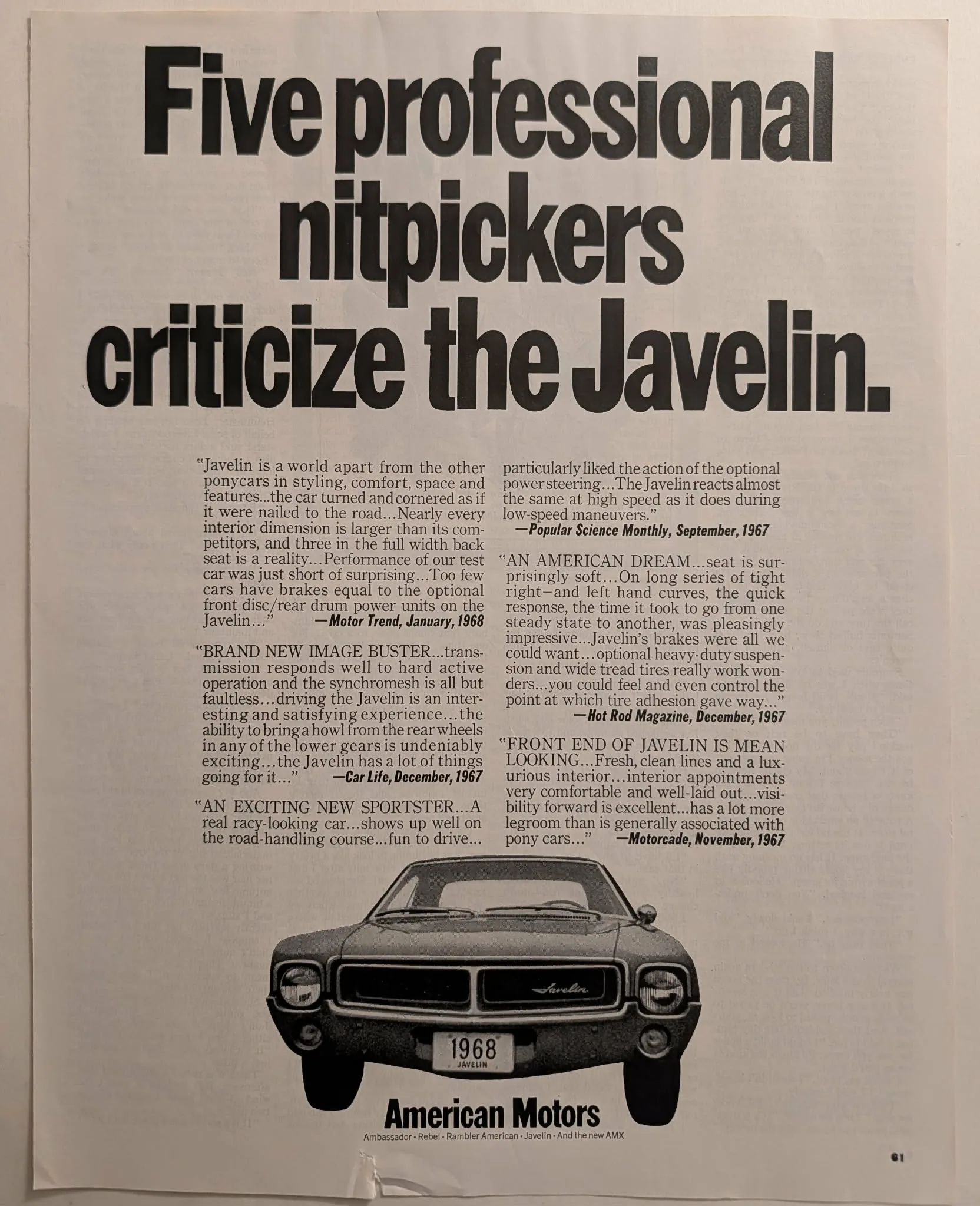
Then: The American automotive industry operated on a doctrine of manufactured perfection. Advertising was a strict monologue. Brands dictated desires from a pedestal, utilizing hyperbolic illustrations and idealized lifestyle tableaus to project an illusion of flawlessness. The consumer was expected to simply listen and purchase. Now: This document stands as a structural disruption. It is a deliberate fracture in the facade of corporate infallibility. By weaponizing the concept of the "nitpicker"—the professional skeptic—American Motors Corporation (AMC) shifted the paradigm from monologue to dialectic. They did not tell the consumer the vehicle was perfect. They invited journalists to meticulously dissect it, relying on the sheer engineering competence of the machine to survive the scrutiny. This artifact marks the exact moment automotive advertising matured, acknowledging an audience that had grown weary of hollow corporate promises and hungry for mechanical truth.
Category: Technology
The History
The Epoch of the Underdog: Detroit in 1968 To understand this artifact, one must first understand the macroeconomic theater of late-1960s America. The automotive landscape was an oligopoly, ruthlessly dominated by the "Big Three": General Motors, Ford, and Chrysler. These monoliths commanded immense capital, dictating market trends through brute-force manufacturing and astronomical advertising budgets. American Motors Corporation existed on the periphery. They were the perennial underdog, operating with a fraction of the resources. In 1968, the American psyche was also undergoing a profound structural shift. The unquestioning compliance of the post-war 1950s was dissolving into the skepticism of the late 1960s. A counter-culture was rising. Trust in institutional authority was eroding. The consumer was becoming analytical, cynical, and highly resistant to traditional, authoritative marketing tactics. AMC recognized this cultural pivot. They understood that attempting to out-shout Ford or Chevrolet with traditional hyperbole would be a fatal misallocation of capital. They needed a different weapon. They needed radical, almost uncomfortable, transparency. The Pony Car Hegemony and the Crisis of Relevance By 1967, the "pony car" segment, birthed by the Ford Mustang in 1964 and rapidly followed by the Chevrolet Camaro, was the most intensely contested battleground in the industry. These vehicles sold not just transport, but identity: youth, aggression, and freedom. AMC had been late to this specific arms race. Their prior offerings were perceived as sensible, economical, and ultimately pedestrian. To survive, they engineered the Javelin. It was a mechanical counter-offensive designed with a broader stance, a more aggressive silhouette, and superior interior dimensions. However, engineering a competent machine was only a fraction of the equation. The monumental challenge was psychological: how does an underdog brand convince a skeptical public that their new machine is mathematically and viscerally equal to the established titans? The answer was to surrender the corporate voice and hand the microphone to the harshest critics. Engineering the Alternative: The Architecture of the Javelin The physical manifestation of this strategy is embedded in the textual evidence of the document itself. The ad does not rely on vague adjectives; it deploys clinical, verifiable data through third-party proxies. Through the lens of Motor Trend (January 1968), we observe the geometric triumph of the Javelin: "Nearly every interior dimension is larger than its competitors, and three in the full width back seat is a reality." This directly attacks the known physical limitations of the Mustang. The engineering tolerances are validated by Car Life (December 1967), which notes the "synchromesh is all but faultless." By referencing specific mechanical components—the front disc and rear drum power units, the heavy-duty suspension, the optional power steering—the artifact transitions from an advertisement into a technical briefing. It grounds the vehicle in cold, hard physics. The Javelin is not presented as an abstract dream; it is presented as a collection of meticulously engineered steel and hydraulic systems, verified by independent operators. The Epistemological Shift: Weaponizing the Critique The headline of this artifact—"Five professional nitpickers criticize the Javelin."—represents an epistemological shift in mass communication. Traditionally, the word "criticize" was toxic in corporate marketing. Here, it is the anchor. A "nitpicker" is someone who looks for microscopic flaws. By boldly inviting this level of pedantic scrutiny, AMC projected absolute, unshakeable confidence in their product. They were stating, implicitly, that the Javelin could withstand the harshest light. The typography of the quotes further reinforces this. They are dense, intimidating blocks of text. This was a deliberate filtering mechanism. It demanded a literate, patient, and analytical reader. It repelled the superficial buyer and attracted the enthusiast. When Popular Science Monthly (September 1967) remarks that the car reacts "almost the same at high speed as it does during low-speed maneuvers," it speaks a specific language to a specific demographic. This was advertising functioning as peer-review. The Arsenal of the Incumbent and the Legacy of Disruption The established brands relied on emotional manipulation. They sold the sizzle. AMC, through this artifact, sold the steak. They dismantled the Goliath syndicate by changing the rules of engagement. They embraced their position as the challenger brand, utilizing self-awareness as their primary currency. The bottom of the page proudly lists the lineage: "Ambassador • Rebel • Rambler American • Javelin • And the new AMX." This is not an apology for their catalog; it is a battle standard. The historical significance of this specific document lies in its anticipation of modern consumer behavior. Decades before the internet, before customer reviews, and before the democratization of critique, this advertisement built a framework based on third-party validation. It acknowledged that the most persuasive voice is not the creator, but the independent observer. It shifted the industry from a dictatorial monologue to a transparent dialogue, permanently altering the velocity and trajectory of automotive copywriting. The artifact stands as a monument to the moment vulnerability was weaponized for commercial victory.
The Paper
This artifact is a study in industrial reproduction. Printed on a low-GSM, highly acidic newsprint or magazine stock, it was never designed for permanence. Its survival is an accident of archiving. A microscopic analysis of the imagery reveals a distinct, monochromatic halftone pattern. The gradients of the Javelin's front grille, the shadowing beneath the bumper, and the reflective contours of the hood are all illusions constructed from precisely arranged dots of varying diameters. This specific mechanical reproduction method strips away the gloss and romance found in high-end automotive brochures. It presents the information with the clinical austerity of a daily newspaper or a technical manual. The paper itself is subjected to the slow violence of time; oxidation has likely brittle the edges and shifted the once-stark white background into a warmer, historical sepia. This static artifact, captured in its halftone degradation, holds a latent kinetic energy. It is a prime candidate for temporal resurrection—an ideal subject for those who seek to animate vintage print, transforming its rigid typography into a moving, breathing manifesto. It is a physical recording of a bygone era's analog reality.
The Rarity
While millions of these magazines were printed in 1967 and 1968, the survival rate of intact, unblemished pages is exceedingly low due to the disposable nature of the medium. However, its true rarity is not dictated by its market scarcity, but by its philosophical weight. It is a "Class A" artifact because it perfectly encapsulates a paradigm shift in corporate communication. Market price is irrelevant compared to its educational value for archivists and strategic analysts studying the evolution of mass media persuasion. It is a foundational text in the history of transparent marketing.
Cite this article
- MLA
- Naodhinsuk, Ronin. “The Time Traveller's Dossier : 1968 AMC Javelin - The Shift to Radical Transparency in Automotive Advertising.” The Record Institute, 20 July 2026, https://therecord.institute/journal/the-time-travellers-dossier-1968-amc-javelin-the-shift-to-radical-transparency-in-automotive-advertising.
- APA
- Naodhinsuk, R. (2026, July 20). The Time Traveller's Dossier : 1968 AMC Javelin - The Shift to Radical Transparency in Automotive Advertising. The Record Institute. https://therecord.institute/journal/the-time-travellers-dossier-1968-amc-javelin-the-shift-to-radical-transparency-in-automotive-advertising
- CHICAGO
- Naodhinsuk, Ronin. 2026. “The Time Traveller's Dossier : 1968 AMC Javelin - The Shift to Radical Transparency in Automotive Advertising.” The Record Institute, July 20, 2026. https://therecord.institute/journal/the-time-travellers-dossier-1968-amc-javelin-the-shift-to-radical-transparency-in-automotive-advertising.