The Time Traveller's Dossier : 1968 Sprite - The Nature Shift
The year is 1968. The era of post-war artificiality has reached its zenith. Synthetic materials are the foundation of modern life. Laboratory-born conveniences dominate the American household. Then, a pivot occurs. Sprite, a mass-produced carbonated beverage, changes the narrative. They do not sell a formula. They sell a feeling. They sell "natural". This is not merely an advertisement. It is a documented shift in consumer psychology. A deliberate move from the mechanics of industrial production to the illusion of botanical purity. The problem was a society fatigued by the synthetic. The solution was a green bottle, cold ice, and daisies.
Category: Beverage
Brand: Sprite
The History
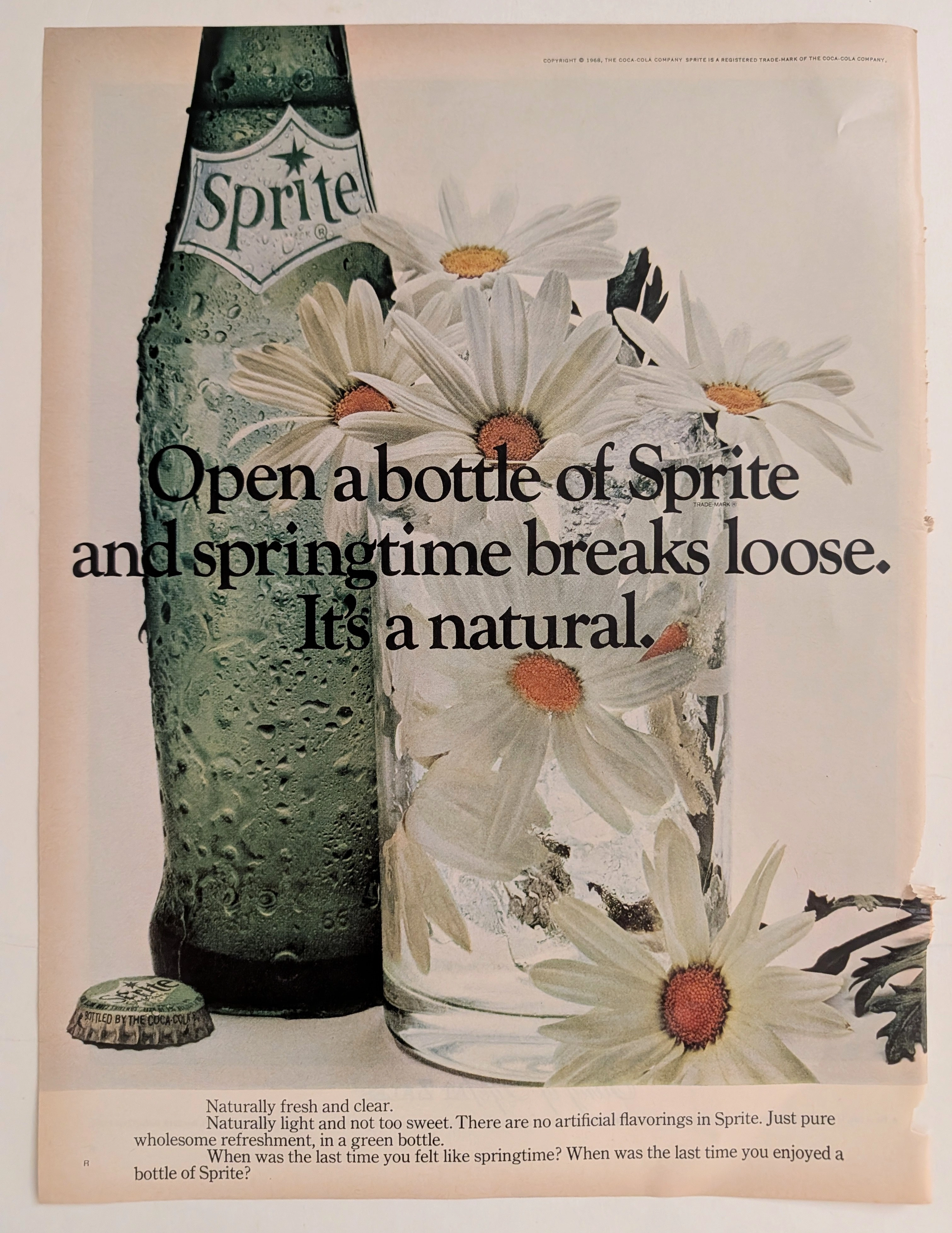
The artifact before us requires profound contextualization. To understand this piece of printed matter, we must understand the world that birthed it. The year 1968 is a scar on the timeline. It is a year of global upheaval. The Vietnam War is raging. Political assassinations fracture the American psyche. The Space Race is pushing technology into the cold void of the cosmos. Society is accelerating at a terrifying velocity. In the decades prior, the consumer market worshipped the artificial. The 1950s promised better living through chemistry. Plastics, synthetics, and lab-created flavors were symbols of progress. They were clean. They were modern. They were uniform. But by 1968, a fracture appears in this utopia. The counterculture movement is gaining traction. There is a growing unease with the military-industrial complex. There is a rising awareness of environmental degradation. Rachel Carson’s Silent Spring has planted a seed of doubt regarding chemical supremacy. People are beginning to yearn for something else. They want an escape from the sterile. They want a return to the earth. They want the authentic. They want the "natural". Enter The Coca-Cola Company. They launched Sprite in 1961. It was a strategic response to the dominance of 7 Up in the lemon-lime sector. For its first few years, Sprite was marketed primarily on its tartness. It was pushed as a mixer. It was functional. This 1968 advertisement marks a profound philosophical shift. The messaging abandons the laboratory. It weaponizes nature. "Open a bottle of Sprite and springtime breaks loose." It is a masterful stroke of cognitive dissonance. Sprite is, fundamentally, a triumph of industrial engineering. It is carbonated water, high-fructose corn syrup, citric acid, and carefully synthesized flavor profiles. It is manufactured in massive steel vats. It is bottled on mechanized assembly lines. Yet, the narrative presented here completely erases the factory. Consider the competitors of the era. In 1968, 7 Up launched its legendary "Uncola" campaign. 7 Up chose to lean into the counterculture. They positioned themselves as the rebellious alternative to the mainstream colas. They used psychedelic art. They spoke the language of the youth. Sprite took a different path. Sprite did not choose rebellion. Sprite chose comfort. Sprite chose purity. While 7 Up asked you to defy the establishment, Sprite offered you a meadow. This was a brilliant bifurcation of the non-cola market. The economic landscape of 1968 supported this illusion. The post-war boom had created a massive middle class with disposable income. Mass media allowed for the rapid dissemination of carefully constructed realities. Magazines were the primary vehicle for high-fidelity visual communication. The printing presses of the era were churning out millions of these pages, embedding this specific association—Sprite equals spring—into the collective subconscious. Let us analyze the technological landscape of the product itself. The green bottle is not an accident. It is a deeply calculated piece of engineering and psychology. Technically, green glass (often created by adding iron oxide to the silica mixture) offers slight protection against UV light, preserving the beverage. Psychologically, green is the color of flora. It signals freshness. It signals life. In a sea of brown colas, the green bottle stood out on the grocery shelf like a beacon of hydration. The copy at the bottom of the artifact is equally crucial. "Naturally fresh and clear." "Naturally light and not too sweet." "There are no artificial flavorings in Sprite. Just pure wholesome refreshment, in a green bottle." The repetition of "natural" is a rhythmic drumbeat. It is a direct assault on the growing anxiety over chemical additives. It reassures the consumer. It provides permission to indulge. It tells the buyer that drinking this industrialized sugar water is akin to partaking in a natural harvest. This artifact captures the exact moment advertising learned to mask the machine behind the flower. It is the dawn of "greenwashing" long before the term existed. It is the commodification of the changing seasons. The ad does not promise to quench thirst. It promises to alter reality. It suggests that popping a metal cap can manipulate time and space, releasing "springtime" into a presumably stale room. The historical shift is undeniable. We moved from celebrating the engineering of a beverage to disguising it. This advertisement paved the way for decades of subsequent marketing across all industries. From "natural" cereals to "clean" beauty products. The template was forged here. Take an industrial product. Surround it with natural imagery. Use the word "pure". The human brain, craving simplicity and safety, will make the association. This artifact is a primary source document of that psychological manipulation.
The Paper
The physical medium is a testament to the era of offset lithography. We are looking at a magazine tear sheet from 1968. The paper stock is typical for mass-market publications of the mid-20th century. It is a medium-weight, coated stock. The coating was designed to hold the ink on the surface, allowing for the relatively sharp reproduction of the halftone dots. In the provided macro photographs, the technical reality of the printing process is exposed. The illusion of the daisy breaks down into a matrix of Cyan, Magenta, Yellow, and Key (Black). The CMYK rosette patterns are clearly visible upon close inspection. This is the mechanical truth behind the "natural" image. The smooth gradation of the green glass is achieved through thousands of microscopic ink droplets layered over each other. The aging process is evident. The paper is oxidizing. The edges are brittle and frayed, showing physical trauma from removal. The chemical composition of the paper—likely containing acid-producing wood pulp—ensures its eventual degradation. The background, once a stark white, has shifted to a warm, aged cream. This yellowing paradoxically enhances the vintage appeal of the artifact today. It physically embodies the passage of time. It is an artifact recording its own decay. The mechanical reproduction of nature is slowly being reclaimed by the natural law of entropy.
The Rarity
Classification: Class B. Millions of these magazines were printed and distributed across North America in 1968. The sheer volume of production means the material itself is not inherently scarce. However, its survival rate is low. Magazines were ephemeral. They were consumed and discarded. Finding an intact page, free from severe water damage or total structural failure, elevates its status. The true value of this artifact is not monetary; it is contextual. It is a pristine example of a major corporation pivoting its global strategy. It is an anchor point in the timeline of advertising psychology. Its rarity lies in its utility as an educational and historical tool.
Cite this article
- MLA
- Naodhinsuk, Ronin. “The Time Traveller's Dossier : 1968 Sprite - The Nature Shift.” The Record Institute, 6 May 2026, https://therecord.institute/journal/the-time-travellers-dossier-1968-sprite-the-nature-shift.
- APA
- Naodhinsuk, R. (2026, May 6). The Time Traveller's Dossier : 1968 Sprite - The Nature Shift. The Record Institute. https://therecord.institute/journal/the-time-travellers-dossier-1968-sprite-the-nature-shift
- CHICAGO
- Naodhinsuk, Ronin. 2026. “The Time Traveller's Dossier : 1968 Sprite - The Nature Shift.” The Record Institute, May 6, 2026. https://therecord.institute/journal/the-time-travellers-dossier-1968-sprite-the-nature-shift.