The Time Traveller's Dossier : 1976 Bertone Navajo - Design's Crisis
Before 1973, progress was a straight, undeniable line. It was drawn by raw horsepower, limitless combustion, and absolute mechanical optimism. Then, the world ran dry. The line snapped. This document captures the precise, uncomfortable aftermath. It is the exact moment an entire global industry attempted to tape that shattered line back together with fiberglass and deception. Faced with choking emissions regulations, stringent safety legislation, and the terrifying realization of finite resources, engineering innovation stalled. The machine could no longer breathe freely. The solution was not a mechanical revolution, but a visual fabrication. If the automobile could no longer break physical boundaries, it had to look as if it were breaking the sound barrier while standing completely still. The future was no longer forged in the foundry; it was sculpted in the studio. We transitioned violently from an era of mechanical truth to an era of aerodynamic fiction.
Category: Automotive
The History
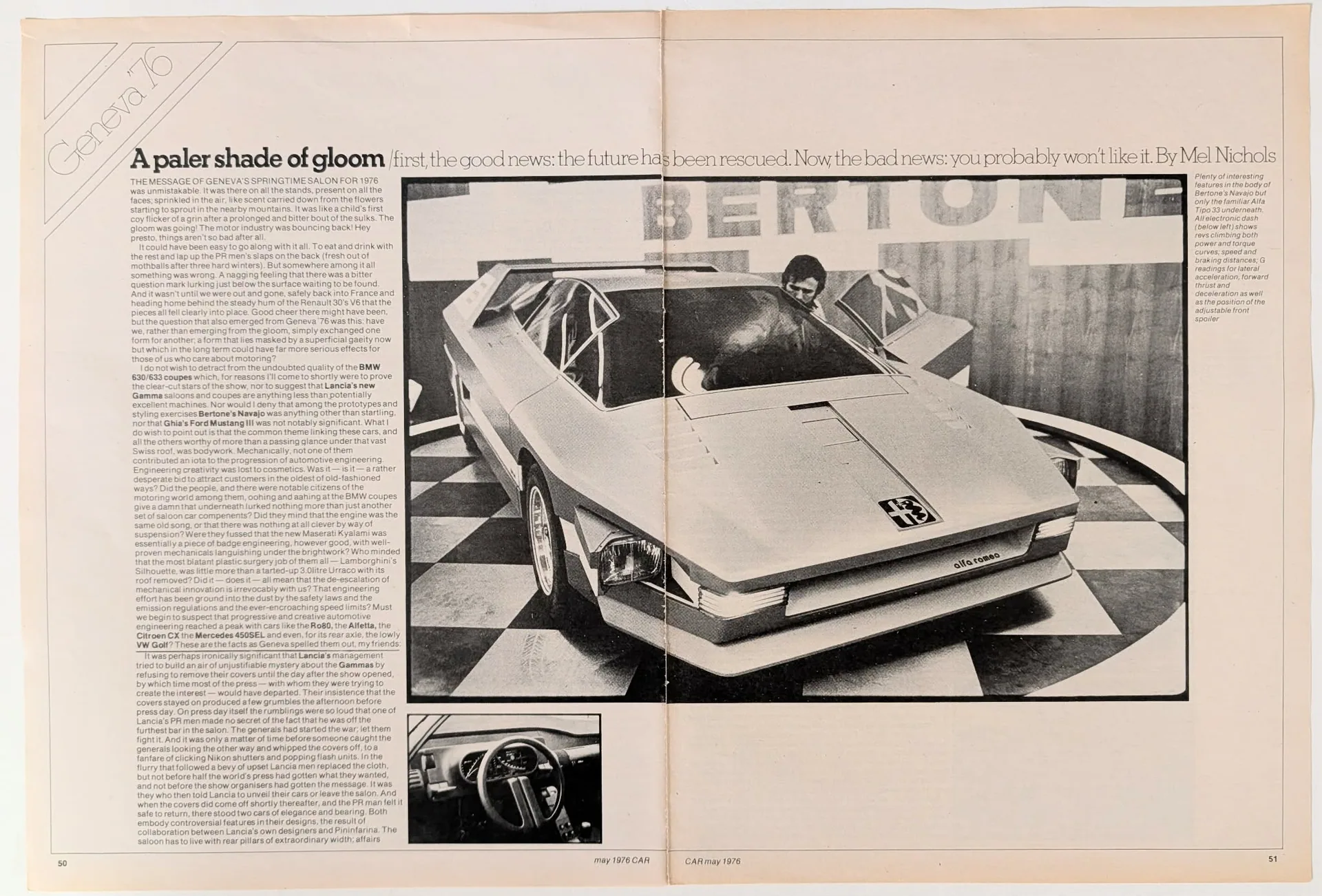
The Shattered Paradigm To comprehend the sheer weight of this artifact, one must first step into the suffocating vacuum in which it was printed. The decades following the Second World War were defined by a relentless, unrestricted arms race of displacement and speed. The automobile was the ultimate avatar of human expansion—heavy, thirsty, and entirely unconcerned with tomorrow. Fuel was an infinite given. Engineering was a matter of adding more cylinders, more carburetors, more mass. The 1973 OPEC oil embargo acted as a brutal, instantaneous guillotine to this philosophy. It was a macroeconomic shock that permanently fractured the post-war illusion. Overnight, the sprawling titans of the asphalt were rendered not just obsolete, but deeply irresponsible. They transformed from symbols of American and European liberty into heavy liabilities of excess. The automotive industry suddenly found itself operating within a hostile, restrictive matrix. Speed limits were slashed and militantly enforced. Bureaucratic bodies emerged, dictating bumper heights, pedestrian impact survivability, and crash structures. The air itself became a legislated entity, demanding the rapid adoption of catalytic converters. These early emissions devices acted as chokeholds, strangling the power output and the very life out of once-breathing engines. Innovation was no longer a pursuit of excellence; it was a desperate scramble for legal compliance. A Paler Shade of Gloom This is the grim, anxious climate permanently preserved in the May 1976 issue of CAR magazine. The Geneva Motor Show of that year was not a triumphant exhibition of human ingenuity. It was a cautious, nervous exhalation. The industry was attempting a recovery, projecting superficial confidence, but the underlying institutional dread was palpable on the showroom floor. The journalist Mel Nichols perfectly distills this fragile moment in his opening thesis, branding the event with a masterful phrase: “A paler shade of gloom.” The motor industry was bouncing back, the PR men were slapping backs, but a bitter question mark hovered above every polished roofline. The good news, as Nichols observes with surgical cynicism, was that the future of motoring had been rescued. The bad news was that the purists were going to hate it. The historical shift documented across these pages is the explicit death of engineering-led design. Nichols mourns a time, just years prior, when mechanical progression was paramount. He points to the recent past—the complex rotary-powered Ro80, the hydropneumatic suspension of the Citroen CX, the sheer over-engineering of the Mercedes 450SEL—as the absolute peak of progressive, creative automotive thought. By the spring of 1976, that era was irrevocably closed. Engineering effort had been ground into the dust by the immediate, overwhelming necessity of meeting safety and emission laws. The soul of the machine was placed on indefinite pause. The Engineering Graveyard In this vacuum of mechanical progress, aesthetics emerged as the primary weapon of corporate survival. If you cannot offer a better machine, you must offer a newer shape. The industry engaged heavily in what the text derisively labels “badge engineering” and “blatant plastic surgery.” Beneath the freshly painted skin, the cars of Geneva ’76 were stagnant. The text notes the new Maserati Kyalami was essentially a repurposed chassis with fresh sheet metal. The Lamborghini Silhouette, meant to be a showstopper, was merely an aging Urraco with the roof sliced off. The mechanicals were languishing. The engineering departments were exhausted, fighting a losing battle against physics and politicians. Thus, the designers were handed absolute control. The narrative shifted from what the car could do, to what the car could make you feel just by looking at it. The Corporate Panic This document also serves as a masterclass in reading the psychological state of corporate entities under pressure. While some presented a brave face, others struggled to maintain basic operational composure. The article details a chaotic, almost farcical press day for Lancia. Management attempted to manufacture an aura of “unjustifiable mystery” around their new Gamma models. They kept the cars shrouded under heavy covers, insisting the press wait. This artificial scarcity infuriated the journalists, leading to a minor revolt where the covers were unceremoniously whipped off by the crowd before Lancia was ready. When the Lancia executives finally returned to officially unveil their creations, they found two cars of objective elegance. Yet, the narrative had already been lost to the farce of their own insecurity. It is a perfect microcosm of the era: manufacturers were so terrified of presenting stagnant technology that they bungled the presentation of perfectly adequate design. The Wedge as a Weapon: Bertone's Navajo Standing in stark, violent contrast to the corporate fumbling is Carrozzeria Bertone and the Alfa Romeo Navajo concept. Dominating the center of the spread, this vehicle is the ultimate, unapologetic manifestation of the 1976 paradigm shift. If the internal organs of the automobile could not evolve, the exoskeleton had to leap a century forward. The Navajo is a masterpiece of visual misdirection. It is a brutalist, monolithic wedge. It is a shape that abandons the organic, flowing curves of the 1960s entirely. It looks less like a mode of civilian transportation and more like an orbital strike vessel dropped onto a checkered exhibition floor. It is aggressive, angular, and deeply uncompromising. Yet, the Navajo was a magnificent lie. Beneath that radical, unpainted fiberglass bodywork—which featured active aerodynamic spoilers designed to manage extreme forward thrust and severe deceleration—lay a ghost. The chassis belonged to an Alfa Romeo Tipo 33. The Tipo 33 was a legendary, fire-breathing race car from the late 1960s, a relic of the very era that had just died. Bertone took an aging, obsolete, heavily polluting racing heart and encased it in the impenetrable armor of tomorrow. It was the physical embodiment of the era’s ethos: conceal the stagnant, problematic reality beneath an impossibly futuristic veneer. Digitizing the Analog Thrill The interior of the Navajo further solidifies this desperation for a new, unlegislated frontier. Traditional dials, needles, and mechanical gauges have been entirely banished from the cockpit. In their place sits a fully electronic dashboard that mimics the avionics of a spacecraft. The steering wheel is absent, replaced by a rigid, rectangular yoke that forces the driver to adopt the rigid posture of a fighter pilot. The digital readouts were programmed to measure not just conventional speed, but lateral acceleration and G-forces. It is a pure cybernetic dreamscape. The designers at Bertone, likely under the direction of Marcello Gandini, were acutely aware that the physical, visceral driving experience was being systematically dulled by legislation. The roar was quieted; the speed was capped. Therefore, they attempted to digitize the thrill. They shifted the locus of engagement from the mechanical feedback of the chassis to the glowing, silent data of a screen. They were designing for a digital, screen-dominated age while still hopelessly trapped in an analog decade. The Navajo wasn’t meant to be produced; it was meant to be a declaration. It stated that even if the state controlled the engine, the human imagination could still render a shell entirely unconstrained by present reality.
The Paper
This artifact is a physical manifestation of temporal decay, a subject of immense importance to the archival integrity maintained by The Record Institute. Printed via high-volume web offset lithography, the substrate is an uncoated, low-GSM magazine stock, hovering near the 75 GSM mark. It was strictly ephemeral media, designed to be consumed and discarded within a thirty-day cycle. The passage of half a century is evident in the heavy oxidation dominating the margins. The lignin within the cheap wood pulp has steadily broken down, reacting with ambient light and oxygen to produce a distinct, yellowed patina. Close inspection reveals a coarse halftone dot structure, particularly visible in the deep shadows of the Navajo’s wheel wells and the granular texture of the figure inside the cockpit. The CMYK separation is entirely absent here, relying instead on a stark, single-channel black ink that demands aggressive contrast to create the illusion of depth. The ink sits flat on the porous surface, lacking the gloss of modern coated stock. This matte absorption gives the imagery a raw, brutalist quality, grounding the futuristic subject matter in a distinctly gritty, tactile, and deteriorating analog reality.
The Rarity
While individual pages of vintage automotive magazines are not inherently rare in the open collector's market, this specific spread elevates to Class S solely due to its concentrated historical narrative. It is exceedingly rare to find an artifact that so perfectly juxtaposes a definitive editorial manifesto—the literal, written declaration of an era’s end—with the exact conceptual vehicle that visually defines the incoming era. The physical object is common, but the intersection of the cynical foresight in the text and the desperate futurism of the imagery creates an invaluable archival cornerstone. It is a perfectly isolated cross-section of global industrial anxiety.
Cite this article
- MLA
- Naodhinsuk, Ronin. “The Time Traveller's Dossier : 1976 Bertone Navajo - Design's Crisis.” The Record Institute, 29 August 2026, https://therecord.institute/journal/the-time-travellers-dossier-1976-bertone-navajo-designs-crisis.
- APA
- Naodhinsuk, R. (2026, August 29). The Time Traveller's Dossier : 1976 Bertone Navajo - Design's Crisis. The Record Institute. https://therecord.institute/journal/the-time-travellers-dossier-1976-bertone-navajo-designs-crisis
- CHICAGO
- Naodhinsuk, Ronin. 2026. “The Time Traveller's Dossier : 1976 Bertone Navajo - Design's Crisis.” The Record Institute, August 29, 2026. https://therecord.institute/journal/the-time-travellers-dossier-1976-bertone-navajo-designs-crisis.