The Time Traveller's Dossier : 1980 Fuzzbuster Elite - The Architecture of Electronic Insurgency
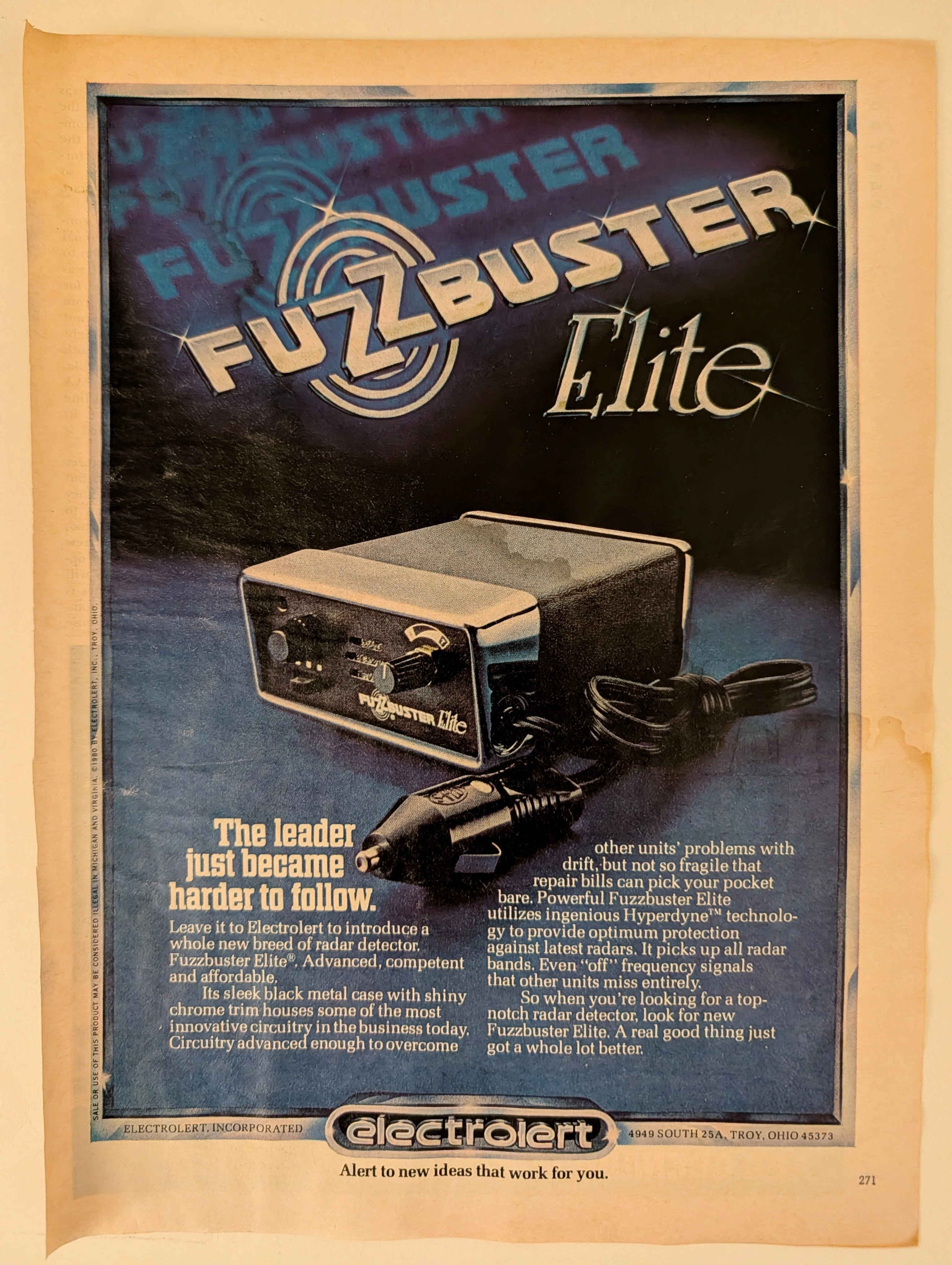
We are observing an artifact of a silent, invisible war. Before this era, the American highway was marketed as a vector of absolute, unbridled freedom. The automobile was the ultimate vessel of personal sovereignty. Here, the paradigm shifts into something darker. The open road has become a zone of constant surveillance. The state has weaponized the electromagnetic spectrum to monitor and penalize the citizen. In response, the citizen weaponized the dashboard. This is the 1980 Fuzzbuster Elite by Electrolert. It is not a car accessory. It is a piece of civilian counter-measures equipment. In an era defined by the deeply unpopular 55 MPH national speed limit and the rise of police microwave radar, this device commodified paranoia. It packaged civil disobedience into a sleek, chrome-trimmed metal box that plugged directly into a cigarette lighter. It represents the exact moment when the act of driving transitioned from a physical experience into an electronic arms race.
The History
The Death of the Open Road: The 55 MPH Mandate To truly understand the psychological weight of this artifact, we must deconstruct the sociological trauma of the American highway in the 1970s. For decades, the culture was built on the theology of horsepower. The V8 engine. The endless interstate. The promise of speed as a constitutional right. Then came the oil crises of 1973 and 1979. In response, the federal government enacted the National Maximum Speed Law, capping the speed limit at a grueling 55 miles per hour. It was an act of national conservation, but to the American motorist, it felt like an act of suffocating tyranny. The grand, sprawling interstates, engineered for speeds of 75 MPH or more, were suddenly reduced to crawling, heavily policed corridors. The psychological whiplash was severe. A nation that had just put men on the moon using raw thrust was now being told to idle its engines. The highway patrol, previously viewed as guardians of the road, were instantly recast in the public consciousness as tax collectors and agents of oppression. The state needed a way to enforce this unpopular mandate efficiently. They turned to technology. They turned to microwave radar. The Invisible Net and the Doppler Effect The deployment of police radar fundamentally altered the relationship between the citizen and the state. Law enforcement began casting invisible nets of X-band and K-band microwave frequencies across the highways. They utilized the Doppler effect. The radar gun would emit a continuous wave of microwave radiation. When this wave struck a moving vehicle, the frequency of the reflected wave shifted in direct proportion to the vehicle's speed. The machine calculated the shift, and the trap was sprung. The driver was entirely blind to this interrogation. The first indication of capture was the flashing of red and blue lights in the rearview mirror. It was an asymmetrical war. The state had the technology; the citizen only had their foot on the brake. This asymmetry created a massive, highly lucrative void in the consumer market. A void that Electrolert, Inc., operating out of Troy, Ohio, was uniquely positioned to fill. The Birth of the Electronic Insurgency Enter the radar detector. Enter the Fuzzbuster. The name itself is a masterpiece of anti-establishment branding. "Fuzz," the mid-century slang for the police. "Buster," the promise of negation. It did not promise safety. It promised evasion. By 1980, the arms race had escalated. Early radar detectors were primitive, plagued by false alarms from automatic grocery store doors and ambient microwave noise. The state adapted, utilizing new frequencies and "instant-on" radar guns that only emitted a signal when the trigger was pulled, giving the motorist zero warning. The artifact before us, the Fuzzbuster Elite, represents the counter-escalation. Look at the promotional copy. It speaks the language of military superiority. "The leader just became harder to follow." It introduces a completely fabricated, highly technical-sounding marketing term: "Hyperdyne™ technology." The advertisement claims it provides "optimum protection against latest radars" and picks up "off frequency signals that other units miss entirely." This is the monetization of technological anxiety. Electrolert is not selling a metal box; they are selling an invisible shield. They are selling early warning systems to the civilian populace. The Architecture of Paranoia Observe the physical design of the device, as depicted in the artifact. It does not look like a friendly consumer appliance. It looks brutalist. It looks like military surplus. "Its sleek black metal case with shiny chrome trim houses some of the most innovative circuitry in the business today." It features heavy, analog dials. A thick, coiled power cord terminating in a heavy-duty cigarette lighter adapter. The act of plugging this device into the dashboard was a visceral, tactile ritual. It was the arming of the vehicle. When the unit powered on, it glowed in the dark cabin, a silent sentinel watching the invisible spectrum. When the alarm sounded, it was not a gentle chime. It was a harsh, terrifying klaxon that triggered an immediate, adrenaline-fueled physical reaction: the slamming of the foot upon the brake pedal. The Fuzzbuster trained the human nervous system to respond to invisible waves. It literally rewired the psychological experience of driving. The Commodification of the Outlaw Status The most fascinating element of this artifact is hidden in the fine print along the left margin of the page. "SALE OR USE OF THIS PRODUCT MAY BE CONSIDERED ILLEGAL IN MICHIGAN AND VIRGINIA. © 1980 BY ELECTROLERT, INC., TROY, OHIO." This tiny string of text is the philosophical anchor of the entire campaign. In a conventional advertising paradigm, legality issues are hidden, minimized, or viewed as a liability. Here, the illegality is a feature, not a bug. By explicitly stating that the state has attempted to ban the device, Electrolert validates its efficacy. If it didn't work, the government wouldn't try to outlaw it. This disclaimer instantly elevates the purchaser from a mere consumer to a technological outlaw. It taps into the deep, romanticized American mythos of the bandit, the bootlegger, and the rebel. The driver with a Fuzzbuster on the dashboard was no longer just commuting; they were actively subverting the surveillance state. They were participating in a silent, high-speed insurgency. This single piece of paper captures the exact moment when civil disobedience was packaged, priced, and sold through the mail.
The Paper
We examine the physical substrate of the artifact. It is printed on standard, mass-market magazine stock from the dawn of the 1980s. The paper weight is relatively light, likely around 60 to 70 GSM. It was designed to be turned quickly, to convey a message, and to be discarded. The printing process relies on a four-color CMYK analog separation. Notice the profound depth of the background. It is a deep, technological blue, fading into black. To achieve this, the printer saturated the paper with heavy cyan and black inks. Time has exerted its inevitable toll on the material. Look closely at the edges of the page. The acidic nature of the cheap wood pulp has reacted with the atmospheric oxygen over four decades. This chemical degradation manifests as a severe, uneven yellowing and browning along the borders—a classic example of advanced foxing and acid burn. The paper is actively digesting itself. The physical artifact is a ticking clock, slowly turning back into dust, carrying the rebellious spirit of 1980 with it.
The Rarity
Classification: Class B (Contextual Anomaly) This advertisement was mass-produced. It was inserted into millions of copies of automotive magazines, men's lifestyle publications, and popular mechanics journals. The physical survival rate is moderate; many copies still exist in bound archives or forgotten basements. However, its true rarity is entirely contextual. It is a Class B artifact because it perfectly encapsulates a vanished sociopolitical moment. The 55 MPH speed limit was eventually repealed. The existential dread of the highway patrol radar trap has been somewhat normalized or replaced by automated traffic cameras and GPS tracking. You cannot replicate the specific brand of 1980s analog paranoia depicted here. Its value is anchored entirely in its status as a primary historical document of the electronic arms race.
Cite this article
- MLA
- Naodhinsuk, Ronin. “The Time Traveller's Dossier : 1980 Fuzzbuster Elite - The Architecture of Electronic Insurgency.” The Record Institute, 8 April 2026, https://therecord.institute/journal/the-time-travellers-dossier-1980-fuzzbuster-elite-the-architecture-of-electronic-insurgency.
- APA
- Naodhinsuk, R. (2026, April 8). The Time Traveller's Dossier : 1980 Fuzzbuster Elite - The Architecture of Electronic Insurgency. The Record Institute. https://therecord.institute/journal/the-time-travellers-dossier-1980-fuzzbuster-elite-the-architecture-of-electronic-insurgency
- CHICAGO
- Naodhinsuk, Ronin. 2026. “The Time Traveller's Dossier : 1980 Fuzzbuster Elite - The Architecture of Electronic Insurgency.” The Record Institute, April 8, 2026. https://therecord.institute/journal/the-time-travellers-dossier-1980-fuzzbuster-elite-the-architecture-of-electronic-insurgency.