The Time Traveller's Dossier : 1980 Johnnie Walker - The Monetization of Aspiration
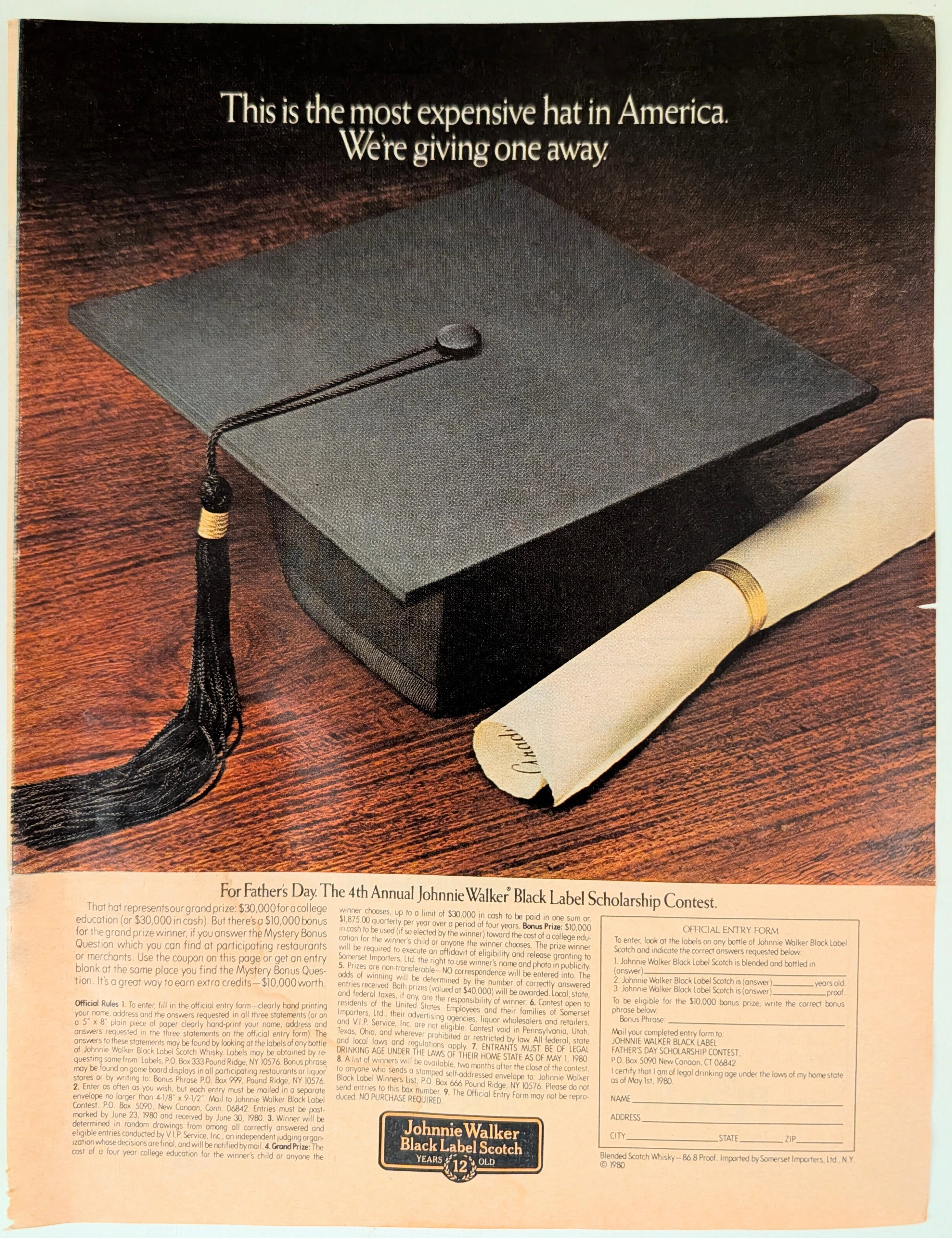
We observe a singular artifact from a transitional era. Before this moment, spirits were marketed through the lens of pure leisure. They were social lubricants, evening rewards, or markers of aristocratic isolation. Here, the paradigm shifts. The liquid is secondary. The product being sold is a legacy. In a period defined by economic stagflation, a whiskey brand bypasses the palate entirely to target the deepest anxiety of the American middle class: the rising cost of higher education. By framing a $30,000 scholarship as a Father’s Day promotion, the artifact reconciles the indulgence of premium alcohol with the noble sacrifice of parenthood. It is no longer a drink. It is a financial instrument. It is the monetization of parental hope.
The History
The 1980 Macroeconomic Reality: The Anxious Middle Class To understand the weight of this artifact, one must first deconstruct the temporal coordinates of its origin. The year is 1980. The United States is caught in the suffocating grip of stagflation—a paradoxical economic condition characterized by stagnant economic growth, high unemployment, and rampant inflation. The post-war economic boom that defined the 1950s and 1960s has thoroughly evaporated. Consumer confidence is shattered. The cost of living is accelerating far faster than wages. In this precise moment, the American Dream is undergoing a structural mutation. Previously defined by homeownership and a steady corporate job, the baseline requirement for class security is shifting toward elite higher education. A college degree is rapidly transitioning from a localized marker of intellectual curiosity into a mandatory, increasingly expensive tollbooth for entry into the upper-middle class. The cost of a four-year university education is beginning the steep, exponential upward curve that will define the next forty years of American economics. A sum of $30,000 in 1980 is not merely a prize; it is a life-altering capital injection. Adjusted for inflation, it represents well over
The Paper
We examine the physical substrate. The artifact is printed on standard high-gloss, medium-weight magazine stock, typical of premier publications of the early 1980s. The paper weight, likely hovering around 70 to 80 GSM, is designed to withstand the rapid mechanics of offset lithography while providing a smooth surface capable of holding dense ink coverage. The printing process relies on a four-color CMYK separation. Notice the profound density of the black ink used for the mortarboard cap. To achieve this depth without the paper buckling, the printer utilized a "rich black"—a precise mixture of Cyan, Magenta, Yellow, and Key (Black) rather than 100% black ink alone. Over the decades, the acid inherent in the wood pulp has begun its slow, inevitable oxidation. The edges of the page display a faint yellowing, a condition known as foxing. This chemical degradation is the physical manifestation of time. The glossy finish has dulled slightly, absorbing the micro-abrasions of being turned, stacked, and archived. The paper itself is a ticking clock, slowly digesting its own structural integrity.
The Rarity
Classification: Class B (Contextual Anomaly) While the physical advertisement was mass-produced and circulated in widely read magazines with circulations in the millions, its survival rate in unblemished condition is low. Most were discarded. However, its true rarity lies not in its scarcity, but in its contextual obsolescence. It is a Class B artifact because it perfectly encapsulates an advertising framework that is now legally and culturally impossible to replicate. It possesses high historical significance as a primary document of late 20th-century economic anxiety and the evolution of liquor marketing. Its value is anchored in its narrative, far outweighing its base material worth.
Cite this article
- MLA
- Naodhinsuk, Ronin. “The Time Traveller's Dossier : 1980 Johnnie Walker - The Monetization of Aspiration.” The Record Institute, 8 April 2026, https://therecord.institute/journal/the-time-travellers-dossier-1980-johnnie-walker-the-monetization-of-aspiration.
- APA
- Naodhinsuk, R. (2026, April 8). The Time Traveller's Dossier : 1980 Johnnie Walker - The Monetization of Aspiration. The Record Institute. https://therecord.institute/journal/the-time-travellers-dossier-1980-johnnie-walker-the-monetization-of-aspiration
- CHICAGO
- Naodhinsuk, Ronin. 2026. “The Time Traveller's Dossier : 1980 Johnnie Walker - The Monetization of Aspiration.” The Record Institute, April 8, 2026. https://therecord.institute/journal/the-time-travellers-dossier-1980-johnnie-walker-the-monetization-of-aspiration.