The Time Traveller’s Dossier: 1983 Delco-GM/Bose Music System Vintage Advertisement — The Anthropomorphic Architecture of Sound
Within the expansive, carefully curated archive of vintage ads, the 1983 Delco-GM/Bose Music System vintage advertisement stands as a profound testament to the intersection of automotive engineering and early psychoacoustics. This executive dossier examines a pivotal moment in consumer technology marketing, highlighted by the enigmatic figure of "Morgan," an acoustic computer brain developed at M.I.T. As a cornerstone among old advertisements, this piece transcends mere commercial promotion; it offers a fascinating, tactile glimpse into algorithmic audio design before the digital era fully matured. Collectors, audiophiles, and historians of classic print ads will recognize the profound cultural shift this campaign represents: the definitive transition from basic, aftermarket car radios to custom-tuned, acoustically mapped vehicular auditoriums. By merging General Motors' formidable industrial might with Bose's avant-garde acoustic science, this document captures a true revolution in high-fidelity sound. Explore the physical preservation, deep historical context, and striking visual rhetoric of an artifact that permanently altered how society perceives the driving experience, turning the automobile interior into a meticulously calculated chamber of sonic perfection.
Category: Automotive
Brand: Bose
The History
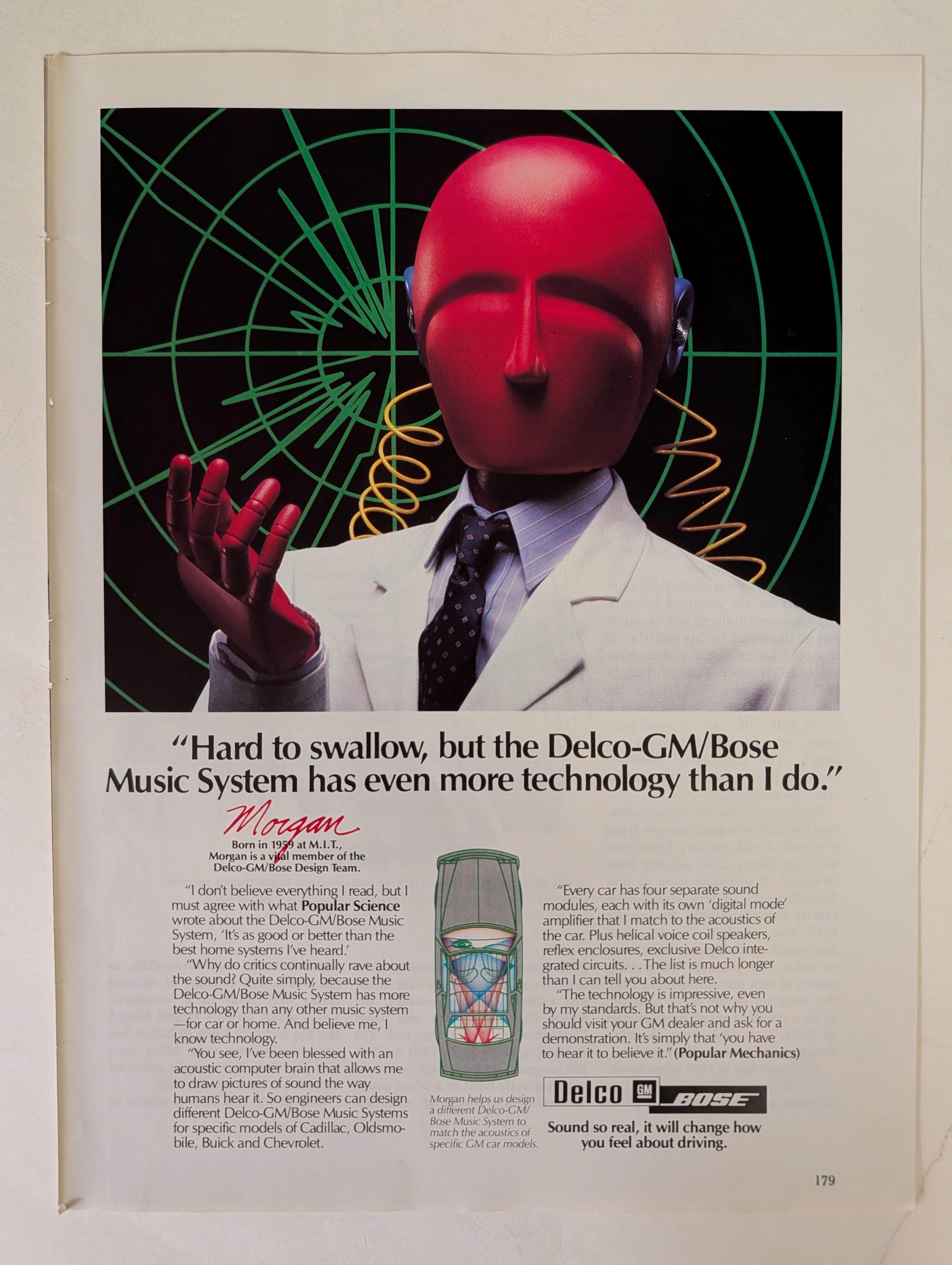
To fully comprehend the gravity of this advertisement, one must transport themselves to the automotive landscape of the early 1980s. For decades, the car radio was treated as an afterthought—a generic metallic box slotted into the dashboard, pushing a narrow band of frequencies through paper-cone speakers that were haphazardly mounted into the doors or rear deck. The resulting audio was entirely at the mercy of the car’s inherently hostile acoustic environment: glass windows that fiercely reflected high frequencies, and plush velour or leather upholstery that aggressively absorbed the low end. The 1983 model year marked a geological shift in this paradigm, heralded by the unprecedented partnership between Delco Electronics (the technological arm of General Motors) and the Bose Corporation. Amar Bose, a professor at the Massachusetts Institute of Technology (M.I.T.), had built his company on the rigorous, mathematical study of psychoacoustics—the science of how the human brain perceives sound. The Delco-GM/Bose Music System was not merely an upgrade; it was a bespoke, factory-installed acoustic ecosystem. This advertisement introduces the public to "Morgan," an anthropomorphic representation of the intricate acoustic measurement systems utilized by the design team. The text proudly notes that Morgan was "Born in 1959 at M.I.T.," a direct nod to the foundational research years of Dr. Bose. In the real world, "Morgan" was essentially a highly sophisticated binaural recording dummy—a mechanical head outfitted with specialized microphones situated within artificial ear canals. By placing this dummy inside the pre-production cabins of specific General Motors vehicles—such as the Cadillac Seville, Oldsmobile Toronado, Buick Riviera, and Chevrolet Corvette—engineers could map the exact sonic reflections and absorptions of the interior. The resulting data allowed the team to construct a system where every car model received its own unique set of equalization parameters. As the ad copy technically details, the system utilized "four separate sound modules, each with its own 'digital mode' amplifier," paired with "helical voice coil speakers" and "reflex enclosures." This was a staggering level of technological integration for the era. The campaign was designed to educate an affluent consumer base, communicating that high-end, home-quality stereophonic reproduction was no longer confined to the living room. It was now available at 65 miles per hour.
The Paper
From an archival standpoint, examining the physical properties of this document reveals the specific print chronologies of 1980s mass-market periodicals, such as Popular Science and Popular Mechanics, where this ad prominently featured. The artifact is printed on standard, mid-weight, clay-coated magazine stock typical of the era. The clay coating (kaolinite) was essential for achieving the high-gloss finish required to make the rich, saturated inks pop—a necessity for luxury automotive marketing. However, the underlying paper fibers were predominantly mechanical wood pulp, which inherently retains a high concentration of lignin. Over the decades, exposure to ultraviolet light and atmospheric oxygen initiates an oxidation process in the lignin, leading to the faint, warm yellowing visible at the extreme margins of the page. This subtle patina does not detract from the piece; rather, it authenticates its provenance. The printing technique employed is four-color web offset lithography (CMYK). When viewed under an archival loupe, the halftone dot matrix becomes vividly apparent, particularly in the smooth, continuous tones of Morgan's white suit and the gradients of the green radar-grid background. The registration—the precise alignment of the cyan, magenta, yellow, and black printing plates—is exceptionally tight, an indicator of the high production budget GM allocated for this campaign. The most technically demanding element on the page is the deep, semi-translucent ruby red of Morgan’s face. Achieving this specific hue required a heavy, perfectly balanced laydown of magenta and yellow inks, contrasted sharply against the stark black background, without suffering from ink bleed or offset onto the facing page.
The Rarity
While the Delco-GM/Bose campaign ran extensively across major American publications in the early 1980s, locating pristine, unblemished, full-page examples of this specific "Morgan" variant has become increasingly difficult for archivists. Magazine ephemera from this decade was inherently disposable. Furthermore, the cross-disciplinary appeal of this specific advertisement accelerates its scarcity. It is actively sought by three distinct collector demographics: automotive historians focusing on the peak era of General Motors' luxury divisions; audiophiles curating the early corporate history of Bose and the evolution of high-fidelity sound; and retro-technology enthusiasts fascinated by 1980s representations of computing and artificial intelligence. Most surviving copies exhibit significant flaws—spine creases from tight magazine bindings, moisture rippling, or severe acid degradation from poor storage environments. A specimen maintaining the structural integrity and vibrant chromatic punch of this particular page holds commendable museum value. It represents not just a product, but the genesis of the OEM (Original Equipment Manufacturer) premium car audio industry—a multi-billion dollar sector today.
Cite this article
- MLA
- Naodhinsuk, Ronin. “The Time Traveller’s Dossier: 1983 Delco-GM/Bose Music System Vintage Advertisement — The Anthropomorphic Architecture of Sound.” The Record Institute, 3 April 2026, https://therecord.institute/journal/the-time-travellers-dossier-1983-delco-gmbose-music-system-vintage-advertisement-the-anthropomorphic-architecture-of-sound.
- APA
- Naodhinsuk, R. (2026, April 3). The Time Traveller’s Dossier: 1983 Delco-GM/Bose Music System Vintage Advertisement — The Anthropomorphic Architecture of Sound. The Record Institute. https://therecord.institute/journal/the-time-travellers-dossier-1983-delco-gmbose-music-system-vintage-advertisement-the-anthropomorphic-architecture-of-sound
- CHICAGO
- Naodhinsuk, Ronin. 2026. “The Time Traveller’s Dossier: 1983 Delco-GM/Bose Music System Vintage Advertisement — The Anthropomorphic Architecture of Sound.” The Record Institute, April 3, 2026. https://therecord.institute/journal/the-time-travellers-dossier-1983-delco-gmbose-music-system-vintage-advertisement-the-anthropomorphic-architecture-of-sound.