The Time Traveller's Dossier : 3M Scotch Videocassettes - The Dawn of the Living Room Revolution
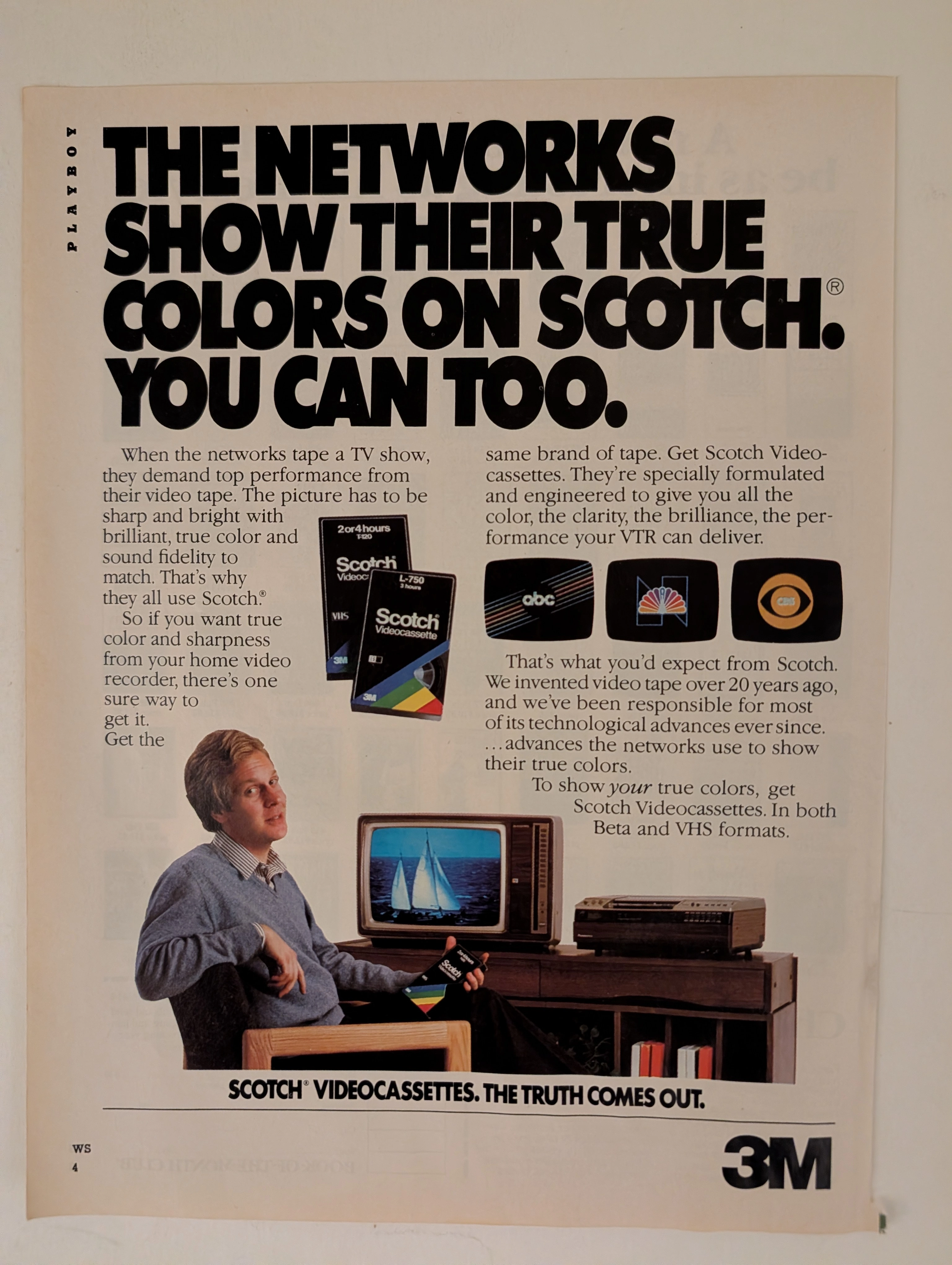
We often memorialize the late 1970s and early 1980s through the superficial lenses of neon aesthetics, synth-pop music, and Cold War anxieties. However, strictly through the perspective of consumer technology, this era represents one of the most profound paradigm shifts in human history: "The Living Room Revolution." Prior to the commercial viability of the Video Cassette Recorder (VCR), television viewers were entirely subservient to the broadcast schedules of major networks. If you missed a Thursday night broadcast, that cultural moment was lost to the ether. The consumer was a passive receiver of scheduled programming. This artifact—a print advertisement for 3M Scotch Videocassettes—is a primary historical document capturing the exact moment the consumer was handed the power of "Time-Shifting." This advertisement is not merely selling a plastic cassette filled with magnetic tape. It is selling autonomy. It is selling the democratization of the television screen. Furthermore, hidden within its visual layout is a physical snapshot of the most aggressive corporate battlefield of the late 20th century: the infamous "Format War" between JVC’s VHS and Sony’s Betamax.
Category: Technology
Brand: 3M
The History
The Network Oligopoly and "Borrowed Authority" To understand the psychological strategy of this advertisement, one must first understand the media landscape of the era. Before the proliferation of cable television and the internet, the American cultural consciousness was entirely dominated by "The Big Three" broadcast networks: ABC, NBC, and CBS. They dictated the news, the entertainment, and the visual fidelity standards of the nation. The primary marketing strategy employed here is "Borrowed Authority." The advertisement prominently displays the iconic, stylized test-pattern logos of these three monolithic networks on television screens. The copy explicitly states, "When the networks tape a TV show, they demand top performance from their video tape... That’s why they all use Scotch.". This logic was incredibly potent for the 1980s consumer. The underlying message was clear: If the national broadcast engineers—the arbiters of visual perfection—trust this magnetic tape for network television, it is more than sufficient for your domestic VCR. The headline, "THE NETWORKS SHOW THEIR TRUE COLORS ON SCOTCH. YOU CAN TOO," acts as an invitation. It elevates the consumer from a mere viewer to an active participant, promising them studio-grade archival power in their own living room. Artifacts of the Great Format War (VHS vs. Betamax) If you look closely at the center of the composition, the advertisement serves as a historical casualty report of the great Format War. It clearly displays two distinct videocassette boxes side-by-side. On the left is the VHS format (specifically labeled T-120, indicating 2 or 4 hours of recording time), championed by JVC. On the right is the Beta format (labeled L-750, indicating 3 hours of recording time), the proprietary innovation of Sony. At the time this advertisement was printed, the war was still raging. Sony’s Betamax had entered the market earlier (1975) and offered arguably superior image resolution and a more compact cassette size. However, JVC’s VHS (introduced in 1976) countered with a brilliant, consumer-focused strategy: longer recording times. A standard VHS tape could record a two-hour movie, or an entire Sunday afternoon football game, on a single cassette without needing to be flipped or changed. Sony’s early Beta tapes could only record one hour. 3M, as a manufacturer of the raw magnetic medium, wisely chose to be an arms dealer to both sides rather than picking a winner. The copy diplomatically states that Scotch Videocassettes are available "In both Beta and VHS formats". This dual-offering immortalizes a specific window in time—a few years later, the Beta box would quietly disappear from consumer advertising entirely as VHS achieved total market dominance. The Genesis of Magnetic Tape and 3M's Legacy To reinforce their market dominance, 3M drops a massive historical flex in the final paragraph: "We invented video tape over 20 years ago, and we’ve been responsible for most of its technological advances ever since". This is not marketing hyperbole; it is historical fact. The 3M Company (Minnesota Mining and Manufacturing) was a pioneer in magnetic audio tape. In 1956, working in conjunction with Ampex, 3M developed the first commercially viable magnetic video tape for the Ampex VRX-1000 broadcaster. This invention revolutionized television, allowing networks to broadcast the same program across different time zones without performing the show live twice or resorting to low-quality kinescope film recordings. By reminding the consumer of this heritage, the advertisement effectively positions 3M not as a trendy electronics brand, but as the foundational architect of the video industry. They are telling the consumer: You are not buying a new gadget; you are buying the original industrial standard. The Cultural Concept of "Time-Shifting" Though not explicitly named in the copy, the entire product exists to facilitate "Time-Shifting"—the act of recording a broadcast to view at a more convenient time. Today, in the age of on-demand streaming, this concept is invisible because it is the default. But in the late 70s and early 80s, it was a radical, almost subversive behavior. In fact, it was so disruptive that Universal Studios and Disney sued Sony in 1976, claiming that recording television broadcasts for home viewing constituted massive copyright infringement. This legal battle culminated in the landmark 1984 Supreme Court case Sony Corp. of America v. Universal City Studios, Inc., which ruled that home recording for non-commercial purposes was "fair use." This advertisement exists in the crucible of that cultural shift, selling the physical medium that made "Time-Shifting" possible.
The Paper
Demographic Placement and Material Context: One of the most fascinating aspects of this specific archival pull is the context of the publication it was printed in. The vertical text reading "P L A Y B O Y" in the upper left corner firmly anchors this artifact in a highly specific demographic space. During the 1970s and 1980s, premium men's lifestyle magazines were the primary advertising battlegrounds for high-end consumer electronics. Early VCRs were astronomically expensive—often costing well over
The Rarity
Classification: Class A (High Socio-Technological Documentation) The rarity of this artifact does not lie in the scarcity of the paper itself—magazines of this era had circulations in the millions. Its archival value lies in its high concentration of historical context. It is a pristine snapshot of the analog video era at its absolute peak. It documents the exact moment when the broadcast oligopoly (ABC, NBC, CBS) still held ultimate authority over visual quality, while simultaneously documenting the VCR format war (VHS vs. Beta) that would ultimately give the power of the archive back to the consumer. It is a primary source document capturing the bridge between the era of live broadcast and the era of on-demand media.
Cite this article
- MLA
- Naodhinsuk, Ronin. “The Time Traveller's Dossier : 3M Scotch Videocassettes - The Dawn of the Living Room Revolution.” The Record Institute, 12 April 2026, https://therecord.institute/journal/the-time-travellers-dossier-3m-scotch-videocassettes-the-dawn-of-the-living-room-revolution.
- APA
- Naodhinsuk, R. (2026, April 12). The Time Traveller's Dossier : 3M Scotch Videocassettes - The Dawn of the Living Room Revolution. The Record Institute. https://therecord.institute/journal/the-time-travellers-dossier-3m-scotch-videocassettes-the-dawn-of-the-living-room-revolution
- CHICAGO
- Naodhinsuk, Ronin. 2026. “The Time Traveller's Dossier : 3M Scotch Videocassettes - The Dawn of the Living Room Revolution.” The Record Institute, April 12, 2026. https://therecord.institute/journal/the-time-travellers-dossier-3m-scotch-videocassettes-the-dawn-of-the-living-room-revolution.