The Time Traveller's Dossier : '68 Chevrolet - The Silent Shift
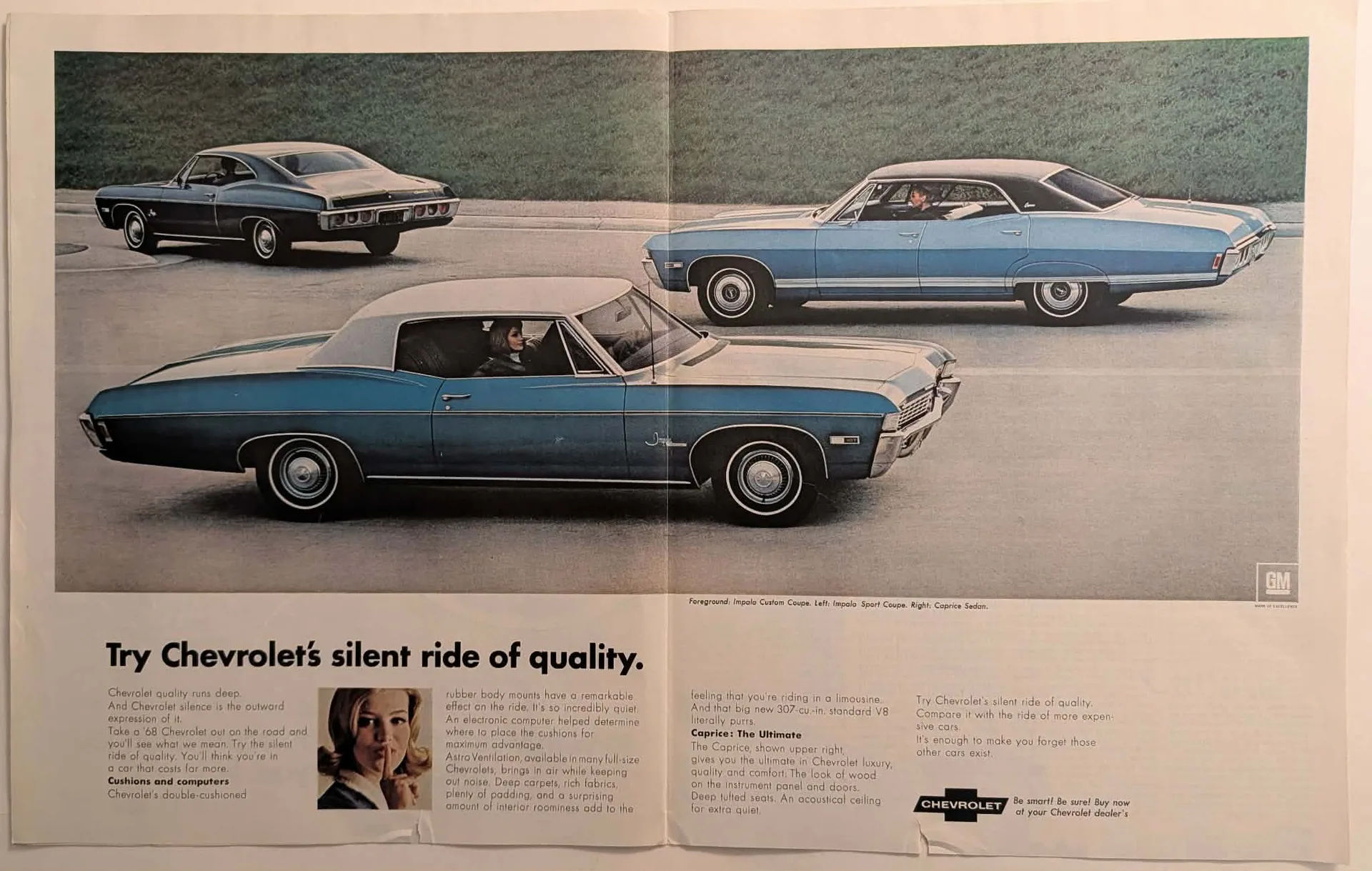
In the chaotic socio-political landscape of 1968, automotive marketing faced a unique dilemma. The outside world was loud. It was defined by protest, mechanical industrialization, and conflict. The solution was not to sell a vehicle, but a sanctuary. This artifact represents a definitive historical pivot. It is the moment the American automobile ceased to be merely an instrument of roaring mechanical power and became an engineered sensory deprivation chamber. The roaring V8 engine was subjugated. The wind noise was eradicated. Then, cars were visceral, vibrating cages of steel. Now, they were shifting into the realm of the insulated capsule. This advertisement sells the absence of sensation. It commodifies silence. It marks the precise technological shift where computing power—previously reserved for ballistics and aerospace—was deployed to calculate the density of a seat cushion. It is a blueprint of modern automotive isolation.
Category: Automotive
Brand: Chevrolet
The History
The Year the World Broke To understand the profound nature of this document, one must understand the year of its inception. The year 1968 was a crucible. Global societies were fracturing under the weight of cultural revolutions, televised wars, and civil unrest. The streets were characterized by noise. The prevailing American muscle car culture up to this point had mirrored that aggression. It was an era of exposed carburetors, roaring exhausts, and the raw, vibrating transfer of horsepower directly to the driver’s spine. Chevrolet, however, identified a shifting psychological need within the American middle class. The consumer no longer wanted to feel the road. They wanted to escape it. This advertisement is a masterclass in reading the sociological room. By leading with the headline, "Try Chevrolet's silent ride of quality," the brand pivoted away from the horsepower wars. They weaponized tranquility. They transformed the interior of the Impala and the Caprice into mobile bunkers. Silence was no longer just an acoustic property; it was a luxury commodity. It was a status symbol. The ability to glide through a turbulent world without hearing it became the ultimate outward expression of wealth and control. The Architecture of the Void Silence in a heavy mechanical object traveling at highway speeds is not a natural occurrence. It requires an aggressive war against physics. The artifact explicitly details the methodology of this silence. It speaks of "rubber body mounts" with a "remarkable effect on the ride." Before this era, the chassis and the body of an automobile were often a singular, resonant acoustic chamber. Every imperfection in the asphalt was transmitted through steel, amplifying into a low-frequency drone within the cabin. By interposing engineered rubber between the frame and the shell, Chevrolet severed the kinetic chain. They isolated the passenger compartment. This was the mechanical equivalent of floating the room. The artifact documents a critical evolution in material science applied to consumer comfort. The vehicle was no longer a contiguous metal object. It was a decoupled system. The chassis absorbed the violence of the road, while the cabin glided above it, insulated and unbothered. The Mainframe Enters the Cabin The most historically significant phrase in this entire document occupies a small, unassuming block of text: "An electronic computer helped determine where to place the cushions for maximum advantage." This is a seismic shift in manufacturing history. In 1968, the "electronic computer" was not a ubiquitous desktop tool. It was a monolithic, room-sized mainframe, likely an IBM System/360, utilizing punch cards and magnetic tape. Computers were the domain of NASA, military ballistics, and massive financial institutions. By announcing that a computer calculated the ergonomics of a car seat, Chevrolet bridged the gap between heavy industry and the dawn of the information age. This represents the absolute genesis of Computer-Aided Design (CAD) in consumer marketing. Previously, automotive seating was drafted by intuitive human proportion and analog testing. It was an art. Here, comfort became a mathematical equation. The human body was mapped as a dataset. The resistance of the "deep tufted seats" was optimized by algorithmic processing. The artifact captures the exact moment the machine was trusted over the craftsman to define human comfort. Breathing Without Breaking the Seal The document highlights "Astro Ventilation." This feature, while seemingly mundane to the modern eye, was a vital component of the "silent ride." Historically, ventilation in automobiles required opening a vent window—a small, triangular piece of glass that directed air into the cabin. This mechanical solution, however, destroyed the aerodynamic profile of the vehicle. It introduced a chaotic, roaring wind noise that shattered the illusion of a silent interior. Astro Ventilation represented the sealing of the glasshouse. It allowed the elimination of the vent window entirely, creating a sheer, uninterrupted plane of glass along the side of the vehicle. Fresh air was drawn in through cowls and exhausted through discrete pressure-relief valves. The cabin became a pressurized, hermetically sealed environment. It allowed the occupants to breathe the outside air without ever having to hear the outside world. This engineering choice fundamentally altered the acoustic signature of the American highway. The Democratization of the Vault Finally, the artifact details the subjugation of the engine itself. It mentions the "big new 307-cu.-in. standard V8" that "literally purrs." A 307 cubic-inch engine is a massive block of iron. It is inherently violent. Yet, the engineering focus was placed on muffling its existence. The ad compares the experience to riding in a limousine and challenges the reader to "Compare it with the ride of more expensive cars." This highlights a massive socio-economic shift. The acoustic isolation and computerized comfort once exclusively reserved for the elite echelons of Cadillac or Rolls-Royce were being democratized. Chevrolet was offering the working and middle classes the psychological armor of the rich. The '68 Chevrolet was not just a means of transport; it was an affordable fortress.
The Paper
The physical composition of this artifact serves as a testament to late-1960s mass-market publishing. Printed on what is demonstrably a mid-weight, likely 60 to 70 GSM coated magazine stock, the paper carries the physical memory of the era's chemical processing. A microscopic analysis of the GM "Mark of Excellence" logo reveals the foundational architecture of the image: the CMYK halftone pattern. The cyan, magenta, yellow, and black inks are not blended, but rather distributed in a precise, geometric rosette structure. The human eye performs the optical illusion of color mixing from a distance. The paper itself exhibits the inevitable, slow-burn oxidation of its acidic wood pulp origins. The margins show a subtle yellowing, a warm patina that alters the original color temperature of the photograph. The ink has embedded itself deep into the fiber matrix, flattening the gloss over decades. This is not merely an image of a car; it is a decaying organic substrate recording the passage of time. The slight softening of the halftone dots speaks to the imperfect pressure of the web offset lithography rollers that birthed it.
The Rarity
While mass-produced automotive advertisements from the late 1960s are numerically common, this specific artifact ascends to a Class A designation purely based on its immense contextual value. Its physical scarcity is low, but its historical weight is massive. The explicit textual integration of "An electronic computer" being utilized for interior ergonomics marks a definitive milestone in the timeline of human-computer interaction. It transforms a standard consumer artifact into a transitional fossil. It is a documented bridge between the mechanical muscle era and the digital optimization era. Its value lies not in its auction price, but in its absolute necessity to any archivist mapping the history of industrial design.
Cite this article
- MLA
- Naodhinsuk, Ronin. “The Time Traveller's Dossier : '68 Chevrolet - The Silent Shift.” The Record Institute, 17 July 2026, https://therecord.institute/journal/the-time-travellers-dossier-68-chevrolet-the-silent-shift.
- APA
- Naodhinsuk, R. (2026, July 17). The Time Traveller's Dossier : '68 Chevrolet - The Silent Shift. The Record Institute. https://therecord.institute/journal/the-time-travellers-dossier-68-chevrolet-the-silent-shift
- CHICAGO
- Naodhinsuk, Ronin. 2026. “The Time Traveller's Dossier : '68 Chevrolet - The Silent Shift.” The Record Institute, July 17, 2026. https://therecord.institute/journal/the-time-travellers-dossier-68-chevrolet-the-silent-shift.