The Time Traveller's Dossier : '69 Chevy - The Apex Predator Shift
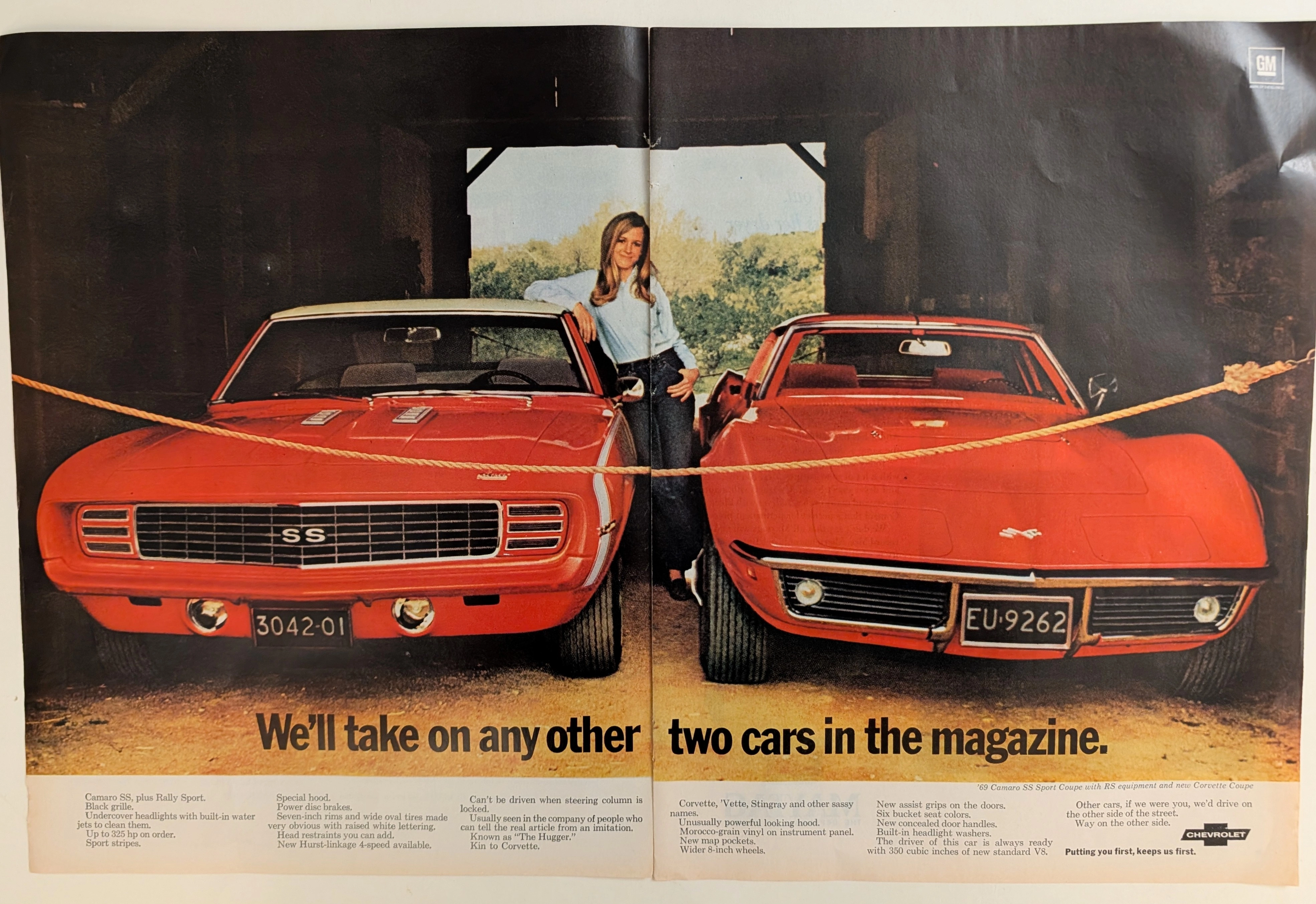
Automobiles were once marketed as solitary solutions. A singular machine, isolated on a page, pleading for the consumer’s validation. The industry standard was polite comparison. Then, the rules of engagement were violently rewritten. Before this specific artifact entered the public bloodstream in 1969, car manufacturers fought gentlemanly duels. This document represents the exact moment General Motors abandoned the duel and initiated a street war. By placing their two apex predators—the Camaro SS and the Corvette Stingray—side-by-side behind a literal rope, Chevrolet executed a masterclass in psychological intimidation. They did not sell a feature. They sold absolute, undisputed hegemony. It changed the expectation of the American driver. It loudly declared that the streets were no longer a shared utility, but a hierarchy. And Chevrolet claimed the summit. This artifact marks the shift from defensive product marketing to offensive, territorial dominance.
Category: Automotive
Brand: Chevrolet
The History
The Zenith of the Analog Empire To comprehend the sheer arrogance and historical weight of this artifact, one must meticulously examine the socio-technological landscape of 1969. The world was standing on a precipice. Humanity was literally aiming for the moon. The American cultural psyche was deeply fractured by overseas conflicts and domestic revolutions. Yet, upon the vast, sprawling asphalt arteries of the United States, a completely different, intensely focused war was raging. It was the apex of the horsepower wars. Detroit was the undisputed Rome of the global automotive empire. General Motors was its emperor, and Chevrolet was its most brutal, effective vanguard. In this era, environmental regulations were nonexistent. Fuel economy was a completely foreign, almost laughable concept. The sole metric of automotive success was displacement, raw torque, and the visceral terror induced by a wide-open throttle. This advertisement is a perfect, unadulterated snapshot of that specific cultural moment. It captures a society obsessed with power, forward momentum, and unyielding confidence. The cars presented are not modes of transportation. They are mechanical weapons of individual sovereignty. The Arsenal of Combustion The core truth of this artifact’s message lies deep within its unyielding, analog engineering. Look at the machines. On the left, the 1969 Camaro SS (Super Sport). Equipped with the RS (Rally Sport) package, evidenced by the menacing, concealed headlights. It was a pony car heavily mutated by Detroit engineers into a muscular street brawler. On the right, the Corvette Stingray. A fiberglass-bodied precision instrument of velocity. It was America’s singular answer to the European sports car elite. Underneath the heavy steel and fiberglass hoods of these machines lay cast-iron V8 engines. These were not engines managed by microprocessors or silent, sterile electric motors. They breathed through massive carburetors, inhaling enormous volumes of air and highly leaded gasoline. There was no electronic traction control to save a careless driver. There was only a braided steel throttle cable connecting a human foot directly to a controlled series of violent, internal explosions. This was the absolute pinnacle of analog automotive engineering. It was an era where raw, unrefined materials—iron, steel, aluminum, and rubber—were violently forged into kinetic art. Chevrolet offered these two distinct bloodlines, bound by one shared, uncompromising philosophy: absolute mechanical superiority. The Psychological Warfare of the Rope Examine the rhetoric and visual strategy with absolute scrutiny. It is entirely stripped of all traditional salesmanship. There is no poetic waxing about fuel efficiency, trunk space, or family safety. There is only cold, hard, psychological intimidation. The copy boldly declares: "We'll take on any other two cars in the magazine." This is not an invitation for a test drive. It is a formal declaration of war. It is a direct, unapologetic challenge to every other manufacturer sharing the pages of that publication. Notice the visual barrier. A thick, rough, utilitarian rope stretches across the front of the vehicles. It is not there to keep the cars in. Psychologically, it is there to keep the viewer out. It suggests that these machines are dangerous, untamed beasts that barely tolerate captivity. The woman standing between them is not presented as a traditional, passive "hood ornament" model common to the era. She is leaning casually, confidently against the steel. She is the handler. She controls the leash. This visual cue shifts the power dynamic entirely. It tells the consumer: to own these cars is to possess a dangerous power that requires mastery. The Adversaries and the Arrogance To understand the audacity of this claim, one must consider the adversaries of 1969. Ford had the Mustang, the originator of the breed, armed with the Mach 1 package. Chrysler deployed the Mopar twins: the Dodge Charger and the Plymouth Road Runner. The competitors fought with bright, cartoonish characters, massive rear wings, and vibrant, playful marketing campaigns. Chevrolet responded to this playful aggression with cold, hard, terrifying silence. The copy at the bottom right delivers the final, devastating, highly calibrated psychological blow. "Other cars, if we were you, we'd drive on the other side of the street. Way on the other side." In the competitive context of the late 1960s, this language was dangerous. It implies that the Chevrolet is an apex predator. The street is its designated hunting ground. It forces the consumer into an uncomfortable, binary choice. You are either driving the predator, or you are driving the prey. The advertisement manipulates the male ego and the primal instinct for dominance with surgical precision. The Legislative Guillotine: The Permanent Shift Ultimately, the profound historical shift represented by this artifact is its role as a glorious, defiant epitaph. This advertisement is historically vital because it represents the absolute zenith of an era. It is a high-resolution photograph taken mere seconds before a devastating fall. This was the peak of the mountain. Within a few short years of this publication, the world would irreversibly change. The Clean Air Act of 1970 would be signed into law, effectively dropping a legislative guillotine on the era of unregulated combustion. By 1973, the OPEC oil embargo would shatter the American illusion of infinite, cheap resources. Insurance premiums for high-horsepower vehicles would skyrocket to punitive levels. Engine compression ratios would plummet to accommodate unleaded fuel. The untamed, raw horsepower explicitly depicted in this artifact would be systematically and ruthlessly legislated out of existence. Therefore, this specific artifact is not merely a record of a beginning. It is the documentation of a spectacular end. Before this era, cars were machines of limitless potential. After this era, cars became highly regulated appliances of compromise. This piece of paper captures the final, uninhibited roar of the American automotive empire before it was forced to surrender to a changing, restricted, and regulated global reality. It stands as a masterclass in using sheer arrogance and absolute mechanical truth as the ultimate aggressive weapon in commerce.
The Paper
The artifact survives on a mid-weight, double-page magazine centerfold stock, likely hovering around 80 GSM. It is born of highly acidic, mass-produced wood pulp, which is an inherently self-destructive material. The lignin within the paper fibers continuously reacts with ambient oxygen and ultraviolet light. The paper is slowly, silently burning itself over the decades. The edges have yellowed heavily, adopting a sickly sepia tone, and the crease down the center—where the staples once held it in the magazine—is dangerously brittle and actively degrading. It acts as a physical chronometer of its own inevitable decay. The printing utilizes a standard four-color CMYK halftone process of the late 1960s. Under an archivist's loupe, the vibrant Hugger Orange and Monza Red paint of the vehicles breaks down into a chaotic, beautiful constellation of cyan, magenta, yellow, and black ink dots. These dots are sunk deeply into the porous, textured surface of the aged paper. The physical degradation of the page creates a profound, inescapable irony. The fragile paper, which aggressively advertises the immortal, unyielding power of American steel and iron, is itself succumbing entirely to the friction of time. The crease physically splits the image, a stark reminder that the era it represents was also violently severed from the timeline.
The Rarity
Classification: Class S (Superior Contextual Value). The physical artifact itself, as a single page, is moderately uncommon. Millions of magazines were printed in 1969. However, as an intact, double-page centerfold, its survival rate drops drastically. Centerfolds were often torn out, pinned to garage walls, and destroyed by grease, sunlight, and time. But its true, immense rarity lies in its contextual value. Most automotive advertisements of this era sold a single car using specific technical features or lifestyle aspirations. This artifact is exceedingly rare because it sells an entire corporate attitude. It is a unified, two-car assault on the rest of the industry. Finding comparative, multi-vehicle advertising this naked, this openly aggressive, and this structurally perfect in the 1960s is highly unusual. Its ultimate value is measured by its inclusion in the syllabus of automotive history and strategic market warfare.
Cite this article
- MLA
- Naodhinsuk, Ronin. “The Time Traveller's Dossier : '69 Chevy - The Apex Predator Shift.” The Record Institute, 14 May 2026, https://therecord.institute/journal/the-time-travellers-dossier-69-chevy-the-apex-predator-shift.
- APA
- Naodhinsuk, R. (2026, May 14). The Time Traveller's Dossier : '69 Chevy - The Apex Predator Shift. The Record Institute. https://therecord.institute/journal/the-time-travellers-dossier-69-chevy-the-apex-predator-shift
- CHICAGO
- Naodhinsuk, Ronin. 2026. “The Time Traveller's Dossier : '69 Chevy - The Apex Predator Shift.” The Record Institute, May 14, 2026. https://therecord.institute/journal/the-time-travellers-dossier-69-chevy-the-apex-predator-shift.