The Time Traveller's Dossier : A-4E Skyhawk - The Lethal Shift
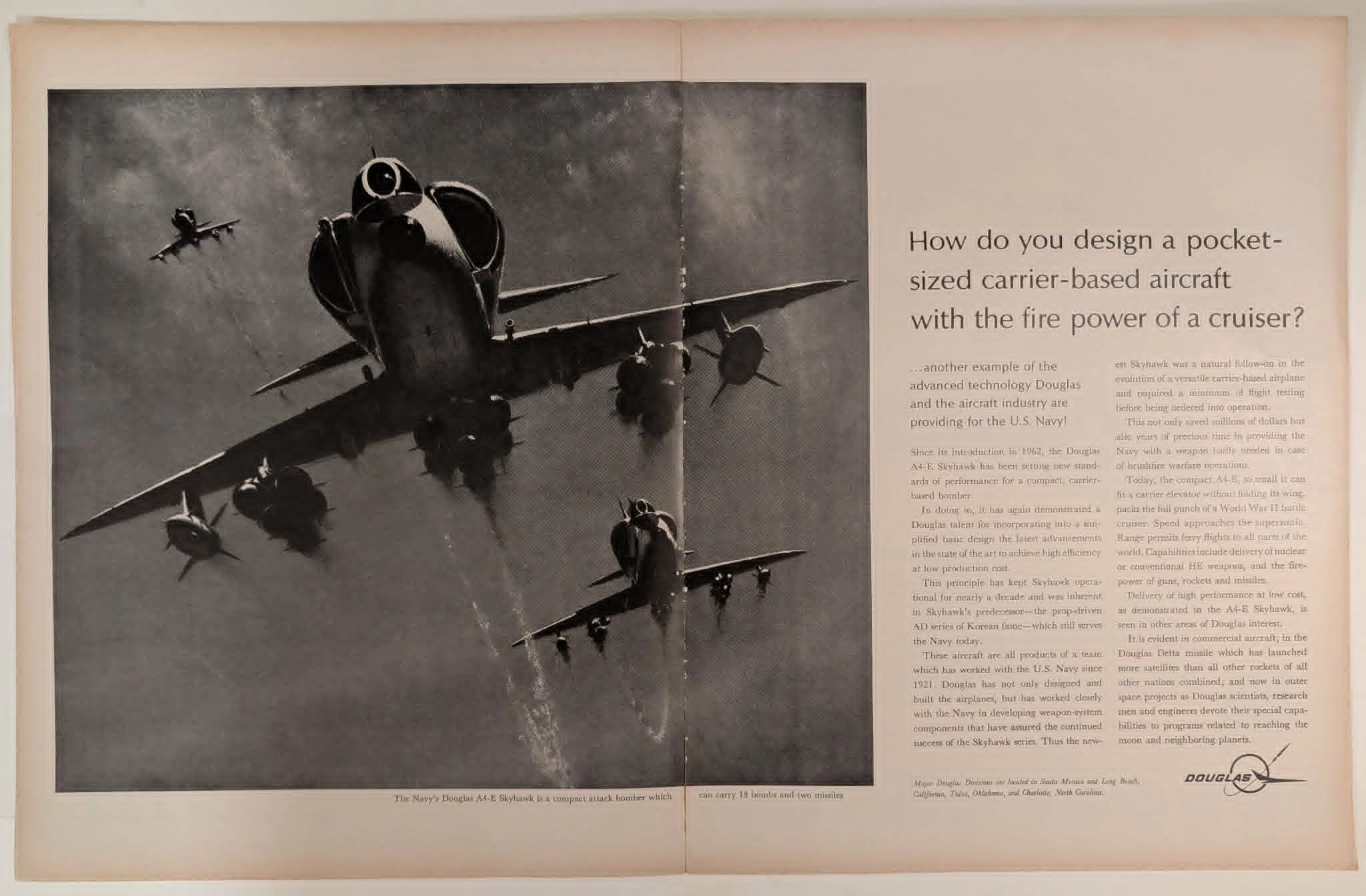
Then, the prevailing doctrine dictated that survival required massive scale. Aircraft grew exponentially heavier. Internal systems grew endlessly convoluted. Defense budgets swelled into the stratosphere. Now, we observe the deliberate anomaly. A machine that violently rejected the bloat. This artifact documents a critical inflection point in military engineering and human history. It is not merely an advertisement for an attack bomber. It is the physical manifestation of a philosophical rebellion against the "growth factor." The Douglas A4-E Skyhawk represents a precise moment when the military-industrial complex briefly prioritized stark, brutal efficiency over sprawling complexity. By applying the domestic language of consumer convenience to a vehicle of mechanized destruction, the document reveals the chilling, everyday normalization of Cold War lethality.
Category: Technology
Brand: Douglas
The History
The Geopolitical Architecture of the Jet Age To understand the profound significance of this artifact, we must first reconstruct the geopolitical architecture of the early 1960s. The world was firmly gripped by the doctrine of mutually assured destruction. The United States and the Soviet Union were engaged in a macroscopic, ideological standoff. Both superpowers prioritized massive, strategic nuclear delivery systems. Aircraft carriers, functioning as the floating sovereign territories of the United States Navy, were scaling up dramatically to accommodate this terrifying reality. The new supercarriers were designed specifically to launch heavy, long-range bombers capable of striking deep within hostile territory. In this era, the trajectory of aerospace engineering was strictly linear. The mandate was clear: fly faster, climb higher, and carry a heavier payload. This resulted in a relentless, compounding accumulation of mass. Radar systems became immensely dense. Hydraulic networks transformed into labyrinths of potential catastrophic failures. The prevailing logic dictated that to carry more ordnance, the delivery vector must inherently be a massive structure. Aircraft weights were spiraling entirely out of control. The cost per unit was accelerating at a terminal rate. Defense analysts of the era began to project a bleak future where the entirety of the national defense budget would eventually purchase precisely one heavily armored, highly complex tactical aircraft. The Reality of the Brushfire War However, the macroscopic nuclear standoff remained a theoretical framework. The practical, bleeding reality of the era was something entirely different. The military called it the "brushfire war." The advertisement deliberately invokes this specific terminology. It refers to the localized, conventional conflicts that erupted continuously on the volatile periphery of the superpowers' spheres of influence. In these brutal, asymmetrical engagements, supersonic speeds and strategic nuclear payloads were functionally useless. The military required a profoundly different instrument. They did not need a strategic sledgehammer. They desperately needed a tactical scalpel. Commanders required an aircraft capable of lingering low over a contested target area. They needed a machine that could deliver conventional high-explosive ordnance with devastating precision. It had to survive intense, low-altitude ground fire and return safely to the cramped, chaotic deck of an aircraft carrier. The fundamental requirements shifted. The Navy needed high sortie generation rates. They demanded low maintenance hours per flight hour. Above all, they required economic expendability in the face of inevitable combat attrition. Ed Heinemann and the Engineering Rebellion Enter Edward Heinemann. As the Chief Engineer at the Douglas Aircraft Company, Heinemann observed the alarming trend of ballooning aircraft weights. He recognized it immediately as a terminal disease of industrial design. When the United States Navy officially issued a requirement for a jet-powered replacement for the aging, propeller-driven Skyraider, the initial specifications were heavy. The military suggested an aircraft weighing approximately thirty thousand pounds. Heinemann countered with a proposal that bordered on sheer engineering heresy. He confidently promised a machine that weighed exactly half that amount. He proposed a jet that would weigh roughly fourteen thousand pounds empty, yet still remain fully capable of carrying the precisely specified payload. This audacious counter-proposal birthed the A-4 Skyhawk. Heinemann's entire philosophy was rooted in a strict mathematical concept known as the "growth factor." In advanced aerospace engineering, every single additional pound of payload or internal equipment requires a compounding, mandatory increase in the weight of the surrounding structure. It requires more fuel to lift the added weight. It requires more engine thrust to propel the heavier mass. Heinemann rigorously calculated that for every single pound of equipment unnecessarily added, the aircraft's gross takeoff weight increased by ten pounds. Therefore, the absolute only way to achieve true aerodynamic efficiency was to wage an agonizing, microscopic war on weight. The Physics of Subtraction The design of the Skyhawk, clearly visible in the stark, aggressive silhouette of the document, was an absolute masterclass in the physics of subtraction. The most radical, defining decision was the complete elimination of the heavy folding wing mechanism. Carrier-based aircraft traditionally require incredibly heavy, highly complex hydraulic hinges. These mechanisms allow the wings to fold upward, permitting the aircraft to fit onto narrow carrier elevators and conserve vital deck space. Heinemann completely bypassed this fundamental naval requirement. He designed a modified delta wing that was shockingly compact. Measuring merely twenty-seven feet and six inches across, the wing was so short that it could easily fit onto the elevators of even the older, World War II-era escort carriers without needing to fold at all. This single, brilliant design choice instantly eliminated hundreds of pounds of hydraulic actuators. It removed structural reinforcements. It erased countless maintenance liabilities. The wing itself became a brilliant piece of engineering. It was constructed as a single, continuous, integral fuel tank, built solidly from tip to tip. This maximized the internal fuel volume while minimizing the heavy structural framework. The landing gear was equally revolutionary. It was designed not to retract inward into the wing root, which would require heavy structural cutouts that inherently compromise wing integrity. Instead, it retracted forward into the fuselage itself. Every single component was brutally scrutinized. If a standard military pilot's ejection seat weighed eighty pounds, Heinemann's team engineered a custom replacement that weighed exactly forty. This was not merely technical drafting. It was a rigorous, ideological purge of industrial excess. The Payload Paradox This strict philosophy brings us directly to the core claim of the historical advertisement. The text asks: "How do you design a pocket-sized carrier-based aircraft with the fire power of a cruiser?" The document proudly and clinically states the A4-E can effortlessly carry "18 bombs and two missiles." This is the definitive payload paradox that eternally defined the Skyhawk. Because the base airframe itself was so impossibly light, an unprecedented, record-breaking percentage of its maximum takeoff weight could be completely dedicated to offensive ordnance. The aircraft could essentially lift its own empty weight in external weapons. The A4-E variant, specifically highlighted and immortalized in this artifact, introduced a highly critical technological upgrade. It featured the Pratt & Whitney J52-P-6A turbojet engine. This advanced powerplant provided significantly more thrust than any earlier model. This raw power allowed the Douglas engineers to add two completely new external wing pylons. The image captures the brutalist, functional reality of this newfound capability. We see the Skyhawk frozen in a steep, terminal dive. It carries a heavy, asymmetrical load of general-purpose iron bombs slung aggressively beneath its belly and its delta wings. The visual weight of the lethal ordnance seems to vastly exceed the visual weight of the tiny aircraft carrying it. It is, functionally, a flying bomb rack. The Corporate Ecosystem The artifact also serves as a final, poignant testament to the Douglas Aircraft Company before its inevitable absorption into the modern corporate monoliths. The text meticulously lists the "Major Douglas Divisions." It carefully notes facilities located in Santa Monica, Long Beach, Tulsa, and Charlotte. It draws a highly deliberate, associative line between the humble A4-E attack bomber and the cutting-edge aerospace frontier. It explicitly mentions the "Douglas Delta missile which has launched more satellites than all other rockets of all other nations combined." This was a highly calculated strategic positioning by the corporation. They were desperately attempting to demonstrate a unified, unassailable theory of engineering excellence. The implication was stark and clear. The exact same meticulous, weight-saving genius that allows a tiny attack jet to carry cruiser-level firepower is the exact same genius powering the American thrust into the space race. It was a desperate plea for corporate prestige. This occurred in an era where the Pentagon was beginning to enforce brutal cost-effectiveness analyses. This rigorous methodology would eventually force the proud Douglas company into a reluctant merger with McDonnell Aircraft. This specific document captures Douglas precisely at the zenith of its independent, historical operational output. The Domestication of Lethality Philosophically, the specific text of the advertisement represents a fascinating, slightly disturbing shift in how military hardware was publicly presented. The phrase "pocket-sized" is inherently a domestic, consumerist term. It immediately evokes images of transistor radios. It brings to mind paperback books. It suggests everyday, harmless convenience. To casually apply this specific nomenclature to a machine designed exclusively to deliver high-explosive payloads is a masterclass in psychological cognitive dissonance. It perfectly reflects a society that had fully, quietly integrated the military-industrial complex into its daily conceptual framework. The absolute horrors of industrialized warfare are perfectly sanitized. They are packaged into an easily understandable, highly relatable metric of simple "efficiency." The aircraft is no longer framed as a terrifying weapon of immense destruction. It is framed strictly as a clever, cost-saving gadget for the United States Navy. The copy claims it saves "millions of dollars" and "years of precious time." The tone is entirely clinical. It is emotionally detached. It is utterly focused on mechanical optimization. The human element is entirely absent from the narrative. Only the efficient machine remains.
The Paper
The physical medium of this historical artifact is a standard mid-century, machine-calendered magazine stock. The relentless aging process is highly evident. The lignin locked within the original wood pulp is slowly oxidizing over the decades. This quiet chemical decay creates authentic, aged paper textures along the extreme margins of the document. These aged paper textures are not flaws; they are structural elements of its historical aesthetic accuracy. It is a flat illustration of reality, waiting to be interpreted. The original printing utilizes a precise offset lithographic process. It presents the aircraft in a distinct, flat illustration style that prioritizes high-contrast impact over subtle photorealistic nuance. It is a monochromatic aesthetic. Maintaining historical aesthetic accuracy absolutely requires acknowledging this physical degradation. The paper is not merely a passive carrier of information. It is a physical, degrading witness to the era. It silently records the slow passage of time through its deteriorating fibers.
The Rarity
Classification: Class B - Contextual Artifact. From a purely material and physical standpoint, this object possesses very low inherent scarcity. General circulation magazines and specialized defense industry journals of this specific era were mass-printed and distributed by the millions globally. However, its true archival value is derived entirely from its immense contextual significance. It is a pristine, physical record of a highly specific psychological shift in defense contracting rhetoric. It captures the precise, chilling moment when the comfortable language of domestic miniaturization was smoothly co-opted to sell maximum military lethality. While the physical paper itself is common, the surviving, well-preserved documentation of this specific engineering pivot elevates its status. It remains a crucial educational artifact for understanding Cold War sociology.
Cite this article
- MLA
- Naodhinsuk, Ronin. “The Time Traveller's Dossier : A-4E Skyhawk - The Lethal Shift.” The Record Institute, 31 May 2026, https://therecord.institute/journal/the-time-travellers-dossier-a-4e-skyhawk-the-lethal-shift.
- APA
- Naodhinsuk, R. (2026, May 31). The Time Traveller's Dossier : A-4E Skyhawk - The Lethal Shift. The Record Institute. https://therecord.institute/journal/the-time-travellers-dossier-a-4e-skyhawk-the-lethal-shift
- CHICAGO
- Naodhinsuk, Ronin. 2026. “The Time Traveller's Dossier : A-4E Skyhawk - The Lethal Shift.” The Record Institute, May 31, 2026. https://therecord.institute/journal/the-time-travellers-dossier-a-4e-skyhawk-the-lethal-shift.