The Time Traveller's Dossier : Alcoa Steamship - The Dual Engine of Leisure and Logistics
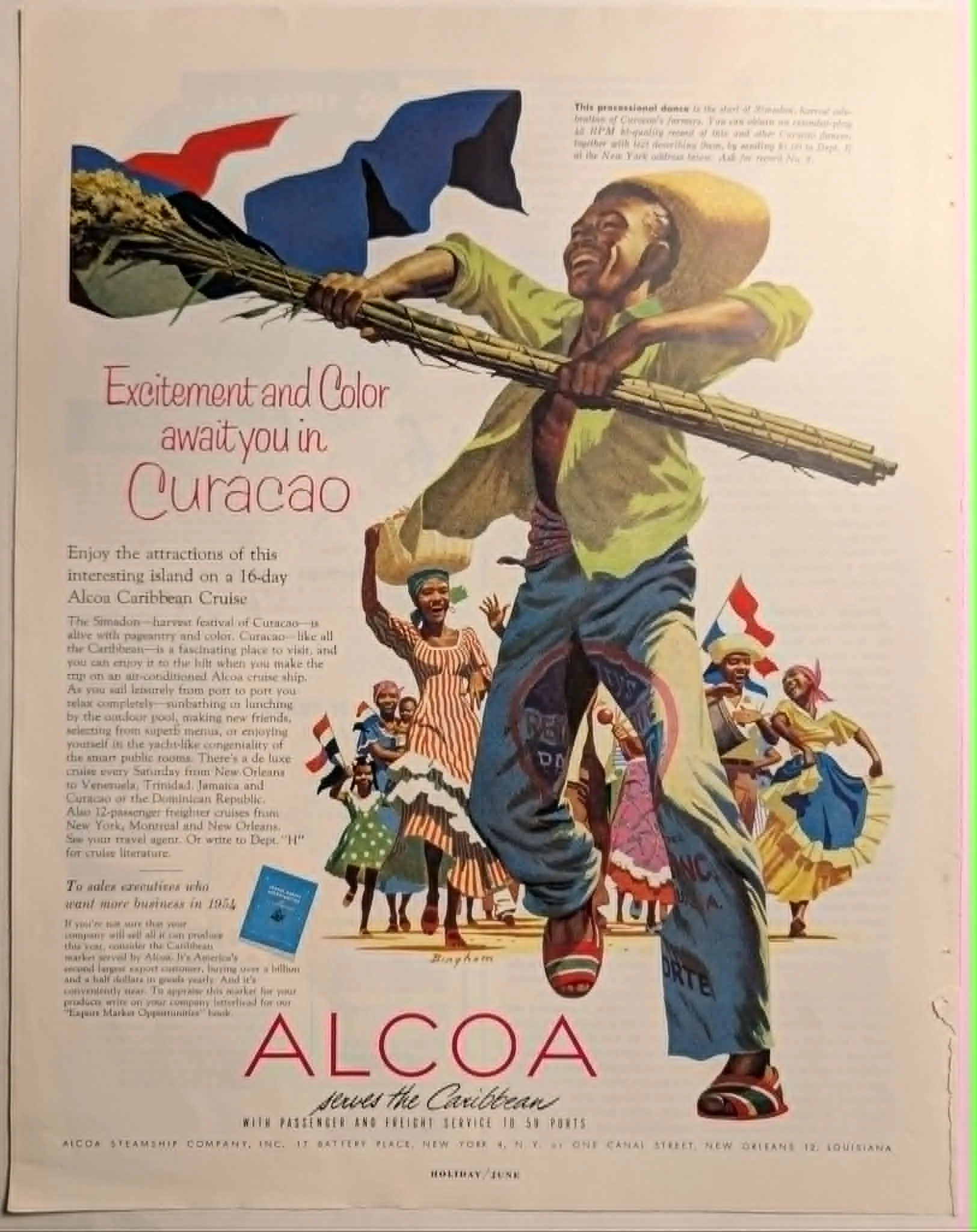
An artifact from 1954. A window into the machinery of post-war American expansion. This is not merely a travel advertisement. It is a masterclass in systemic economic engineering. Then, a corporate behemoth disguised its supply chain as a luxury vacation. They sold the exotic to the consumer. They sold the infrastructure to the executive. Now, shipping and tourism are strictly segregated industries. The passenger-freighter hybrid is a ghost of maritime history. This document captures the exact moment a logistics company attempted to colonize the American imagination.
Category: Technology
The History
The year is 1954. The globe is recalibrating. The machinery of the Second World War has cooled. The machinery of peacetime commerce is accelerating. America stands at the apex of an unprecedented economic boom. The middle class is expanding. Disposable income is surging. The concept of the "vacation" is transitioning from a rare luxury to an annual expectation. At the center of this industrial acceleration is the Aluminum Company of America. Alcoa. They are not a hospitality brand. They are a resource extraction and refinement empire. Their lifeblood is bauxite ore. Bauxite is the foundation of aluminum. Aluminum is the foundation of the post-war world. It builds airplanes, skyscrapers, appliances, and consumer goods. To feed the American industrial machine, Alcoa requires millions of tons of bauxite. This bauxite sits in the earth of the Caribbean and South America. Specifically, Suriname, Guyana, and Jamaica. To move mountains of red dirt across the ocean, Alcoa created its own navy. The Alcoa Steamship Company. This presents a brutal logistical problem. Ships sail north heavily laden with bauxite to the ports of New Orleans, Mobile, and New York. But trade must be a loop. A ship sailing empty is a bleeding artery on a balance sheet. Sending empty ships south to retrieve more ore is a catastrophic inefficiency. Capitalism abhors an empty vessel. The solution is structural genius. Alcoa retrofits and designs its fleet to carry two very specific payloads on the southward journey. The first payload is industrial freight. American manufactured goods destined for the developing Caribbean markets. The second payload is human capital. The American tourist. This advertisement, placed in the June issue of HOLIDAY magazine, is the visual manifestation of this solution. HOLIDAY was the premier publication for the affluent, aspirational American. It was not read by the working class. It was read by executives, managers, and decision-makers. Alcoa understood exactly who held the magazine in their hands. Look closely at the architecture of the copy. It operates on two entirely different psychological frequencies. The primary frequency is leisure. "Excitement and Color await you in Curacao." It speaks of 16-day cruises. Air-conditioned ships. Sunbathing by the outdoor pool. The "yacht-like congeniality of the smart public rooms." It commodifies the Caribbean. It packages the region not as a geopolitical neighbor, but as an exotic playground designed for American relaxation. The secondary frequency is hard, calculated commerce. Tucked into the bottom left corner, framed by a blue graphic of a booklet, is the true objective of the page. "To sales executives who want more business in 1954." It is a Trojan Horse. Alcoa is speaking directly to the corporate titan lounging in his mid-century living room. They remind him that the Caribbean is "America's second largest export customer, buying over a billion and a half dollars in goods yearly." They offer a book: "Export Market Opportunities for U.S.A. Manufacturers." If the executive decides to sell his tractors, his appliances, or his textiles to the Caribbean, who will transport them? Alcoa Steamship Company. They offer to carry the executive on a vacation, while simultaneously pitching him on carrying his company's freight. It is an extraordinary closed-loop marketing strategy. The tourist and the cargo are processed through the exact same corporate pipeline. Furthermore, this artifact represents a massive shift in multimedia marketing. Read the fine print in the upper right quadrant. "This processional dance is the start of Simadon... You can obtain an extended-play 45 RPM hi-quality record of this and other Curacao dances... by sending
The Paper
The physical medium is a standard heavyweight magazine stock from the mid-1950s, likely around 80 to 90 GSM. Extracted from HOLIDAY magazine, the page demonstrates the pinnacle of commercial web offset lithography of its time. The tactile quality is smooth but lacks the high-gloss polymer coating of modern publications, leaving the paper vulnerable to atmospheric degradation. Under magnification, the CMYK halftone dot structure is clearly visible, revealing the mechanical separation of Bingham's original gouache or watercolor illustration. The artifact shows signs of oxidation and mild foxing along the edges. The cellulose fibers are reacting to decades of light and oxygen. The paper is not just a carrier of ink; it is a chronometer. Its slight yellowing and the micro-tears at the binding edge record its seventy-year survival through the archives of human consumption.
The Rarity
Classification: Class A This artifact is not a unique, one-of-a-kind painting. It is a mass-produced consumer object. However, its survival rate in this condition is remarkably low. Magazines of the 1950s were ephemeral by design, meant to be read and discarded. Its true rarity lies in its contextual value. It is increasingly rare to find mid-century artifacts that so explicitly document the intersection of B2C leisure marketing and B2B industrial logistics. The direct solicitation to "sales executives" within a vibrant travel ad elevates this piece from a mere nostalgic image to a critical piece of economic history. It is highly sought after by maritime historians, advertising archivists, and scholars of post-war American imperialism.
Cite this article
- MLA
- Naodhinsuk, Ronin. “The Time Traveller's Dossier : Alcoa Steamship - The Dual Engine of Leisure and Logistics.” The Record Institute, 8 July 2026, https://therecord.institute/journal/the-time-travellers-dossier-alcoa-steamship-the-dual-engine-of-leisure-and-logistics.
- APA
- Naodhinsuk, R. (2026, July 8). The Time Traveller's Dossier : Alcoa Steamship - The Dual Engine of Leisure and Logistics. The Record Institute. https://therecord.institute/journal/the-time-travellers-dossier-alcoa-steamship-the-dual-engine-of-leisure-and-logistics
- CHICAGO
- Naodhinsuk, Ronin. 2026. “The Time Traveller's Dossier : Alcoa Steamship - The Dual Engine of Leisure and Logistics.” The Record Institute, July 8, 2026. https://therecord.institute/journal/the-time-travellers-dossier-alcoa-steamship-the-dual-engine-of-leisure-and-logistics.