The Time Traveller's Dossier : Alfa Romeo 8C 2900B Touring Berlinetta - The Apex of Pre-War Velocity
We categorize automotive history into the eras before and after aerodynamics. Prior to the late 1930s, luxury meant upright, carriage-like monuments of steel. Speed was achieved through brute force, pushing flat radiators and exposed fenders through the atmosphere. Then came the marriage of Vittorio Jano's Grand Prix engineering and Carrozzeria Touring's wind-cheating architecture. This artifact is a meticulous dissection of that paradigm shift. It is a photographic autopsy of the Alfa Romeo 8C 2900B Touring Berlinetta. The problem was the physics of atmospheric drag at high speeds. The solution was "Superleggera"—super-light aluminum stretched over thin steel tubes, shaped not by tradition, but by the wind itself.
The History
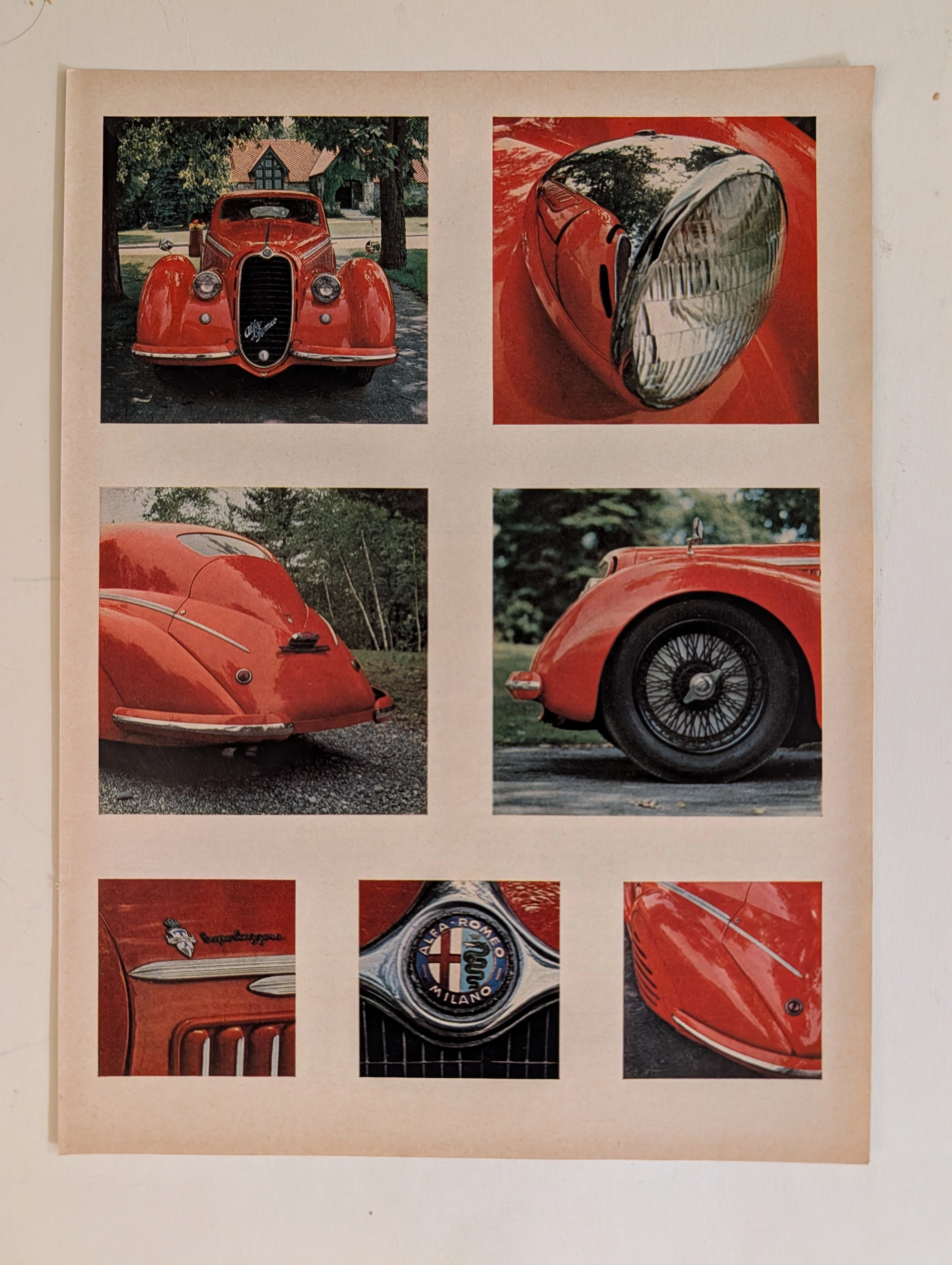
The Grand Prix Heart in a Tailored Suit The era is the late 1930s. The theater is the Italian autostrada and the grueling Mille Miglia road race. Alfa Romeo was not building cars for the masses; they were building state-sponsored instruments of national dominance. The 8C 2900B was essentially a thinly disguised Grand Prix racer built for the road. Beneath the sweeping red hood lay Vittorio Jano's mechanical masterpiece: a 2.9-liter inline eight-cylinder engine. It was not a conventional block. It consisted of two four-cylinder alloy blocks mated together, fed by twin Roots-type superchargers. It was a violent symphony of gears, cams, and forced induction. But a racing engine is useless if the body fights the air. Alfa Romeo commissioned Carrozzeria Touring of Milan to clothe this extraordinary chassis. Only five Touring Berlinettas were ever constructed on the 8C 2900B platform. This makes the vehicle depicted not just a car, but one of the rarest, most coveted mechanical artifacts of the 20th century. The Superleggera Revolution Examine the bottom-left panel of the collage. The delicate chrome script reads "Superleggera" next to the winged 'T' badge of Carrozzeria Touring. This was a patented revolution in coachbuilding. Traditionally, car bodies were built by nailing heavy steel panels to massive, wooden ash frames. Touring discarded the wood. They created an intricate, skeletal framework of small-diameter, hollow steel tubes, directly mirroring the aerodynamic shape they desired. They then wrapped this rigid skeleton in paper-thin aluminum panels. It was violently lightweight and incredibly rigid. This method allowed for the sensual, flowing lines seen in the middle-left panel: the sweeping teardrop rear end, the tiny split rear window, and the fenders that seem to melt seamlessly into the body. It was the physical manifestation of speed. The Aerodynamic Integration The top-right panel focuses on a singular, defining feature: the headlight. Before this era, headlights were standalone brass or chrome buckets bolted to the fenders or chassis, creating massive aerodynamic turbulence. Touring integrated the headlights directly into the pontoon fenders, enclosing them behind flush, teardrop-shaped glass covers. It is an early, brilliant exercise in drag reduction. The car was designed to sustain speeds well over 100 mph for hours across the Italian countryside. Every louver, every sweeping chrome spear, and the iconic heart-shaped Alfa shield (the Scudetto) seen in the top-left and bottom-middle panels, was engineered to cheat the wind while feeding air to the supercharged beast within.
The Paper
Material Context: This layout is extracted from a premium, enthusiast-focused publication—likely a vintage volume of Automobile Quarterly or a similar high-end automotive historical journal from the 1960s or 1970s. The paper is a heavy, high-opacity matte or semi-gloss stock, completely unlike the flimsy, highly coated paper of daily newsstand magazines. It was chosen to hold ink with high fidelity and prevent bleed-through, treating the page more like an art gallery print than disposable media. Printing Pathology: The printing utilizes a high-resolution four-color offset lithography process. The lush, saturated "Rosso Corsa" (racing red) of the Alfa Romeo requires meticulous color registration to avoid muddying the shadows or blowing out the brilliant chrome reflections. The macro lens captures the fine halftone dot structure, revealing how the printer balanced the deep, organic greens of the background with the aggressive mechanical red of the foreground. Chronological Markers: The paper exhibits a faint, warm patina. The crisp white borders separating the grid have softened into a gentle cream hue, the inevitable result of decades of slow oxidation of the paper fibers. It is a vintage document recording a pre-war masterpiece.
The Rarity
Classification: Class S (Pinnacle Automotive Archive) The Alfa Romeo 8C 2900B Touring Berlinetta is the undisputed holy grail of pre-war collector cars (routinely commanding eight-figure valuations in the modern era). To own a piece of high-quality vintage journalism that meticulously dissects one of the five existing chassis is to own a piece of automotive scholarship. The layout itself—a stark, modernist, seven-panel grid applied to a 1930s subject—creates a fascinating juxtaposition between the eras of aerodynamic design and analytical documentation. It belongs in an archive dedicated to the intersection of industrial design, racing history, and print media. Visual impact
Cite this article
- MLA
- Naodhinsuk, Ronin. “The Time Traveller's Dossier : Alfa Romeo 8C 2900B Touring Berlinetta - The Apex of Pre-War Velocity.” The Record Institute, 12 April 2026, https://therecord.institute/journal/the-time-travellers-dossier-alfa-romeo-8c-2900b-touring-berlinetta-the-apex-of-pre-war-velocity.
- APA
- Naodhinsuk, R. (2026, April 12). The Time Traveller's Dossier : Alfa Romeo 8C 2900B Touring Berlinetta - The Apex of Pre-War Velocity. The Record Institute. https://therecord.institute/journal/the-time-travellers-dossier-alfa-romeo-8c-2900b-touring-berlinetta-the-apex-of-pre-war-velocity
- CHICAGO
- Naodhinsuk, Ronin. 2026. “The Time Traveller's Dossier : Alfa Romeo 8C 2900B Touring Berlinetta - The Apex of Pre-War Velocity.” The Record Institute, April 12, 2026. https://therecord.institute/journal/the-time-travellers-dossier-alfa-romeo-8c-2900b-touring-berlinetta-the-apex-of-pre-war-velocity.