The Time Traveller's Dossier : Alinari Caligula - Visualizing Antiquity
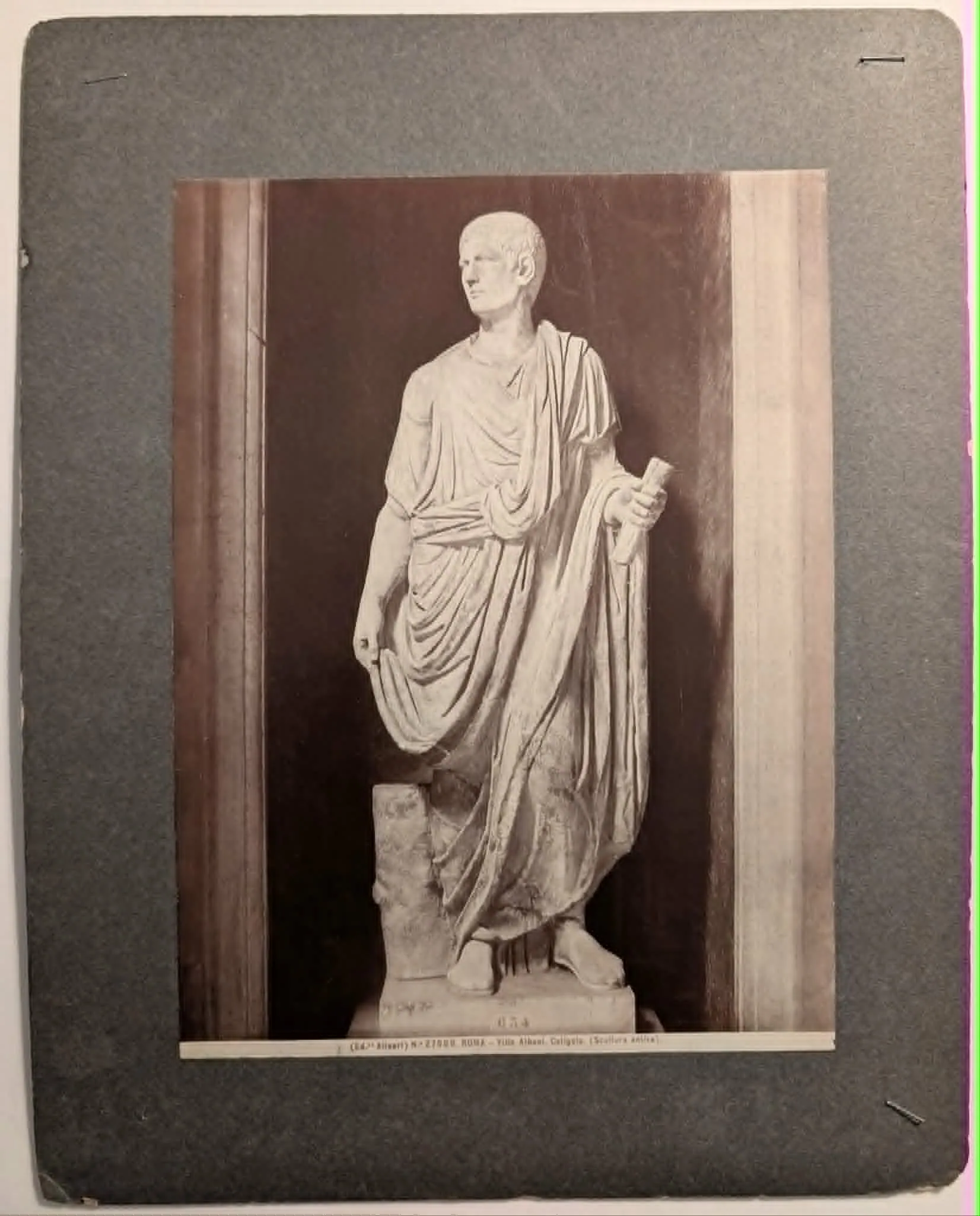
There was a time when the past belonged only to those who could travel to it. To look upon the face of a Roman Emperor required wealth. It required the Grand Tour. It required standing in the private galleries of the European elite. Knowledge of antiquity was physical, localized, and guarded. Then came the photographic apparatus. Then came the imperative to catalog human history. This artifact is not merely a picture of a statue. It is a mechanism of distribution. It is an early data packet. It represents the precise moment when classical art was detached from its physical location and mobilized. It was shipped across oceans. It entered the civic archives of a young American city. It transformed from an imperial monument into a cataloged asset. And eventually, it became obsolete. This is the documentation of how a tyrant became marble, how the marble became silver, and how the silver became a discarded civic record. It is a timeline of human memory.
Category: Other
The History
The Tyrant in Repose Gaius Caesar Augustus Germanicus. Known to history as Caligula. He was an emperor defined by erratic power, infinite cruelty, and eventual assassination. His flesh was erased in 41 AD. His image, however, was carved into stone. The marble statue captured in this photograph stands in the Villa Albani in Rome. It presents a stark contradiction to the historical record. Here, the tyrant is not mad. He is serene. He holds a scroll. He is draped in the heavy, ordered folds of classical drapery. The sculpture represents the propaganda of empire. It is an idealized form, designed to project stability where there was none. For centuries, this marble stood silent. It survived the fall of Rome. It was unearthed, traded, and eventually acquired by Cardinal Alessandro Albani in the 18th century. The Villa Albani was not just a home. It was a statement of neoclassical power. It was a private universe of antiquities, curated to impress diplomats and scholars. The physical statue was anchored to Italian soil. Its audience was strictly limited to the aristocratic elite. The Alinari Mandate The mid-19th century introduced a technological disruption. The photographic camera. In Florence, in 1852, the Fratelli Alinari (Alinari Brothers) established a photographic studio. Their mission was unprecedented in its scale. They did not just want to take portraits. They wanted to index the entire artistic and architectural heritage of Italy. Before Alinari, reproductions of classical art were achieved through sketches or engravings. These were subject to the artist's interpretation. They were inherently flawed. The camera offered absolute, objective geometry. The Alinari catalog was a monumental endeavor in information architecture. Notice the text printed at the base of this artifact: "(Ed. Alinari) N. 27588. ROMA - Villa Albani. Caligola. (Scultura antica)." Number 27588. This is not merely a caption. It is metadata. It is a coordinate in a vast, early analog database of human achievement. The Alinari firm standardized the visual record of the Renaissance and antiquity. They turned massive, unmovable objects into flat, transportable assets. This was a fundamental shift in the economy of knowledge. Art history was no longer constrained by geography. The Mechanics of Light and Silver Consider the engineering required to produce this image in the late 19th or early 20th century. The photographer had to navigate the interior of the Villa Albani. Lighting was natural, supplemented perhaps by crude continuous sources. Marble is a notoriously difficult subject to photograph. It reflects light unevenly. It demands a deep depth of field to maintain sharpness from the front of the drapery to the back of the pedestal. The photographer used a large-format view camera. They utilized heavy glass plate negatives. The exposure required careful calculation to capture the delicate gradations of the white stone without blowing out the highlights. The resulting print—likely an albumen print or an early silver gelatin contact print—holds a remarkable tonal range. The shadows in the folds of the toga are dense but detailed. The face of Caligula is sharply defined, isolating the chiseled features against a stark, shadowed background. The image is a triumph of early photographic chemistry over physical limitations. The Institutional Migration The journey of this specific artifact is documented on its reverse side. It is a journey from the center of the old world to the frontier of the new world. The photograph was purchased, likely in the early 20th century. It crossed the Atlantic. It arrived in the Pacific Northwest of the United States. It became the property of the Seattle Public Library, specifically the Art Department. This transition marks another massive societal shift. The era of the American public library. Fueled by civic pride and philanthropy, American cities built vast repositories of knowledge. They could not buy the original Roman marbles. So, they bought the Alinari prints. These mounted photographs became the visual foundation for public education in art and history. Look at the brutalist stamps on the back of the mount. "SCULPTURE ROMAN ANCIENT". "8351 Caligula Villa Albani Rome". The photograph was stripped of its Italian context and assimilated into an American filing system. It was standardized. It was handled by librarians. It was requested by students, architects, and historians. The Lifecycle of Public Memory Perhaps the most fascinating aspect of this artifact is the command stamped upon it. "Use no thumb tacks gummed tape or mark in any way". This is the voice of civic authority. It is a desperate attempt to preserve the integrity of the physical record. The library recognized the photograph as a permanent asset. They sought to protect it from the very public it was meant to serve. Yet, institutions evolve. Paradigms shift again. The mid-to-late 20th century brought slide projectors, offset printing in mass-market books, and eventually, the digital internet. The physical mounted photograph—once a cutting-edge data packet—became obsolete. It took up too much space. It was too fragile. It was no longer the most efficient way to transmit the image of Caligula. And so, the final stamp was applied. "NO LONGER PROPERTY OF SEATTLE PUBLIC LIBRARY". The deaccession stamp. This mark signifies the death of the artifact's institutional life. It was expelled from the official archive. It transitioned from a functional educational tool to surplus material. It entered the secondary market. It became an antique. This artifact encapsulates three distinct eras of human memory. The imperial era, which carved the stone. The mechanical era, which photographed the stone and distributed it. The digital era, which rendered the physical photograph redundant, turning it into a collectible relic. It is a masterclass in the transient nature of value.
The Paper
The physical construction of this artifact is a testament to durability. The photograph itself is mounted on thick, high-GSM binding board. This was a necessity for institutional use. The board prevents the photographic emulsion from curling. It allows the print to be stored vertically in filing cabinets. The print process is monochromatic, relying on silver halides. It does not use a modern CMYK matrix. The image is formed by actual microscopic particles of silver suspended in gelatin or albumen. Over time, the paper has aged. The edges of the mount show physical abrasion. The corners are blunted from decades of being pulled in and out of wooden drawers. The back of the board bears the chemical ghosts of aging—slight discoloration where adhesives or stamps interacted with the fibrous structure. The physical weight of the board gives the image a sense of gravity that modern digital images lack.
The Rarity
Classification: Class A The visual image of this specific Caligula statue is not rare. Fratelli Alinari produced thousands of prints from negative number 27588. They were distributed globally. However, the contextual rarity elevates this specific object. The density of the provenance marks creates a unique sociological record. It is not just an Alinari print. It is a deaccessioned Seattle Public Library Alinari print. The stamps, the handwritten catalog numbers, and the municipal warnings ("Use no thumb tacks") make this a singular artifact. It possesses high historical significance regarding the mechanics of early 20th-century American education and library sciences. Its value lies not in its scarcity, but in the completeness of its operational narrative.
Cite this article
- MLA
- Naodhinsuk, Ronin. “The Time Traveller's Dossier : Alinari Caligula - Visualizing Antiquity.” The Record Institute, 26 June 2026, https://therecord.institute/journal/the-time-travellers-dossier-alinari-caligula-visualizing-antiquity.
- APA
- Naodhinsuk, R. (2026, June 26). The Time Traveller's Dossier : Alinari Caligula - Visualizing Antiquity. The Record Institute. https://therecord.institute/journal/the-time-travellers-dossier-alinari-caligula-visualizing-antiquity
- CHICAGO
- Naodhinsuk, Ronin. 2026. “The Time Traveller's Dossier : Alinari Caligula - Visualizing Antiquity.” The Record Institute, June 26, 2026. https://therecord.institute/journal/the-time-travellers-dossier-alinari-caligula-visualizing-antiquity.