The Time Traveller's Dossier : American Airlines - The Weaponization of Silence
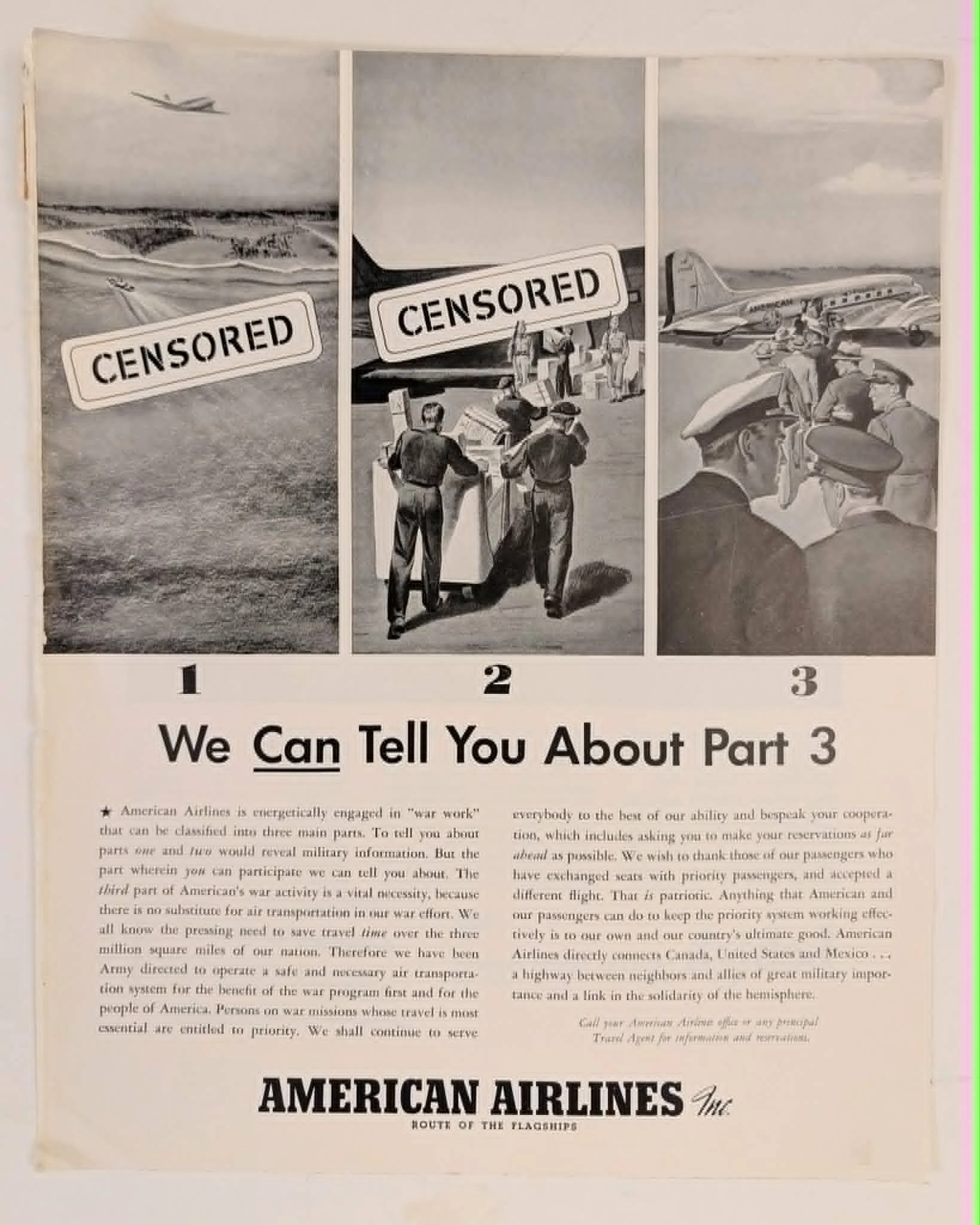
Then, the sky was a canvas of commercial aspiration. Airlines sold luxury. They sold speed. They sold the elite status of defying gravity. Now, the sky is a theater of survival. The airspace is no longer a public commons. It is a supply line. It is a blood vessel for a world at war. The Problem is existential. How does a commercial enterprise maintain brand loyalty when its core product is heavily restricted by the state? How do you advertise when you have nothing to sell to the general public? The Solution is paradoxical. You weaponize silence. You turn absence into patriotism. You obscure your own operations behind a bold, unapologetic stamp. CENSORED. The shift is stark. The commodity is no longer comfort. The commodity is time. Time saved for the war effort. The airline does not ask for your business. It demands your sacrifice.
Category: Travel
Brand: American Airlines
The History
The Death of Aspiration and the Birth of Logistics Before the outbreak of global conflict, commercial aviation was in its golden infancy. Airlines fiercely competed on the plushness of their seats. They competed on the quality of the hot meals served at ten thousand feet. They sold the dream of a shrinking world. Pearl Harbor shattered that paradigm. Overnight, the commercial fleets of the United States were drafted. The transition was brutal. It was absolute. Luxury interiors were ripped out of fuselages. Plush seating yielded to bare aluminum ribs. The stewardess was replaced by the loadmaster. The passenger was largely replaced by ammunition, medical supplies, and military personnel. This advertisement captures the precise moment commercial aviation became a militarized utility. It is a document of structural pivot. American Airlines is no longer operating solely for profit. They are, as the text explicitly states, "Army directed to operate a safe and necessary air transportation system". Capitalism is subordinated to state survival. The marketplace is suspended. The Air Transport Command and the Requisitioning of the Sky To understand the artifact, we must understand the geopolitical apparatus behind it. In 1942, the United States established the Air Transport Command (ATC). The military realized it lacked the logistical infrastructure to fight a two-front global war. They did not have the planes. They did not have the experienced pilots. They did not have the maintenance networks. But the commercial airlines did. American Airlines, United, TWA, and Pan Am possessed the most advanced aviation networks on earth. The War Department effectively absorbed these networks. Airlines were contracted to fly military routes, transport troops, and deliver critical freight across hostile territories. This advertisement is a direct transmission from that reality. Parts 1 and 2—the censored panels—represent the unseen heavy lifting of this hybrid military-civilian apparatus. Panel 1 shows an aircraft flying high over coastal or strategic terrain, a lone vessel against a vast sky, with a massive "CENSORED" stamp obscuring the landscape below. Panel 2 depicts heavy cargo logistics, showing men in uniform pushing large wooden crates toward the open cargo doors of a waiting aircraft, again aggressively struck through with "CENSORED". By censoring these images, American Airlines achieves two strategic goals. First, it complies with the Office of Censorship. Information regarding military logistics, shipping routes, and cargo types was strictly classified. Loose lips sink ships. Loose images destroy supply chains. Second, it generates immense psychological capital. The censorship stamp is not a limitation. It is a boast. It whispers to the reader: "We are doing things so important, so critical to national survival, that we are forbidden from showing you." It is the marketing of vital secrecy. The Engineering of Necessity: The Douglas DC-3 and C-47 The silhouette of the aircraft in the third panel is unmistakable. It is the Douglas DC-3. In military nomenclature, it is the C-47 Skytrain. This is the machine that engineered the shift. Before the war, the DC-3 revolutionized commercial travel. It was the first aircraft that could make a profit carrying passengers alone, without relying on federal airmail subsidies. It was a masterpiece of aeronautical engineering. Stressed-skin aluminum construction. Twin Pratt & Whitney Twin Wasp radial engines. Retractable landing gear. Cantilever wings. When the war began, the DC-3 transmuted into the C-47. The luxury cabin was gutted. A reinforced cargo floor was installed. Wide double doors were cut into the aft fuselage. It became the workhorse of the Allied victory. It dropped paratroopers over Normandy. It flew the treacherous "Hump" over the Himalayas to supply forces in China. In this artifact, American Airlines refers to their fleet as the "Flagships". The term attempts to retain a sliver of civilian prestige. The corporate logo is clearly visible on the side of the fuselage, a reminder of the brand behind the war effort. But the reality is industrial. The plane in the background is a mechanical beast of burden. Its engines roar with the necessity of moving material across "three million square miles of our nation". The artifact forces us to look at the airplane not as a vehicle of leisure, but as a weapon of temporal efficiency. It compresses space to save time. And time, in wartime, is measured in human lives. The Economics of Priority and the Patriotism of Waiting The text of the advertisement introduces a new socio-economic concept to the American public. The Priority System. "Persons on war missions whose travel is most essential are entitled to priority". This is a profound disruption of consumer mechanics. In a free market, priority is dictated by capital. He who pays the highest fare boards first. In the wartime economy depicted here, priority is dictated by utility to the state. Capital is irrelevant. Purpose is everything. American Airlines is actively asking its paying customers to step aside. They are asking passengers to cancel their reservations. They are asking them to yield their seats to military officers, government officials, or critical industrial specialists. The copy reads: "We wish to thank those of our passengers who have exchanged seats with priority passengers, and accepted a different flight". This is a masterclass in behavioral engineering through typography. The ad redefines the act of not flying as an act of patriotism. "That is patriotic," the text bluntly declares. The corporation is shaping civilian morality. It teaches the public how to endure inconvenience. It frames delay not as a failure of service, but as a contribution to the war effort. You are not being bumped from a flight. You are facilitating a victory. The closing line is a gentle but firm command: "Call your American Airlines office or any principal Travel Agent for information and reservations". It is a reminder that the system still exists, but its rules have entirely changed. Competitors and the Unified Voice of the Aviation Sector American Airlines was not alone in this rhetoric. The entire aviation industry adopted a unified voice. TWA ran campaigns detailing their transatlantic cargo flights for the military. United Airlines highlighted their bomber modification centers. Pan American World Airways showcased their globe-spanning flying boats acting as vital couriers for the war department. The competitive lines blurred. The industry acted as a single, distributed nervous system for the war machine. Capitalist rivals became bureaucratic colleagues under the umbrella of the Air Transport Command. Brand differentiation took a back seat to operational efficiency and collective survival. Yet, American Airlines carves out a specific geographical identity in this copy. They explicitly mention that their network "directly connects Canada, United States and Mexico". They frame themselves as "a highway between neighbors and allies of great military importance". They emphasize "the solidarity of the hemisphere". This is calculated geopolitical positioning. While other airlines focused heavily on the European or Pacific theaters in their propaganda, American Airlines grounds its identity in hemispheric defense. They are the arterial network of North America. They are the stabilizing force on the home front. They remind the reader that before you can project power across an ocean, you must move personnel across a continent. The logistics of victory begin at home. By claiming the North American continent as their primary theater of contribution, they secure their legacy not just as a global transport, but as the indispensable domestic spine of the war effort. The Semiotics of the Artifact Let us dissect the structure of the message. The triptych format. Three panels. Numbered boldly: 1, 2, 3. It mimics a logical progression. A sequence of events. But the sequence is intentionally broken. We are denied the premise in Part 1. We are denied the process in Part 2. We are only permitted to witness the periphery in Part 3. "We Can Tell You About Part 3". This creates a cognitive vacuum. The human mind naturally attempts to fill the void behind the "CENSORED" stamp. The reader imagines vast armadas of aircraft. They imagine secret weapons being loaded in the dead of night. The reality was likely mundane. Crates of ball bearings, medical gauze, or engine parts. But the censorship elevates the mundane to the mythological. The artifact proves that human imagination is a more powerful rendering engine than any halftone photograph. By showing less, American Airlines communicates more. They communicate scale. They communicate gravity. They communicate absolute necessity.
The Paper
This is wartime newsprint. It is a physical manifestation of rationing. The GSM (Grams per Square Meter) is remarkably low, likely between 40 and 45. The paper feels brittle to the eye, lacking the dense, glossy coating of pre-war magazine stock. The wood pulp used is highly acidic, a compromise born of chemical shortages in the domestic supply chain. Decades of oxidation have baked a yellow-brown patina into the fibers, a slow burn of temporal degradation. The printing method is a standard rotary letterpress using a coarse halftone dot matrix. Look closely at the gradients in the sky in panel three. You can see the individual dots of black ink. They do not blend smoothly; they are a mechanical grid. This roughness is not a flaw. It is a symptom of the era’s industrial constraints. The paper itself is a survivor of the very shortages the advertisement justifies. It is a fragile substrate carrying a heavy historical weight.
The Rarity
Classification: Class S (Contextual). This piece is not uniquely rare in its physical form. Millions were printed in national periodicals and daily papers. Its rarity is strictly contextual and psychological. It is an artifact of transient psychology. Ads featuring the heavy, self-imposed "CENSORED" motif were localized to a highly specific three-to-four-year window between 1942 and 1945. Once the war ended, this style of messaging vanished overnight, replaced instantly by the post-war boom of vibrant consumerism and the dawn of the jet age. It is a Class S historical document because it perfectly encapsulates the total suspension of free-market advertising in favor of state-directed propaganda. Its true value lies in the philosophical shift it records, not the scarcity of its atoms.
Cite this article
- MLA
- Naodhinsuk, Ronin. “The Time Traveller's Dossier : American Airlines - The Weaponization of Silence.” The Record Institute, 30 May 2026, https://therecord.institute/journal/the-time-travellers-dossier-american-airlines-the-weaponization-of-silence.
- APA
- Naodhinsuk, R. (2026, May 30). The Time Traveller's Dossier : American Airlines - The Weaponization of Silence. The Record Institute. https://therecord.institute/journal/the-time-travellers-dossier-american-airlines-the-weaponization-of-silence
- CHICAGO
- Naodhinsuk, Ronin. 2026. “The Time Traveller's Dossier : American Airlines - The Weaponization of Silence.” The Record Institute, May 30, 2026. https://therecord.institute/journal/the-time-travellers-dossier-american-airlines-the-weaponization-of-silence.