The Time Traveller's Dossier : Ansco Color Ad - WWII Delayed Gratification
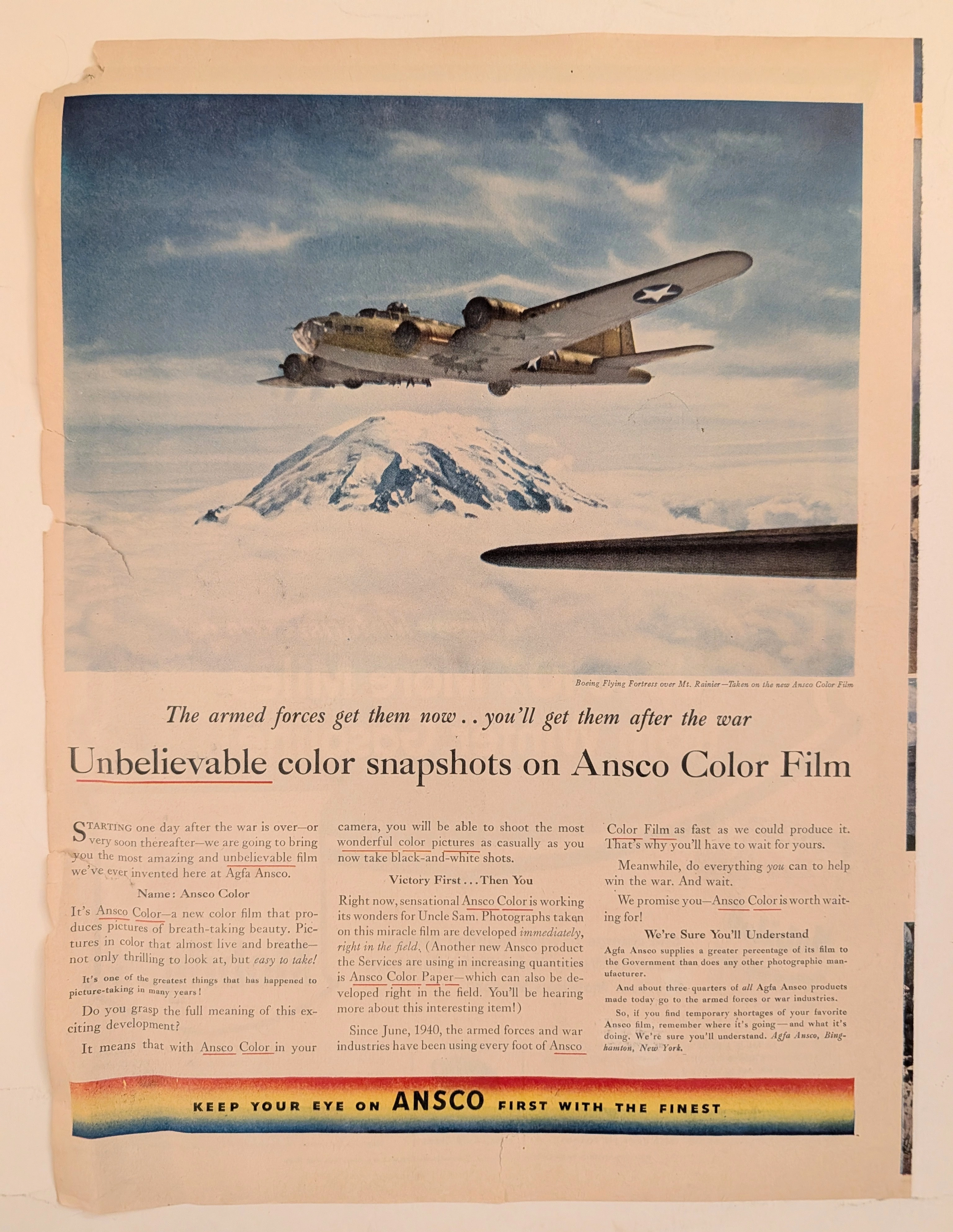
The world was entirely grey. Or so the civilian population was led to believe. Before this artifact, color photography existed as a delicate novelty. A fragile, complex luxury reserved for controlled environments. Then came the mechanized velocity of a global war. This advertisement represents a precise sociological pivot. It openly acknowledges a stark present reality: the total militarization of emerging technology. Simultaneously, it sells a calculated future promise: the inevitable democratization of color. The immediate problem was total resource scarcity. Every frame of manufactured film was drafted into federal service. The proposed solution was societal patience. A collective civilian sacrifice, traded for the eventual, post-war delivery of a hyper-vivid, color-accurate reality.
The History
The Architecture of Monochromatic Memory Human history, up until the mid-twentieth century, was largely documented and consumed through abstractions of light and shadow. The civilian perception of the Second World War was inherently monochromatic. Newsreels, daily newspapers, and magazines printed the conflict in stark tones of silver halides and black ink. This created a psychological distance. Black and white imagery inherently abstracts reality, turning visceral combat into distant, almost cinematic tableaus. Yet, the conflict itself was not fought in greyscale. The physical reality of the war was violently chromatic. The olive drab of armor. The sharp cyan of the high-altitude stratosphere. The crimson of tracer fire. The military apparatus required this color. Tactical reconnaissance demanded absolute clarity to differentiate natural foliage from artificially painted camouflage. Black and white film often failed this specific test, rendering both green leaves and green paint as identical shades of grey. Color film was no longer a civilian luxury; it became a vital instrument of intelligence gathering and strategic survival. This specific Ansco Color advertisement captures the exact historical moment when photochemical technology was forcibly transitioned from the commercial studio to the active battlefield. The Photochemical War and Engineering Superiority To understand the profound shift this artifact represents, one must examine the specific engineering war occurring parallel to the kinetic war. In the 1930s, the Eastman Kodak Company revolutionized photography with Kodachrome. It was undeniably brilliant, but structurally complex. Kodachrome film contained no color dyes itself; rather, the dyes were added during a massively complicated, multi-step chemical development process. It required a pristine laboratory, exact temperature controls, and highly trained technicians. This made Kodachrome largely impractical for immediate, frontline military intelligence. Agfa Ansco engineered a fundamentally different solution. Building upon earlier German chemical patents, Ansco Color was a subtractive reversal film where the color couplers were embedded directly into the film emulsion itself during manufacturing. This fundamental difference in chemical architecture altered the speed of military intelligence. As the advertisement explicitly states: "Photographs taken on this miracle film are developed immediately, right in the field." This was the technological shift. A reconnaissance aircraft could land, and the film could be processed in a rudimentary darkroom tent near the airstrip using a standardized chemical kit. The intelligence officers could review full-color transparencies of enemy positions within hours, rather than waiting days for the film to be flown back to a complex laboratory in the mainland. The artifact physically documents this triumph of logistical chemistry over laboratory perfection. The Propaganda of Patience and Economic Strategy Beyond chemistry, this artifact serves as a masterclass in the economics of total war. By 1943, the United States economy had entirely pivoted to the war effort. Civilian production of automobiles, appliances, and photographic equipment had completely ceased. This created an unprecedented problem for major corporations: how does a company maintain its brand identity and market dominance when it legally has no product to sell to the public? The answer was the "propaganda of patience." Corporations shifted their advertising budgets away from direct sales and toward patriotic alignment. This artifact does not ask the consumer to buy film; it specifically orders them not to. It explicitly normalizes artificial scarcity. The phrasing "Victory First... Then You" is a powerful psychological mechanism. It flatters the reader. It transforms the inability to purchase film from a frustrating inconvenience into a noble, shared sacrifice. By advertising a product that the civilian population cannot acquire, Ansco achieved dual objectives. First, they publicly proved their critical value to the federal government and the war effort. Second, they planted a deep psychological anchor in the minds of the American consumer. They were essentially taking pre-orders for the post-war economic boom. They promised that the delayed gratification of wartime rationing would be rewarded with technological wonders previously unimaginable. The Geopolitical Seizure of Corporate Identity The history of the company producing this film adds another layer of profound complexity to the artifact. The name "Agfa Ansco" reflects a complex transnational marriage. Ansco was an historic American photographic company. Agfa was a massive German chemical conglomerate. The two merged in the late 1920s, falling under the umbrella of the infamous IG Farben. When the United States entered the Second World War, the corporate structure of Agfa Ansco became an immediate geopolitical liability. In late 1941, under the authority of the Trading with the Enemy Act, the United States government via the Alien Property Custodian forcibly seized control of the company. The federal government literally took over the board of directors, severing all ties to Germany. Therefore, this advertisement is not merely commercial communication; it is state-sanctioned messaging. When the text reads "Agfa Ansco supplies a greater percentage of its film to the Government," it is entirely literal. The government owned the output. The prominent inclusion of "Binghamton, New York" at the bottom of the artifact is a deliberate, calculated geographic anchor. It was a required effort to sanitize the brand, aggressively asserting its American domesticity and erasing its German chemical lineage in the minds of the wartime public. The Machinery of Destruction as Commercial Art The visual anchor of the artifact is the Boeing B-17 Flying Fortress, captured mid-flight against the backdrop of Mount Rainier. This specific composition is not accidental. It is a highly calculated piece of industrial iconography. The B-17 was the primary weapon of the American daylight strategic bombing campaign over Europe. It was a heavily armed, four-engine marvel of heavy engineering, designed to absorb massive damage and deliver catastrophic payloads. Yet, in this advertisement, it is divorced from the violence of its purpose. It is framed as an object of sleek, aerodynamic beauty. Placing the bomber over Mount Rainier serves multiple strategic purposes. Geographically, it ties the aircraft to its birthplace—Boeing’s manufacturing facilities in Seattle, Washington. The juxtaposition is philosophically resonant. Mount Rainier represents eternal, unmoving natural permanence. The Flying Fortress represents the pinnacle of human, mechanized velocity. By rendering this scene in full color, Ansco proves their film's dynamic range. It handles the cold, stark whites of the glacial ice and the metallic, olive-drab reflections of the bomber's fuselage with equal precision. The image promises the consumer that if Ansco Color can accurately record the apex of military engineering at high altitudes, it will easily capture their backyard family portraits when peace finally returns.
The Paper
The physical substrate of this artifact speaks directly to the material constraints of the era. This is printed on standard mid-century mass-market magazine stock. It is a lightweight, machine-made paper with a high wood pulp content. Because of the heavy reliance on mechanical pulp, the paper retains a significant amount of lignin. Over eight decades, oxidation and exposure to ultraviolet light have caused this lignin to break down, resulting in the distinct, warm yellowing visible around the margins. The printing method is a classic four-color offset lithography process. Under microscopic examination, the image of the B-17 would resolve into distinct halftone rosettes—overlapping patterns of cyan, magenta, yellow, and black dots. The paper itself is a victim of wartime rationing; it is noticeably thinner and less coated than the heavy, glossy stocks utilized in the late 1930s before the supply chains were heavily restricted. The texture is slightly porous, absorbing the ink deeply rather than letting it sit on a clay-coated surface.
The Rarity
Classification: Class A (Contextual Marker). While the physical page itself was mass-produced within the circulation of millions of mid-1940s periodicals, its preservation status elevates its rarity. Mass-market magazines of the rationing era were frequently recycled in national paper drives. The true rarity lies not in the physical scarcity of the ink and paper, but in its absolute contextual perfection. It perfectly encapsulates a highly specific, very narrow window of time: the exact moment a society was told to wait for the future. It is an artifact of suspension. Finding an example where the color dyes of the printing ink have not entirely faded from UV exposure, allowing the original intent of the "color snapshot" promise to remain legible, moves this from a common clipping to a significant archival document.
Cite this article
- MLA
- Naodhinsuk, Ronin. “The Time Traveller's Dossier : Ansco Color Ad - WWII Delayed Gratification.” The Record Institute, 17 April 2026, https://therecord.institute/journal/the-time-travellers-dossier-ansco-color-ad-wwii-delayed-gratification.
- APA
- Naodhinsuk, R. (2026, April 17). The Time Traveller's Dossier : Ansco Color Ad - WWII Delayed Gratification. The Record Institute. https://therecord.institute/journal/the-time-travellers-dossier-ansco-color-ad-wwii-delayed-gratification
- CHICAGO
- Naodhinsuk, Ronin. 2026. “The Time Traveller's Dossier : Ansco Color Ad - WWII Delayed Gratification.” The Record Institute, April 17, 2026. https://therecord.institute/journal/the-time-travellers-dossier-ansco-color-ad-wwii-delayed-gratification.