The Time Traveller's Dossier : Ansco Color Film - The Chemical Shift of Memory
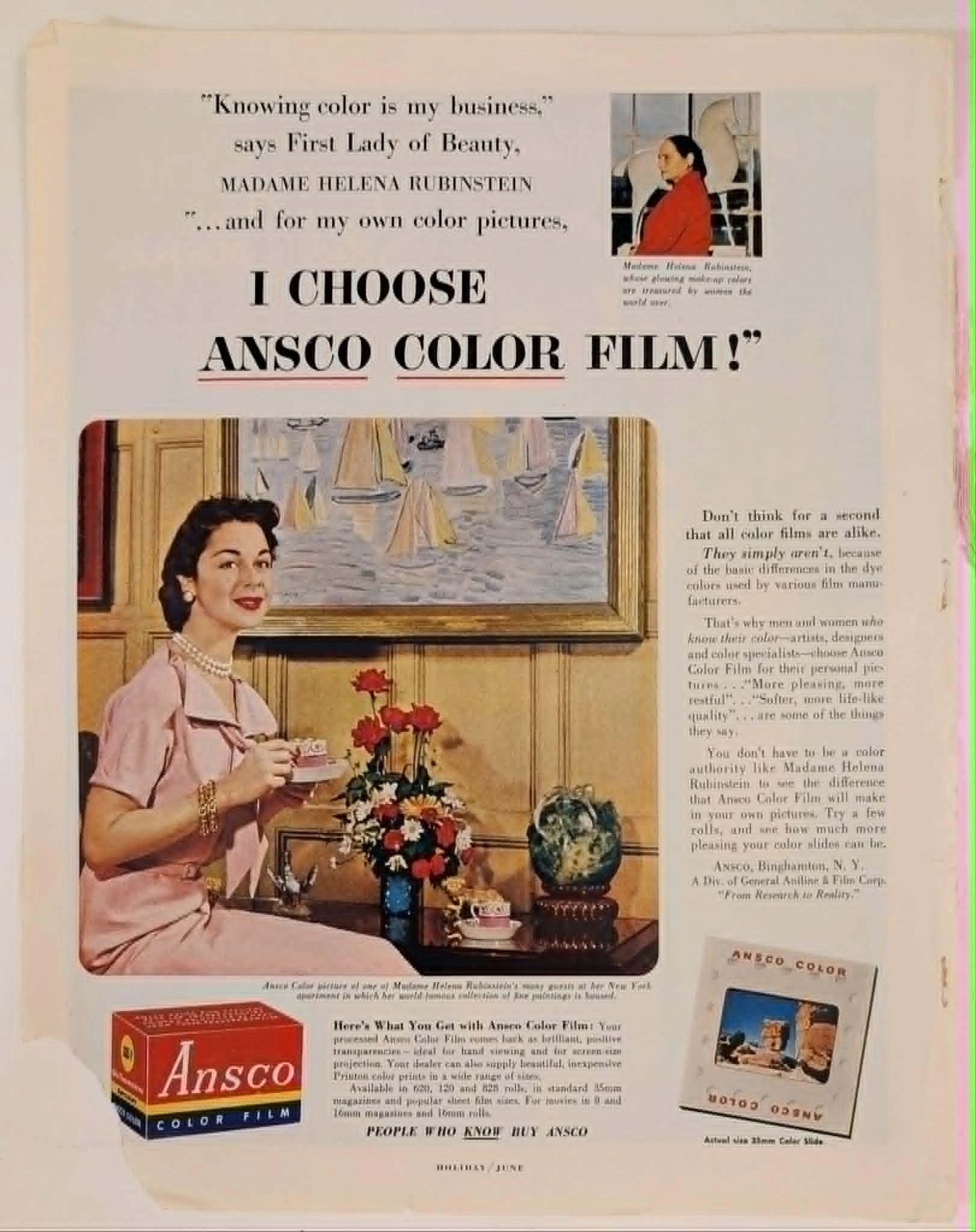
Before the middle of the twentieth century, human memory was formally archived in shades of gray. The world itself was vibrant, but its permanent record was monochromatic. Silver halides captured light and shadow, but they ignored the spectrum. Then came the chemical revolution. The dawn of the consumer color age. The problem was no longer capturing an image; the problem was trust. Color film was in its infancy. It was unstable. It was expensive. It often misrepresented reality, rendering skies too cyan or skin tones uncomfortably magenta. The public needed validation. They needed proof that the memory captured on celluloid would match the reality perceived by the human eye. The solution was alignment with an absolute authority. Enter Ansco Color Film and Madame Helena Rubinstein. This artifact is not merely an advertisement. It is a strategic declaration of technical fidelity. It represents the exact moment when the photographic industry stopped selling the mechanics of cameras and began selling the precise preservation of reality.
Category: Technology
Brand: Ansco
The History
The Monochromatic Era and the Chemical Dawn To understand the weight of this document, we must contextualize the era of its creation. In the immediate post-war period of the mid-twentieth century, the United States was undergoing an unprecedented economic expansion. The middle class was rapidly expanding. Disposable income generated a new concept: mass leisure. With leisure came the desire to document it. Yet, photography was primarily a black-and-white medium. Color photography existed, but it was largely the domain of professionals, commercial studios, and Hollywood. The process was chemically volatile and financially prohibitive. Memory was defined by contrast, not hue. The introduction of subtractive color films changed the trajectory of human archiving. By layering cyan, magenta, and yellow dyes, chemical engineers found a way to filter white light and reproduce the visible spectrum on a single strip of celluloid. This was a profound shift. Society was moving from an era of stylized, formal portraiture to an era of democratic, true-to-life documentation. The camera transitioned from a specialized tool to a household appliance. But a new technical war was brewing, not over who could capture an image, but whose image was the most "real." The Architectural Divergence: Ansco vs. The Giant of Rochester The landscape of color film was dominated by a colossus: Eastman Kodak, operating out of Rochester, New York. Kodak’s Kodachrome was the standard. However, Kodachrome was a highly complex film. The color dye couplers were not in the film itself; they had to be introduced during a rigorous, multi-step development process in a massive factory. You shot the film, mailed it away, and waited. Ansco represented a fundamentally different chemical architecture. Originally tied to the German photographic giant Agfa, Ansco utilized technology based on the Agfacolor Neu process. The crucial difference was architectural: Ansco embedded the dye couplers directly into the emulsion layers of the film itself. This single engineering decision altered the logistical landscape of photography. Because the couplers were built-in, the film could be processed with a much simpler chemical bath. It did not require a specialized factory. It could be developed by independent labs, or even by a dedicated amateur in a home darkroom. During World War II, the United States government seized Ansco under the Trading with the Enemy Act. The military required a color film that could be processed rapidly in the field for reconnaissance. Ansco Color was the solution. After the war, this military-grade technology was released to the civilian market. This artifact represents Ansco’s post-war offensive against Kodak. They were offering the public a film that was technologically robust, proven in the theater of war, and logistically superior for independent processing. The Authority of Pigment: Why Helena Rubinstein? Technology alone does not sway a consumer market; trust does. Ansco faced a significant hurdle. Kodachrome was famous for its vibrant, highly saturated colors. It created a hyper-reality. Reds were explosive; yellows were blinding. Ansco needed to differentiate its product. It chose to market "accuracy" over "saturation." Notice the text in the artifact: "Don't think for a second that all color films are alike. They simply aren't, because of the basic differences in the dye colors used by various film manufacturers... choose Ansco Color Film for their personal pictures... 'More pleasing, more restful',... 'Softer, more life-like quality'." To prove this claim of life-like quality, Ansco executed a masterstroke of strategic marketing. They aligned their chemical engineering with the absolute authority on color: Madame Helena Rubinstein. Helena Rubinstein was not an actress. She was a titan of industry. She was a Polish-American cosmetics entrepreneur who built a global empire. Her entire fortune was predicated on the precise control of pigment. A fraction of a shade difference in a rouge or a lipstick could mean millions of dollars in lost revenue. Her eyes were calibrated to detect the most minute variations in color temperature and hue. By featuring Rubinstein with the quote, "Knowing color is my business... and for my own color pictures, I CHOOSE ANSCO COLOR FILM," the advertising agency bypassed technical jargon entirely. They did not explain the embedded dye couplers. They did not discuss the cyan layer. They simply stated: The woman whose empire relies on perfect color trusts our film to capture reality. The Visual Sociology of the Artifact The main image of the artifact further anchors this narrative. We see a younger woman, impeccably styled, wearing a soft pastel pink dress. She sits in a classically appointed room, holding a teacup. The environment is rich with subtle, complex colors: the gold of her bracelets, the varying reds and yellows in the floral arrangement, the muted tones of the sailboat paintings on the wall. This is not a high-contrast environment. It is a scene designed to test the dynamic range and subtle rendering capabilities of a film. The pastel pink of the dress is notoriously difficult to reproduce chemically without it washing out to white or shifting to an aggressive magenta. Ansco is visually demonstrating its claim of a "softer, more life-like quality." They are proving that their film can handle the quiet nuances of an upper-middle-class domestic interior. Furthermore, the artifact highlights the end product: the 35mm slide. In the bottom right corner, a physical representation of an Ansco Color slide is displayed, depicting a balancing rock in a harsh desert landscape. This serves a dual purpose. While the main image proves the film’s ability to render soft domestic tones, the landscape slide proves its capability to handle sharp contrast, deep blue skies, and rugged textures. The advertisement also mentions "Printon color prints." During this era, color reversal film (which produces a positive transparency or slide) was the standard for serious amateurs. However, viewing slides required a projector—a communal, living room event. By advertising Printon prints, Ansco was acknowledging the consumer's desire for tangible, physical photographs that could be held, framed, or mailed. They were offering a complete ecosystem of memory preservation. The Economic and Cultural Shift This artifact captures the precise moment when color ceased to be a novelty and became an expectation. The alignment of a cosmetic brand with a photographic technology reveals the interconnectedness of post-war consumer industries. Women were a primary demographic for camera manufacturers. The role of the "family archivist" often fell to the mother. By utilizing Helena Rubinstein, Ansco was speaking directly to the female consumer, validating her aesthetic judgment, and intertwining the pursuit of personal beauty with the pursuit of beautiful memories. Ultimately, this document is a testament to the democratization of the spectrum. It marks the decline of the monochromatic age and the rise of a society determined to archive its existence in exact, undeniable color.
The Paper
Material: Mid-20th-century publication paper. Likely a lightweight, coated magazine stock, approximately 60 to 75 GSM. The coating was necessary to hold the ink on the surface, preventing absorption and subsequent dulling of the colors. Printing Method: High-volume rotogravure or advanced offset lithography. Ink and Resolution: Close inspection of the artifact, particularly in the inset portrait of Madame Rubinstein, reveals the distinct CMYK (Cyan, Magenta, Yellow, Key/Black) rosette halftone pattern. The mechanical reproduction of the image requires the eye to optically mix these microscopic dots to perceive the continuous tones of her skin and red coat. Aging Process: The physical artifact exhibits mild edge degradation and a slight yellowing (foxing) due to the acidic nature of the wood pulp used in mid-century paper production. Philosophical Implication: There is a profound irony in the physical state of this artifact. It is a document entirely dedicated to the permanent, perfect preservation of color. Yet, the paper it is printed on is fundamentally unstable, slowly oxidizing and shifting its own hues as it marches through time. The medium decays while the message demands permanence.
The Rarity
Classification: Class A This artifact is not classified as an ultra-rare luxury item (Class SSS). Millions of these magazines were printed. However, its survival rate in exceptional, unclipped condition is steadily decreasing. Its true value lies in its high contextual rarity. It is a flawless intersection of photographic history, chemical engineering, and early influencer marketing. Finding an advertisement that so perfectly encapsulates the technical war between embedded couplers and Kodachrome processing, while simultaneously leveraging a historical figure like Helena Rubinstein, elevates it beyond mere ephemera. It is a cornerstone document for studying the post-war visual economy.
Cite this article
- MLA
- Naodhinsuk, Ronin. “The Time Traveller's Dossier : Ansco Color Film - The Chemical Shift of Memory.” The Record Institute, 2 June 2026, https://therecord.institute/journal/the-time-travellers-dossier-ansco-color-film-the-chemical-shift-of-memory.
- APA
- Naodhinsuk, R. (2026, June 2). The Time Traveller's Dossier : Ansco Color Film - The Chemical Shift of Memory. The Record Institute. https://therecord.institute/journal/the-time-travellers-dossier-ansco-color-film-the-chemical-shift-of-memory
- CHICAGO
- Naodhinsuk, Ronin. 2026. “The Time Traveller's Dossier : Ansco Color Film - The Chemical Shift of Memory.” The Record Institute, June 2, 2026. https://therecord.institute/journal/the-time-travellers-dossier-ansco-color-film-the-chemical-shift-of-memory.