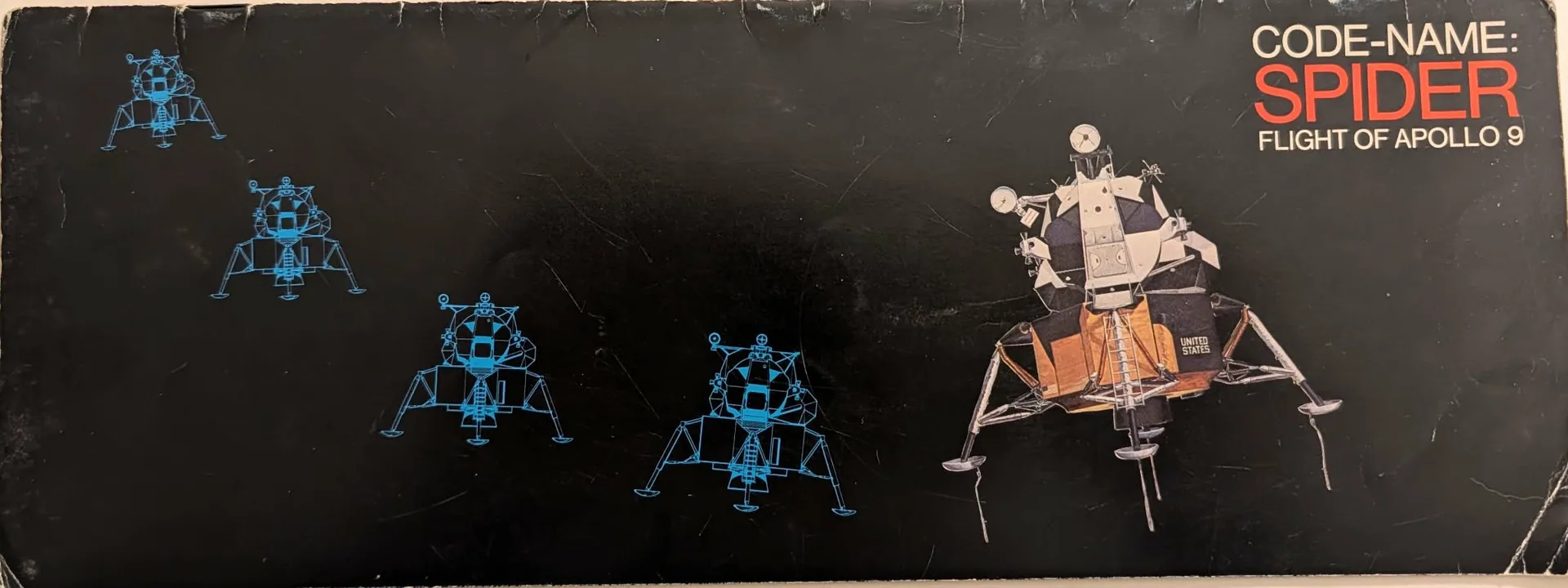
The Time Traveller's Dossier : Apollo 9 Spider - Engineering the Void
Then, space was a mathematical theory. A chalkboard abstraction of orbital mechanics. Now, it was a physical habitat. A room constructed of gold foil and aluminum, floating in absolute nothingness. The problem was singular and unforgiving: humanity needed to prove that a machine designed strictly for a vacuum—incapable of atmospheric flight—could separate, navigate, and reconnect in the abyss of E
Category: Technology
Brand: NASA
The History
The Context of 1969: Selling the Abyss The year 1969 was a crucible of human ambition. The global geopolitical landscape was defined by the silent, omnipresent tension of the Cold War. Space was the ultimate high ground. To control it was to project absolute ideological supremacy. Yet, projecting supremacy required vast, unprecedented economic expenditure. The Apollo program was a monolithic financial endeavor, and the citizens funding it required proof of progress. This document, prepared by the Office of Public Affairs of the National Aeronautics and Space Administration, served as that cruc
The Paper
The physical medium is a testament to mid-20th-century commercial printing capabilities. The substrate appears to be a standard 80 to 100 GSM uncoated offset paper, chosen for mass distribution and economical folding. The printing relies on standard CMYK halftone separation. You can observe the mechanical precision of the era in the tight registration of the flat black backgrounds against the vibrant technical orange typography. Time has interacted chemically with this artifact. The distinct aged paper texture, the yellowing along the margins known as foxing, and the worn creases all serve as
The Rarity
Classification: Class S. While millions of NASA press materials were printed during the Apollo era, intact, fully-folded survivors possessing this level of structural integrity are increasingly scarce. Its true rarity lies not in its auction-house market price, but in its profound contextual value. It is a primary source document from the exact transitional moment before the Moon landing became an inevitability. It captures the tension, the testing phase, and the raw mechanical aesthetic of 1969. It is a pristine fragment of the bureaucratic machinery that made the stars accessible.