The Time Traveller's Dossier : Apple 1997 - The Hitchcock Paradigm Shift
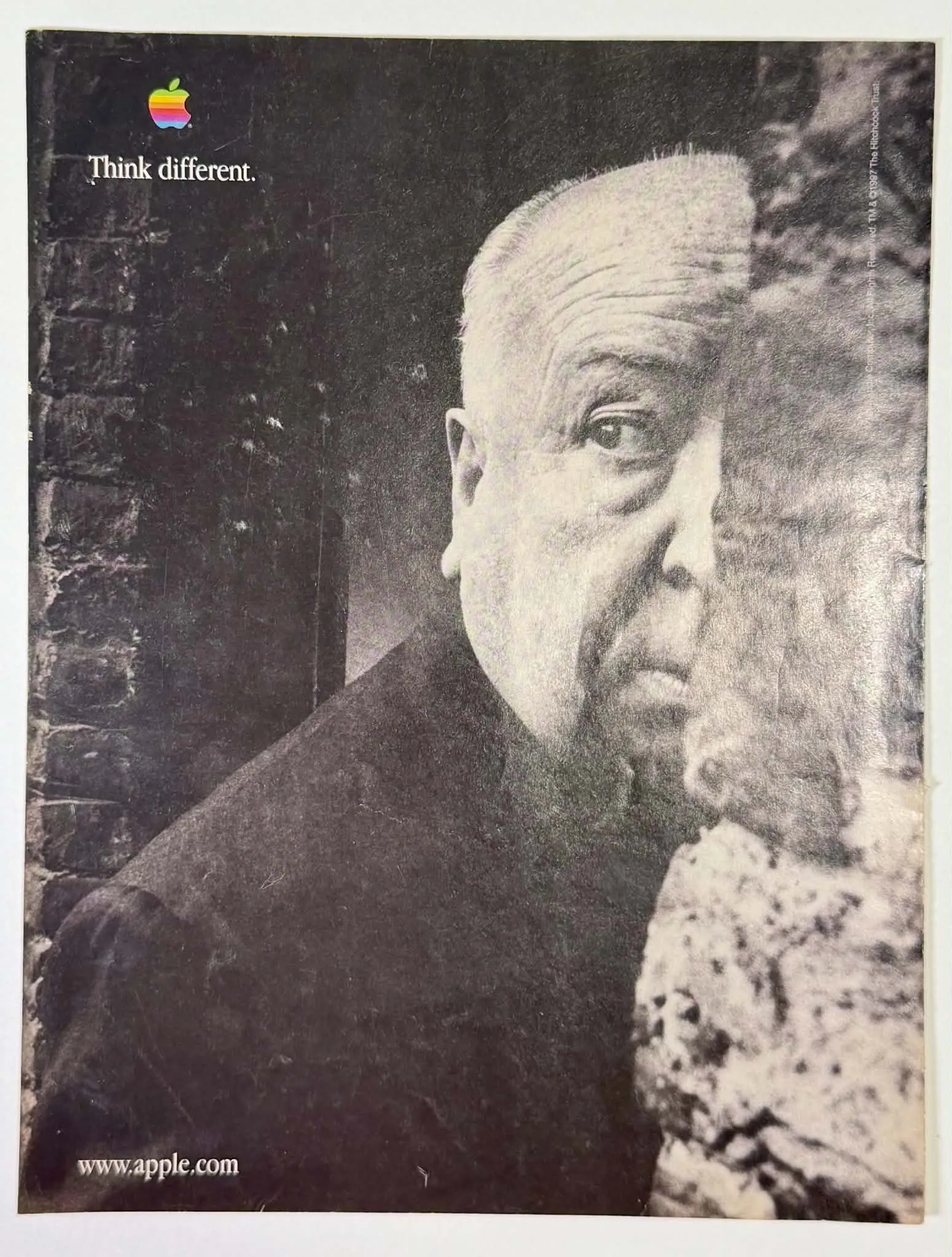
Then: The technological landscape of 1997 was a sterile, unforgiving battlefield of numerical specifications. It was an era dominated by beige plastic boxes, processor clock speeds, and market share spreadsheets. Apple Computer was standing on the absolute precipice of corporate death, totally devoid of identity, hemorrhaging capital, and facing imminent bankruptcy within ninety days. Now: This single piece of printed magazine advertising serves as the physical evidence of the greatest paradigm shift in the history of modern capitalism. It was not a desperate attempt to sell hardware. It was the calculated, surgical distribution of a powerful ideology. Problem: Marketing computers through engineering metrics had led Apple into a fatal dead end. They could not win a price war against generic PC clones. They could not win a specification war against industry giants. Solution: The total annihilation of traditional technology advertising frameworks. In their place, Apple instituted a philosophical cult of personality, utilizing the face of a rebellious cinematic auteur to resurrect the soul of a dying empire.
Category: Technology
Brand: apple
The History
The Architecture of Collapse and The Beige Hegemony To understand the gravity of this artifact, one must first understand the suffocating atmosphere of 1997. The personal computer industry had reached a state of supreme commoditization. The world was overwhelmingly dominated by the Wintel architecture—the monopolistic marriage of Microsoft Windows software and Intel hardware. Computers were no longer viewed as tools of limitless creative liberation; they had been aggressively reduced to mere office appliances. They were beige, they were heavy, and they were profoundly boring. Consumers and enterprise buyers alike made their purchasing decisions based entirely on sterile, quantitative matrices. How many megahertz did the processor have? How many megabytes of RAM were included? What was the capacity of the hard disk drive? In this brutally pragmatic landscape, Apple Computer was drowning. The company had lost its visionary compass following the ousting of Steve Jobs twelve years prior. By 1997, Apple was manufacturing a chaotic, unidentifiable mess of product lines—the Performa, the Quadra, the Centris—none of which resonated with the consumer. Furthermore, the disastrous decision to license the Mac operating system to third-party clone makers like Power Computing was cannibalizing Apple’s own hardware sales. The company was bleeding hundreds of millions of dollars per quarter. Wall Street analysts were actively writing Apple’s obituary, and Dell CEO Michael Dell famously stated that if he were in charge, he would "shut it down and give the money back to the shareholders." The Excision of the Superfluous: Jobs' Return The acquisition of NeXT in late 1996 brought Steve Jobs back to the very empire he had built. He did not return as a gentle caretaker; he returned as an executioner of the superfluous. Jobs immediately initiated a brutal simplification of the company. He terminated the clone licensing agreements, effectively killing the parasitic third-party market overnight. He slaughtered beloved but unprofitable projects like the Newton MessagePad. He reduced a sprawling, confusing product matrix into a simple two-by-two grid: Consumer, Professional, Desktop, Portable. However, streamlining the supply chain and product line was not enough to save the company. The brand was highly toxic. Consumer confidence was shattered. Loyal developers were abandoning the platform, and internal employee morale was completely decimated. Apple desperately needed time to develop the revolutionary hardware that would eventually become the iMac G3, but they did not have time. They needed to immediately halt the mass exodus of their user base. They needed a manifesto. They needed to remind the world, and themselves, why Apple existed in the first place. The Grammatical Rebellion: "Think different." Enter TBWA\Chiat\Day, the legendary advertising agency that had crafted the iconic "1984" Macintosh commercial. The agency, led by creative director Lee Clow and art director Craig Tanimoto, pitched a concept that was dangerously counterintuitive. In an era where tech companies were screaming about processor speeds and lower prices, Apple would run an advertising campaign that did not feature a single computer. They would not mention a product, a price, or a specification. This was an absolute historical shift in technology marketing. They were transitioning from feature-based marketing to identity-based marketing. The core of this new doctrine was encapsulated in two words: "Think different." The phrase was an act of linguistic rebellion. Grammatically, the adverbial form should have been "Think differently." But Jobs and the agency deliberately chose the adjective form. It functioned as an imperative command, a noun phrase operating as a philosophical destination. It was designed to create cognitive friction. It made the reader stumble, pause, and reconsider. The use of a lowercase 'd' following a capitalized 'T' further amplified this subtle disregard for established rules. It was a structural middle finger to the rigid, corporate conformity of the IBM and Microsoft-dominated world. Apple was declaring that their users were not spreadsheet operators; they were the crazy ones, the misfits, the rebels. The Hitchcock Variable: Engineering the Human Psyche The execution of the "Think different" campaign relied on associating Apple with the greatest iconoclasts of the 20th century. Einstein, Picasso, Gandhi, Ali. And, as captured in this specific artifact, Alfred Hitchcock. The selection of Hitchcock was a calculation of immense psychological depth. Hitchcock was not merely a Hollywood director; he was a master architect of human tension and an absolute rebel against the cinematic status quo. In an era where Hollywood studios demanded safe, predictable narratives, Hitchcock weaponized the camera to manipulate his audience. He killed off his leading lady in the first act of Psycho. He explored obsessive, dark psychological manipulation in Vertigo. He entirely bypassed the studio system's unwritten rules to forge his own distinct auteur theory. By superimposing Hitchcock's instantly recognizable profile onto this advertisement, Apple was executing a brilliant transfer of equity. They were aligning the cinematic rebellion of Hitchcock with the computational rebellion of the Macintosh user. The underlying message was profound: The tools you use dictate the art you create. A PC is for writing a memo; a Mac is for writing a masterpiece. Apple was elevating itself from a failing manufacturer of beige plastic into a patron of the creative arts. The legal copyright text in the corner, "©1997 The Hitchcock Trust," serves as a temporal coordinate, proving that this dying technology company managed to successfully merge its identity with a legendary cultural estate. It was a masterclass in brand resurrection. The Economic and Societal Pivot Point This campaign arrived at a very specific inflection point in human history. The internet was just beginning to permeate mainstream consciousness. The dot-com bubble was in its embryonic stages of inflation. Society was experiencing a profound anxiety regarding the encroaching digital age, culminating in the looming fear of Y2K. Technology was generally perceived as a cold, calculating, and somewhat threatening force. The Hitchcock artifact represents the exact moment Apple successfully repositioned technology as a "bicycle for the mind"—a humanistic, warm, and creatively liberating force. By stripping away the hardware and focusing entirely on human potential, Apple bought themselves the crucial months needed to survive. This campaign did not just save the company financially; it restored its soul. It laid the ideological foundation for the next two decades of unprecedented innovation, from the iPod to the iPhone. Without the philosophical reset initiated by this very page of printed paper, the modern technological landscape as we know it would simply not exist.
The Paper
This artifact manifests as a standard magazine print page, typical of late 1990s commercial publishing. The substrate is a lightweight, coated text paper, likely hovering around 80 to 90 GSM. When examined closely, the image reveals the distinct CMYK halftone dot structure inherent to analog offset lithography. The ink has physically saturated the paper fibers, creating a subtle tactile depth that stands in stark contrast to the sterile, frictionless glow of modern digital pixels. The physical degradation of this paper is essential to its identity as a historical artifact. The micro-creases along the edges, the slight yellowing oxidation of the paper stock, and the varying reflectivity of the coated surface where the heavy black ink sits—these are all physical timestamps. They are the friction of time acting upon a philosophical manifesto. This page is not merely an image; it is a tangible fossil extracted from the exact moment Apple pivoted away from the abyss.
The Rarity
Classification: Class B From a purely material standpoint, this item possesses minimal scarcity. It was mass-printed and distributed in hundreds of thousands of magazines globally in 1997. Its market price as a physical object is therefore negligible. However, its true value is entirely derived from its "contextual rarity." This piece of paper is a foundational text of modern corporate mythology. It is the physical incarnation of the ideological pivot that saved a trillion-dollar empire. To possess this artifact is to hold the architectural blueprint of Apple's resurrection. It is a class B historical document not because it is hard to find, but because of the immense historical weight it carries.
Cite this article
- MLA
- Naodhinsuk, Ronin. “The Time Traveller's Dossier : Apple 1997 - The Hitchcock Paradigm Shift.” The Record Institute, 28 September 2026, https://therecord.institute/journal/the-time-travellers-dossier-apple-1997-the-hitchcock-paradigm-shift.
- APA
- Naodhinsuk, R. (2026, September 28). The Time Traveller's Dossier : Apple 1997 - The Hitchcock Paradigm Shift. The Record Institute. https://therecord.institute/journal/the-time-travellers-dossier-apple-1997-the-hitchcock-paradigm-shift
- CHICAGO
- Naodhinsuk, Ronin. 2026. “The Time Traveller's Dossier : Apple 1997 - The Hitchcock Paradigm Shift.” The Record Institute, September 28, 2026. https://therecord.institute/journal/the-time-travellers-dossier-apple-1997-the-hitchcock-paradigm-shift.